Homemade Dog Food Seasoning Recipe: The 4-2-1 Formula + 5 Blends
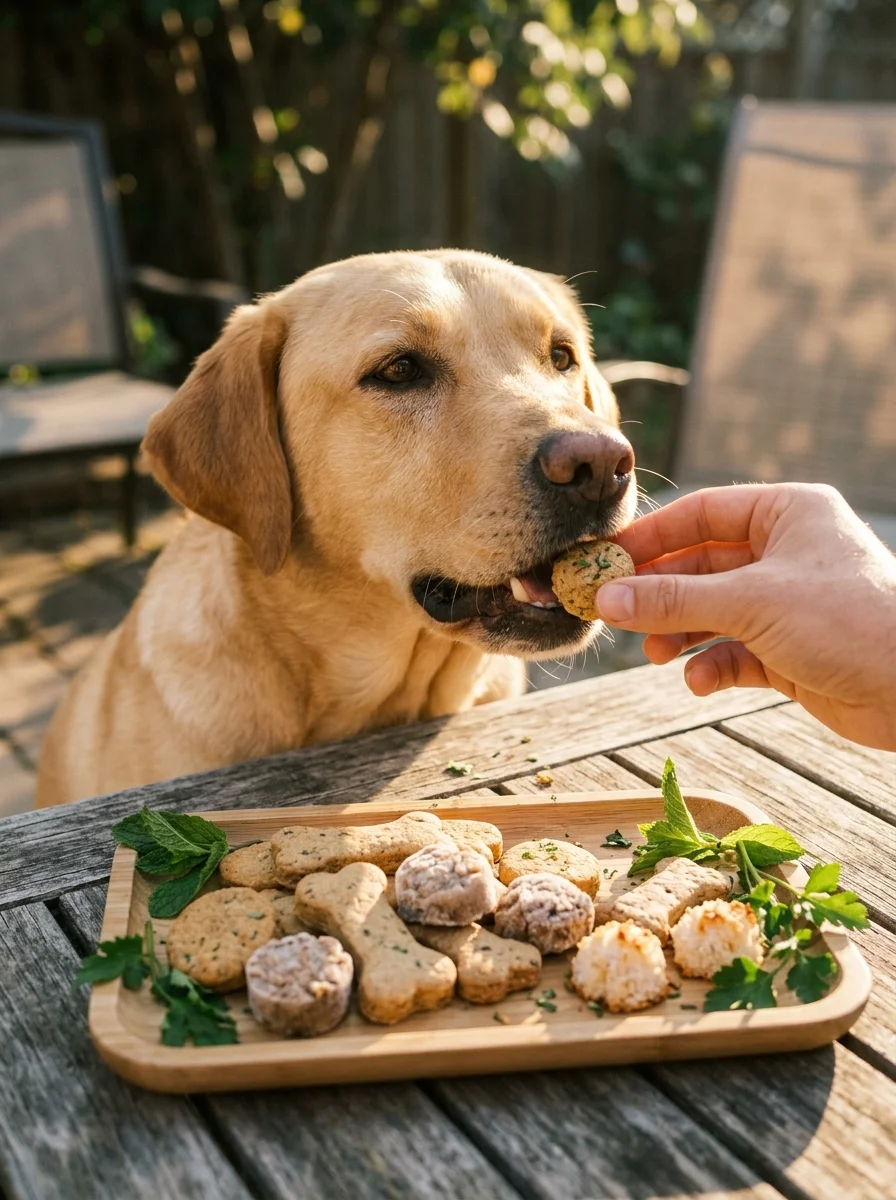
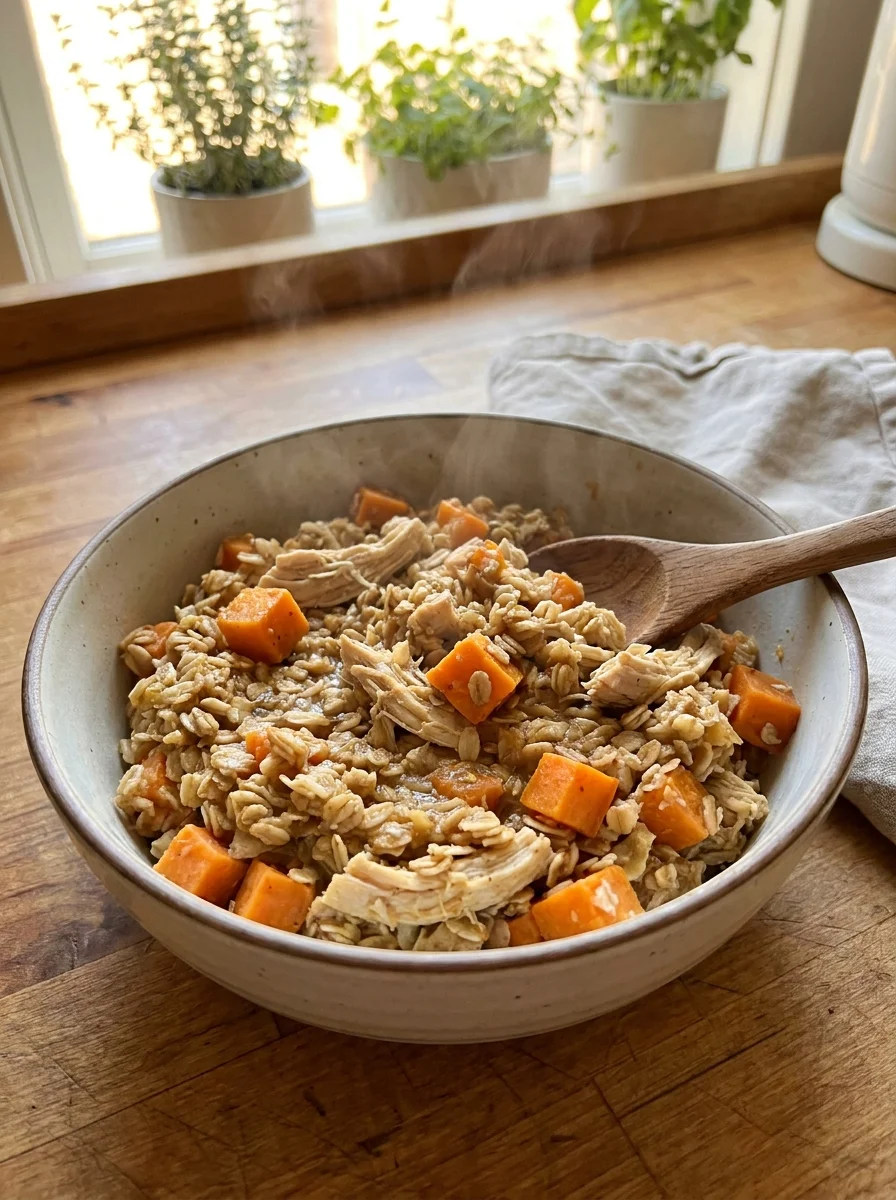
If you cook for your dog, you know the disappointment of a balanced homemade meal getting sniffed and ignored. It looks nutritious. It smells like homework. This isn’t another recipe to follow once — it’s a ratio. Learn it once, and you can build a Homemade Dog Food Seasoning Recipe around whatever your dog already loves.
Every ingredient here is dog-safe by design. Nothing borderline, nothing you’ll Google at midnight. The formula is three parts, and you can memorize it while the kettle boils.
One distinction first: a seasoning is a topper, not a meal. It boosts aroma and adds micronutrients, but it doesn’t replace the protein, fat, and complete nutrition in your dog’s actual food.
The 3-Part Formula Behind Every Good Seasoning
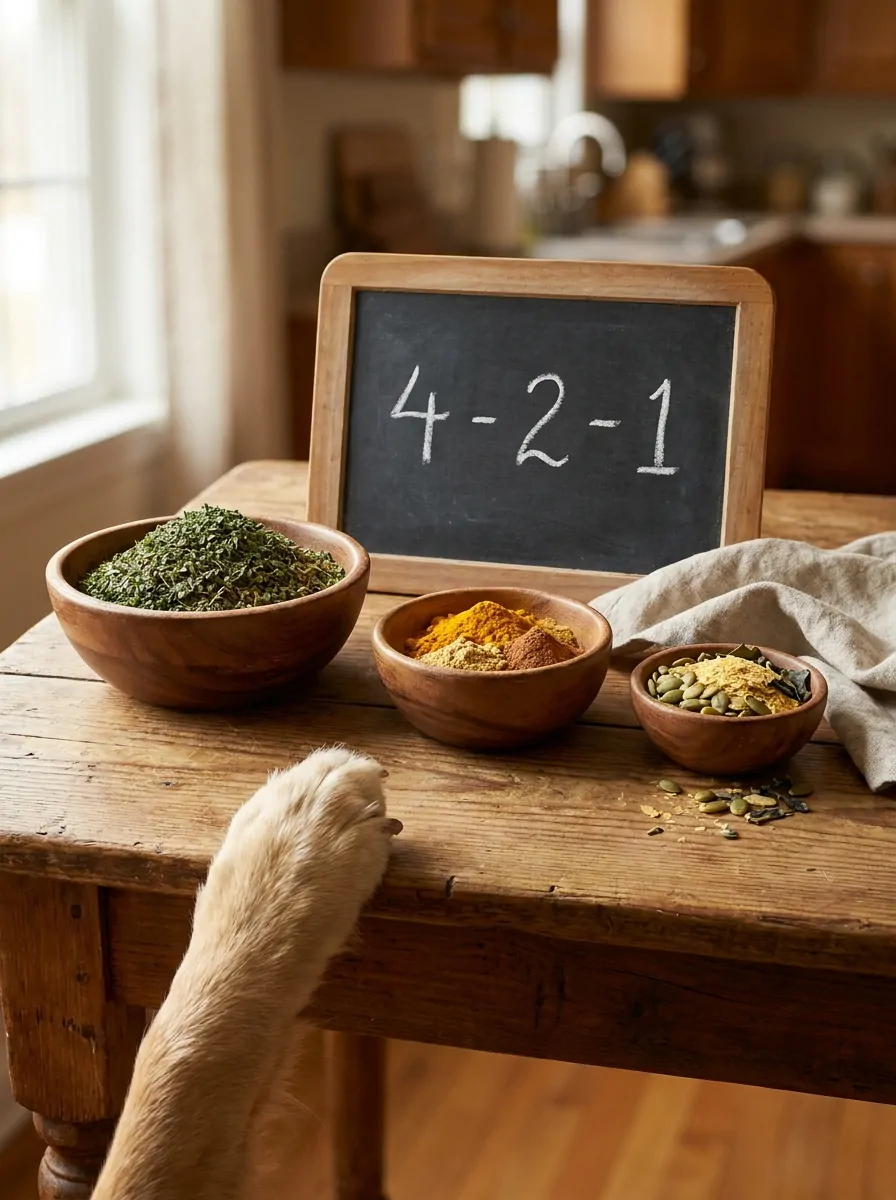
Part 1: A green base: Dried parsley, basil, oregano, nettle — your volume and everyday nutrition. Parsley is the workhorse; nettle is the iron-rich quiet powerhouse.
Part 2: A warming spice: Turmeric, ginger, cinnamon — what you smell from across the room. This part makes a blend smell like food instead of grass.
Part 3: A finishing accent: Pumpkin seed, flaxseed, nutritional yeast, kelp. Small amounts, big impact — the savory depth fussy eaters respond to.
The ratio to remember: Roughly 4 parts green, 2 parts spice, 1 part accent — 4-2-1. A starting point, not a law.
The Dog-Safe Ingredient List (and the Hard No’s)
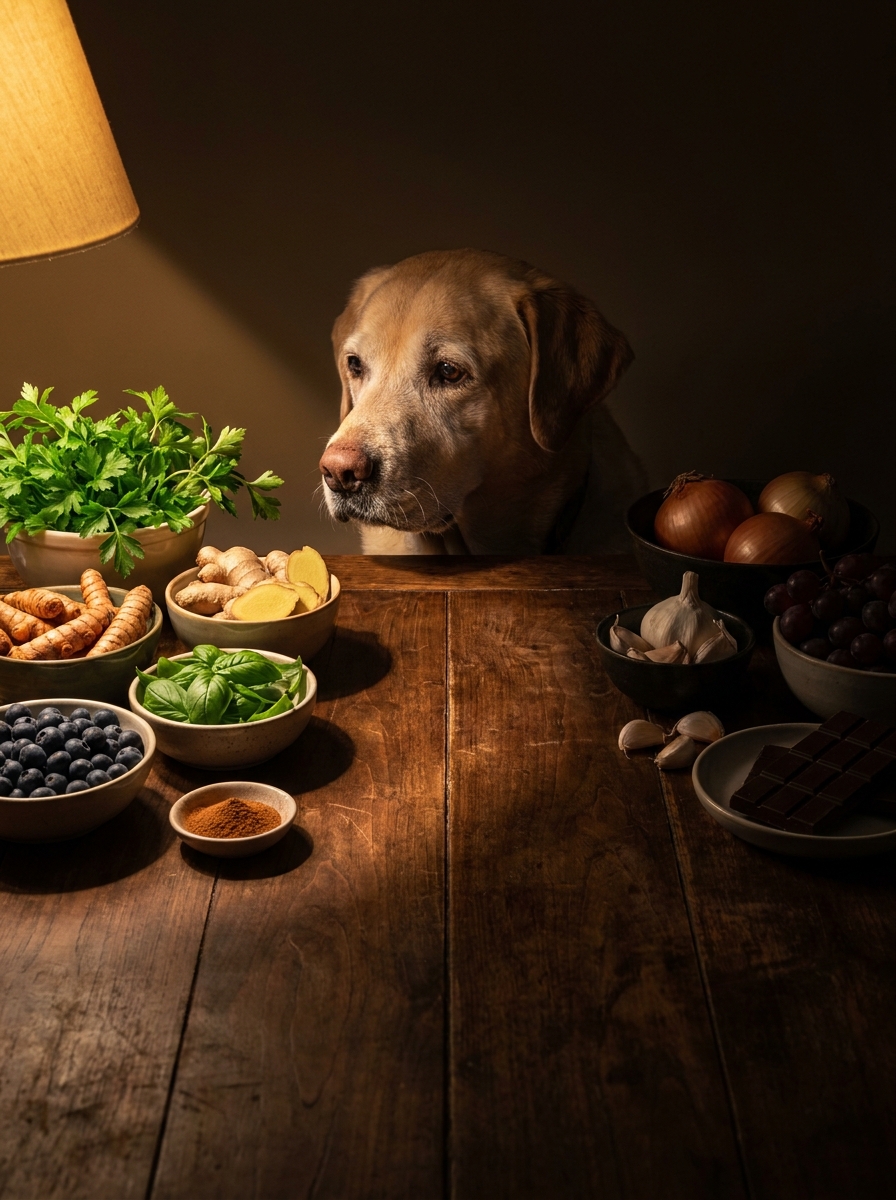
What’s in the pantry: Parsley — the base of most blends; vitamins A, C, K, freshens breath.
Basil — sweet, aromatic, gentle on stomachs.
Oregano — bold and savory; a favorite for fussy eaters.
Nettle — mineral-dense, traditionally used as a gentle tonic.
Mint — cooling and bright; freshens breath.
Dill — light and grassy; pairs with fish and poultry.
Lemon balm — soft citrus note; calming in small amounts.
Turmeric — warming and earthy; pair with a pinch of black pepper for absorption.
Ginger — spicy and warming; traditionally used for digestion.
Cinnamon — sweet and warming; small amounts only.
Cardamom — aromatic, slightly citrusy; a gentle digestive.
Fennel — mild anise flavor; traditionally used for bloating.
Anise — strong licorice note; use sparingly.
Chamomile — calming and floral; good for evening meals.
Lavender — food-grade only, sparingly; a little goes a long way.
Passionflower — traditionally used as a gentle calming support.
Valerian — earthy and strong; a gentle support, not a treatment.
Skullcap — a traditional nervine herb; very small amounts.
Oats — ground rolled oats add body and soft texture.
Pumpkin seed — crunchy, rich in zinc and healthy fats.
Flaxseed — ground only; omega-3s and nutty aroma.
Nutritional yeast — savory, cheesy aroma; picky-dog favorite.
Kelp — deep umami and natural minerals in small amounts.
Dried mushroom — dog-safe varieties only; deep, meaty flavor.
The hard no’s: Short list — memorize it. Alliums (onion, garlic, chives, leeks): toxic in all forms, no exceptions. Salt as a seasoning: dogs don’t need added sodium. Xylitol / birch sugar: lethal — check peanut butter labels.
Macadamia nuts, nutmeg, cocoa, grapes, raisins, avocado pit and skin — all stay out of the kitchen entirely.
Where quality matters most: Buy organic where you can, especially for herbs you’ll use regularly — dried herbs are concentrated, so any residue is concentrated too. If you already feed quality freeze dried dog food toppers, you know the principle: what goes in small amounts still matters.
1. The Base Blend (Built on the Formula)
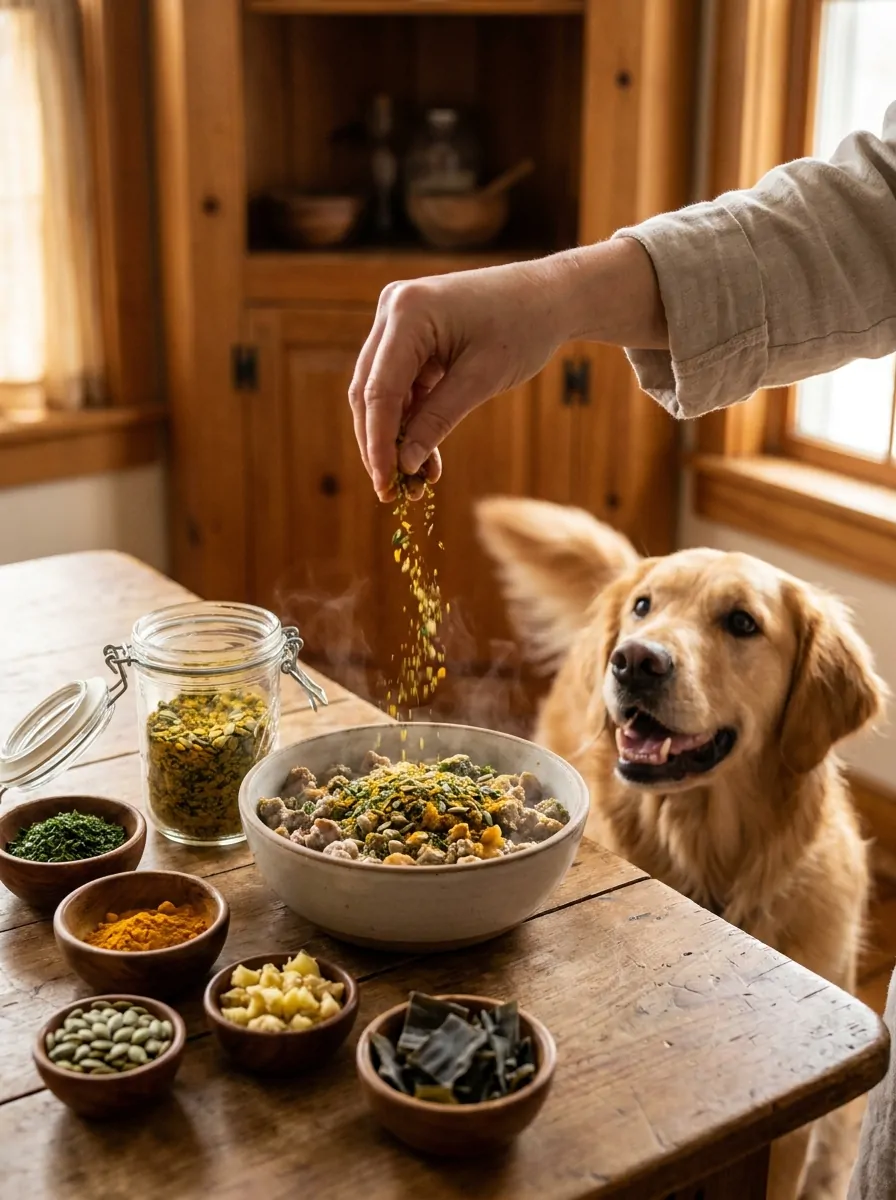
Start here — 4-2-1 in its purest form. Balanced, aromatic, works on almost any meal.
Ingredients
- 4 tablespoons dried parsley, crumbled
- 1 teaspoon dried turmeric
- 1 teaspoon dried ginger
- 1/2 teaspoon ground pumpkin seed
- 1/8 teaspoon kelp powder (a generous pinch)
Instructions
- Dry-check everything. If any herb feels damp, spread it on a plate and air-dry for an hour. Wet herbs turn to paste when ground.
- Measure by ratio. Four parts green, two parts spice, one part accent. Scale up or down as long as the shape holds.
- Combine in a grinder or mortar. Pulse in short bursts — you want a coarse, even crumble, not powder.
- Shake the jar. Transfer to a clean, dry jar and shake hard for thirty seconds so ingredients distribute evenly.
- Rest for an hour. Lid on. The blend tastes better after the volatile oils settle and meld — same reason curry tastes better the next day.
2. The Savory/Umami Blend
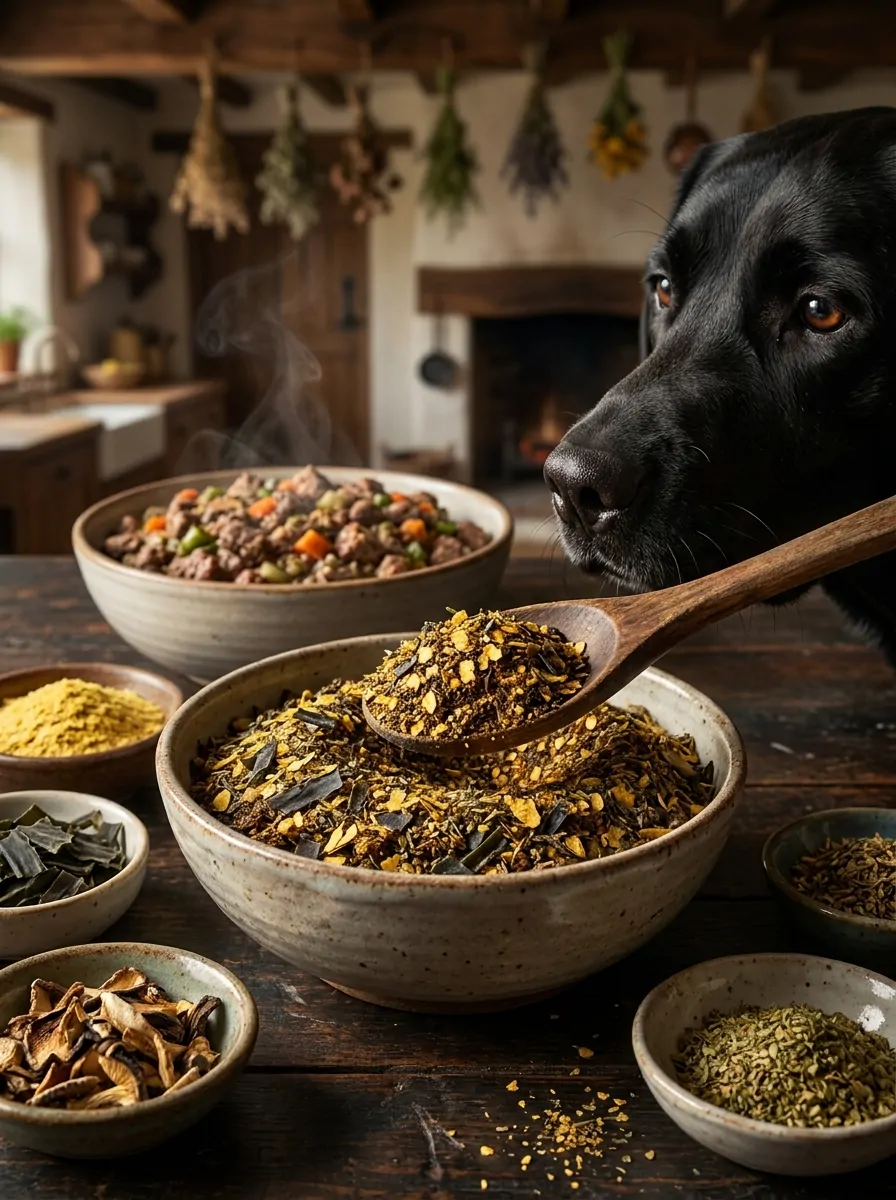
The one for fussy eaters. Nutritional yeast and kelp give it a deep, almost meaty aroma with a brothy quality that makes plain chicken and rice interesting again. Pairs beautifully with high protein dog food toppers — the umami notes stack with cooked protein.
Ingredients
- 2 tablespoons dried parsley
- 1 tablespoon dried oregano
- 1 teaspoon dried basil
- 1/2 teaspoon kelp powder
- 1 tablespoon nutritional yeast
- 1 teaspoon dog-safe dried mushroom, ground
Instructions
- Grind the mushroom first. It’s denser than herbs — pulse alone to a coarse powder, then set aside.
- Combine the green base. Pulse parsley, oregano, and basil until evenly crumbled. Don’t over-process the oregano into dust.
- Add the accents. Return the mushroom with kelp and nutritional yeast. Pulse two or three times just to distribute.
- Transfer and shake. Jar it and shake hard for thirty seconds — the yeast tends to float.
- Rest and serve. An hour of rest lets the mushroom and kelp soften into the herbs. It’ll smell like slow-cooked broth.
Best on: beef, pork, or hearty grain bowls. Your cold-weather blend.
3. The Bright & Fresh Blend
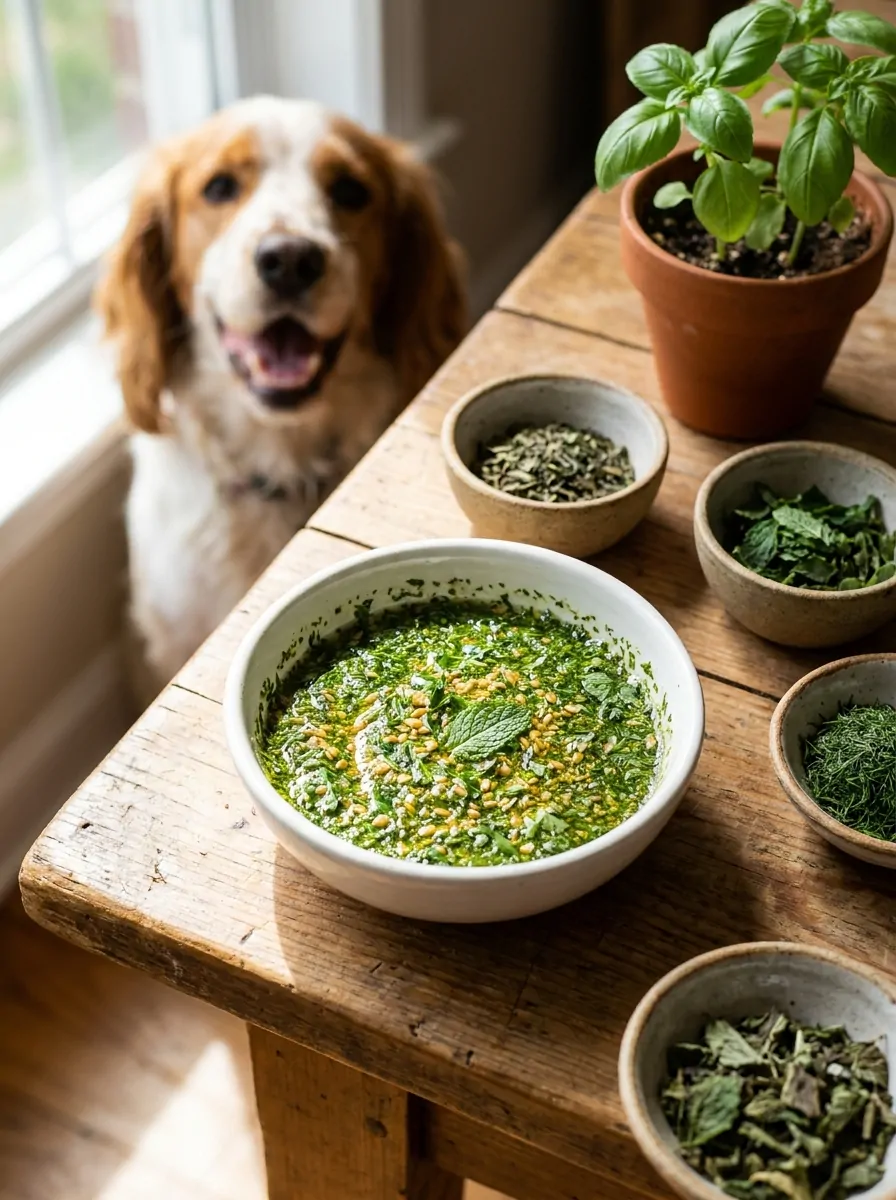
Light, green, almost garden-like. Mint and dill lift it; lemon balm adds a soft citrus edge. The summer blend — for when heavy spice feels wrong. Lovely on homemade meatballs for dogs made with lighter proteins.
Ingredients
- 2 tablespoons dried parsley
- 1 tablespoon dried basil
- 1 teaspoon dried mint
- 1 teaspoon dried dill
- 1/2 teaspoon dried lemon balm
- 1 tablespoon ground flaxseed
Instructions
- Grind the flaxseed separately. Toast two minutes in a dry pan first, then grind to a coarse meal. Seeds need longer than herbs.
- Combine the herbs. Pulse parsley, basil, mint, dill, and lemon balm gently — all delicate, all turn to powder fast.
- Fold in the flaxseed. Stir by hand for more control over texture.
- Shake and rest. Jar, shake well, rest an hour so the mint and lemon balm mellow into the parsley.
- Use within a few weeks. Ground flaxseed shortens shelf life — refrigerate and use quickly.
Best on: fish, turkey, and summer grain bowls.
4. The Warm & Earthy Blend
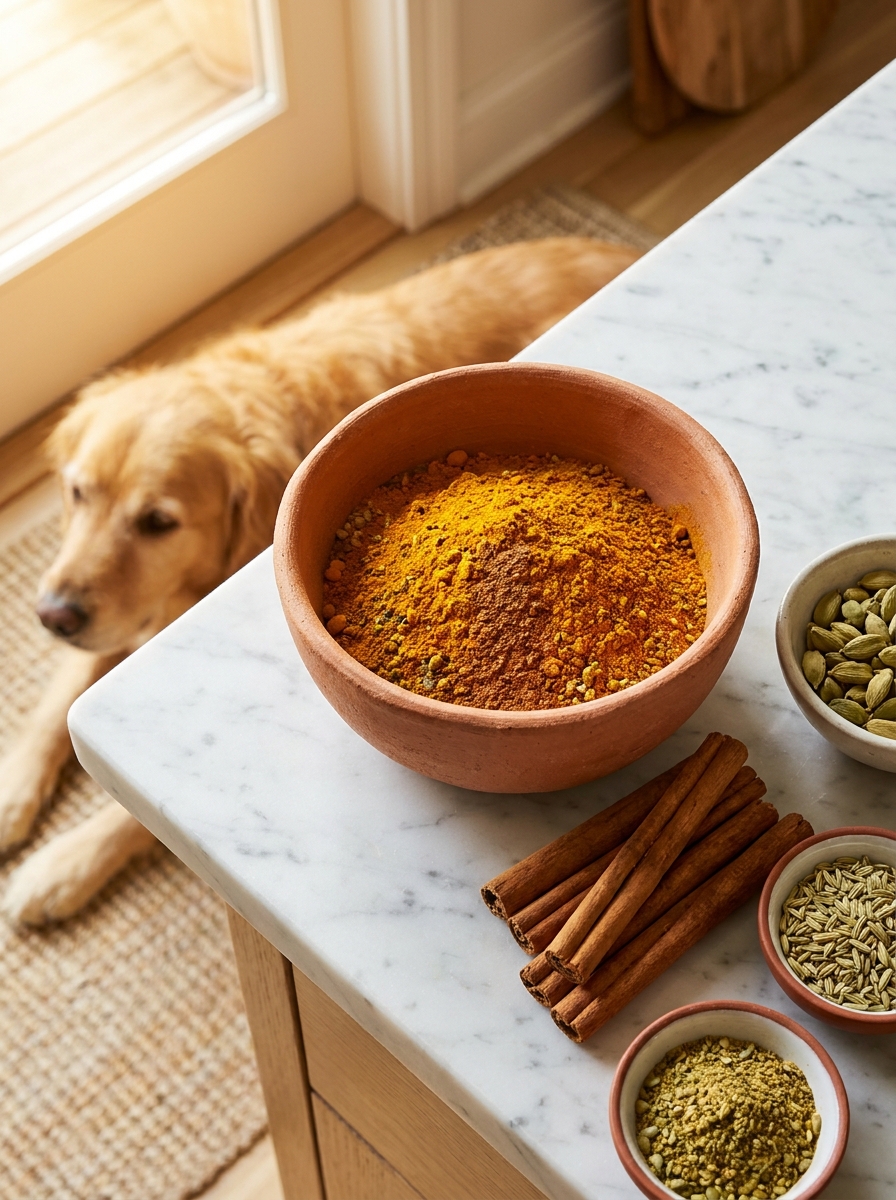
Smells like a kitchen in autumn. Turmeric and ginger lead; cinnamon and cardamom round it out; fennel and anise add a licorice warmth dogs find comforting. A natural fit for 4-ingredient pumpkin dog biscuits — the cinnamon echoes the pumpkin beautifully.
Ingredients
- 2 tablespoons dried parsley
- 1 teaspoon turmeric
- 1 teaspoon ground ginger
- 1/2 teaspoon cinnamon
- 1/4 teaspoon cardamom
- 1/2 teaspoon fennel seed, ground
- 1/4 teaspoon anise seed, ground
- 1 tablespoon ground pumpkin seed
Instructions
- Toast the whole spices. Warm cardamom, fennel, and anise in a dry pan two minutes until fragrant. Don’t let them smoke.
- Grind the toasted seeds to a coarse powder.
- Add parsley and ground spices. Pulse just until evenly mixed and crumbled.
- Stir in the pumpkin seed last, by hand or with a quick pulse — keep the texture.
- Shake, rest, store. Jar, shake hard, rest at least an hour. This blend tastes flat if rushed.
Best on: chicken, turkey, and grain-based meals.
5. The Calm & Settle Blend
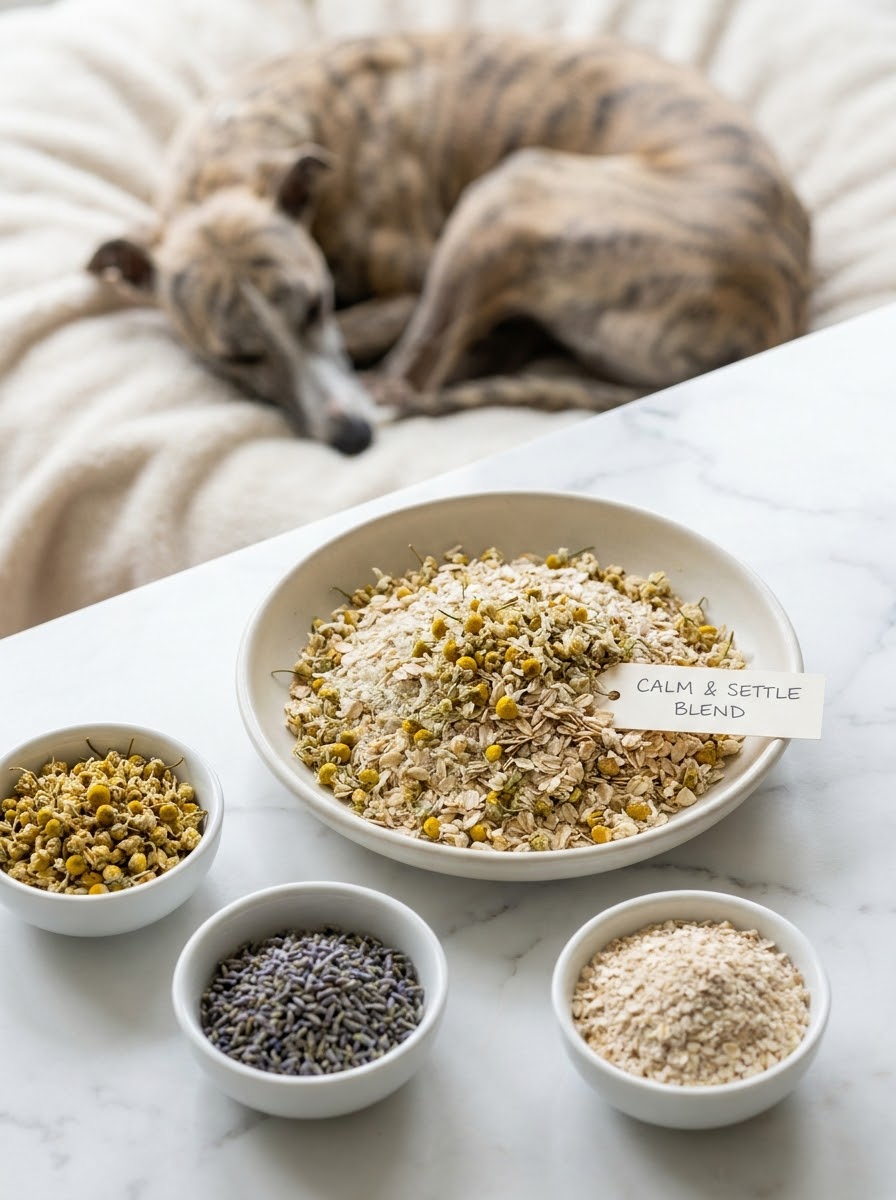
The evening blend. Chamomile, passionflower, and skullcap are traditional gentle supports for relaxation — not a sedative or anxiety treatment. For genuinely anxious dogs, work with your vet.
Ingredients
- 2 tablespoons dried chamomile
- 1 tablespoon rolled oats, ground
- 1 teaspoon dried passionflower
- 1/2 teaspoon dried lavender (food-grade only)
- 1/2 teaspoon dried valerian root
- 1/4 teaspoon dried skullcap
Instructions
- Grind the oats first. Pulse to a coarse meal and set aside.
- Combine the flowers and herbs. Pulse gently and briefly — all light, delicate botanicals.
- Fold in the ground oats by hand. They buffer the blend and soften the texture.
- Shake gently. Lavender is potent — a light shake distributes it without turning the jar into a soap shop.
- Rest and serve. An hour lets the strong-smelling valerian settle into the chamomile.
Best on: light evening meals — plain chicken, a little rice, a spoon of yogurt. Keep it simple and let the blend do the quiet work.
How to Serve It Without Overdoing It
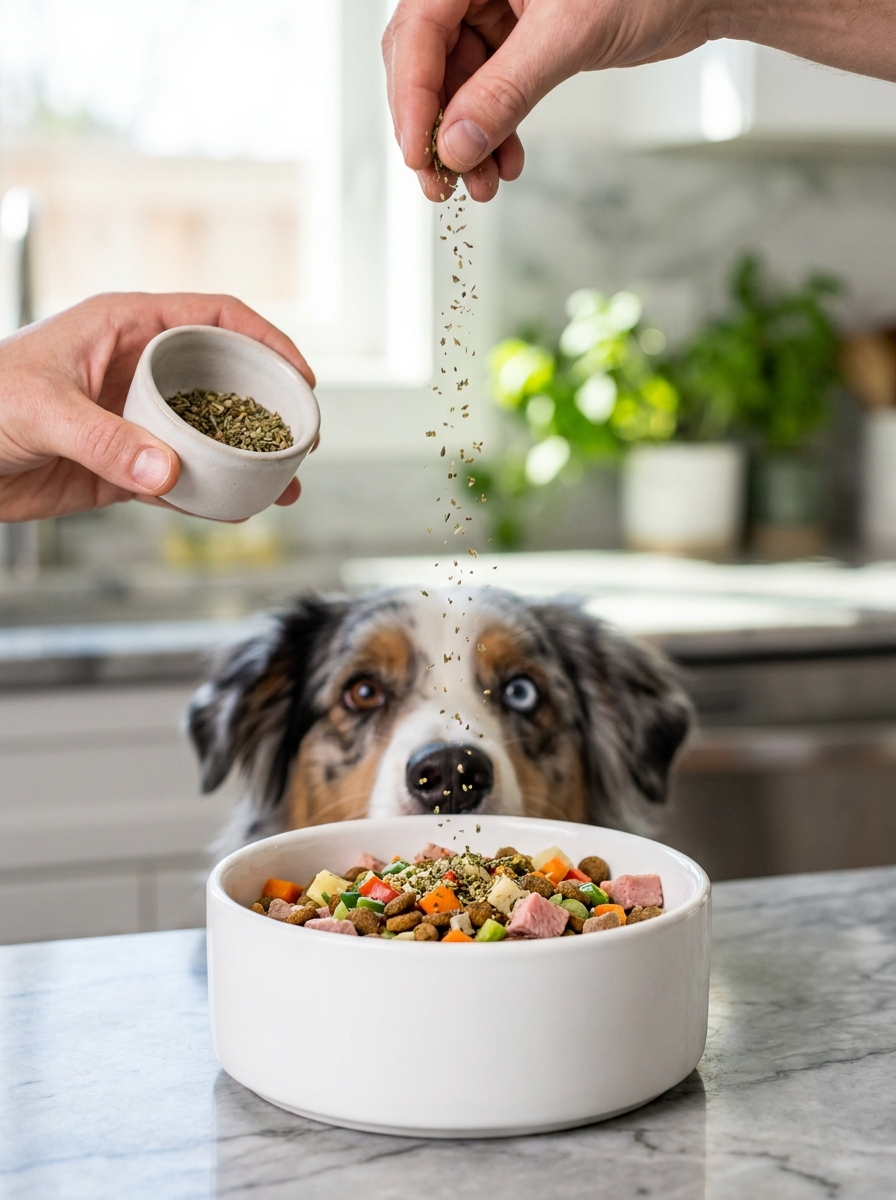
Start with a pinch. Under 20 pounds: a pinch is enough. Medium dogs: about 1/4 teaspoon. Large dogs: up to a teaspoon, rarely more.
Introduce any new blend gradually — a tiny amount, then watch for 48 hours. If stool softens or appetite shifts, back off and try a different blend.
Dogs have ~1,700 taste buds to our 9,000 — they respond to aroma, not nuance. You’re seasoning for the nose, not the tongue.
Storage, Shelf Life, and Batch Sizing
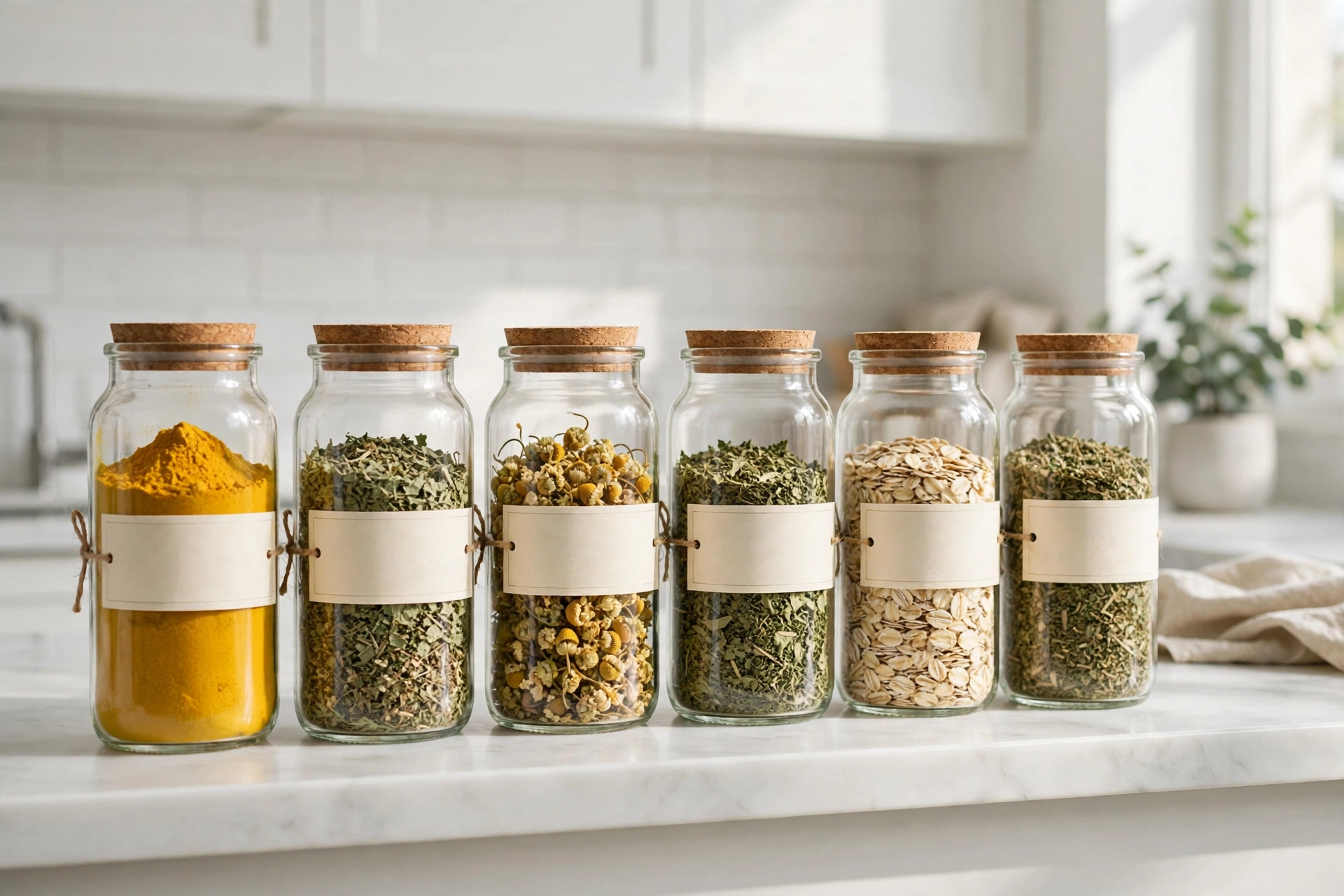
Use a clean, dry glass jar with a tight lid. Label it with the blend name and date — future you will be grateful.
Store in a cool, dark cupboard away from the stove. Heat and light degrade the volatile oils that make the blend work.
Pure dried-herb blends keep three to four months. Anything with ground seeds or flaxseed: refrigerate and use within two to three weeks.
Right-size your batches. One dog eating three times a week needs only 8 to 10 tablespoons at a time. A fresh small batch beats a stale large one every time. For more ways to add interest without volume, see our senior dog food toppers.
Technique Tips That Make a Difference
Grind, don’t buy pre-ground, when you can: Pre-ground herbs have been losing volatile oils on a shelf for months. Grinding yourself is dramatically more aromatic — and aroma is the whole point.
Toast seeds before grinding: Two minutes in a dry pan transforms fennel, anise, cardamom, and pumpkin seed. You’ll smell the difference immediately. Don’t walk away — the line between toasted and burnt is about forty seconds.
Add it to the food after cooking, not during: Heat destroys the volatile oils you’re preserving. Stir the seasoning in once food has cooled to serving temperature — warm, not hot.
Keep a pinch jar by the bowl: Keep a small jar of your dog’s favorite blend next to the food bin. Within arm’s reach, you’ll use it. Buried in the spice cupboard, you won’t.
Frequently Asked Questions
Final Thoughts
That’s the framework: a 4-2-1 formula, dog-safe ingredients, and four directions — base for everyday, savory for fussy eaters, bright for summer, warm for winter, calm for evenings. Keep the hard no’s out of the kitchen. When in doubt, leave it out.
Now experiment. Find the blend your dog gets excited about. And if your dog has health conditions or takes medication, loop in your vet — they’ll help you build a seasoning routine that’s safe for your specific dog.

Izzy is an experienced ranch worker who has a passion for exploring nature and getting up close to wildlife. With her connections to various animal organizations, Izzy is well-versed in animal care and rehabilitation.