Free Cozy Waves Dog Bandana Crochet Pattern
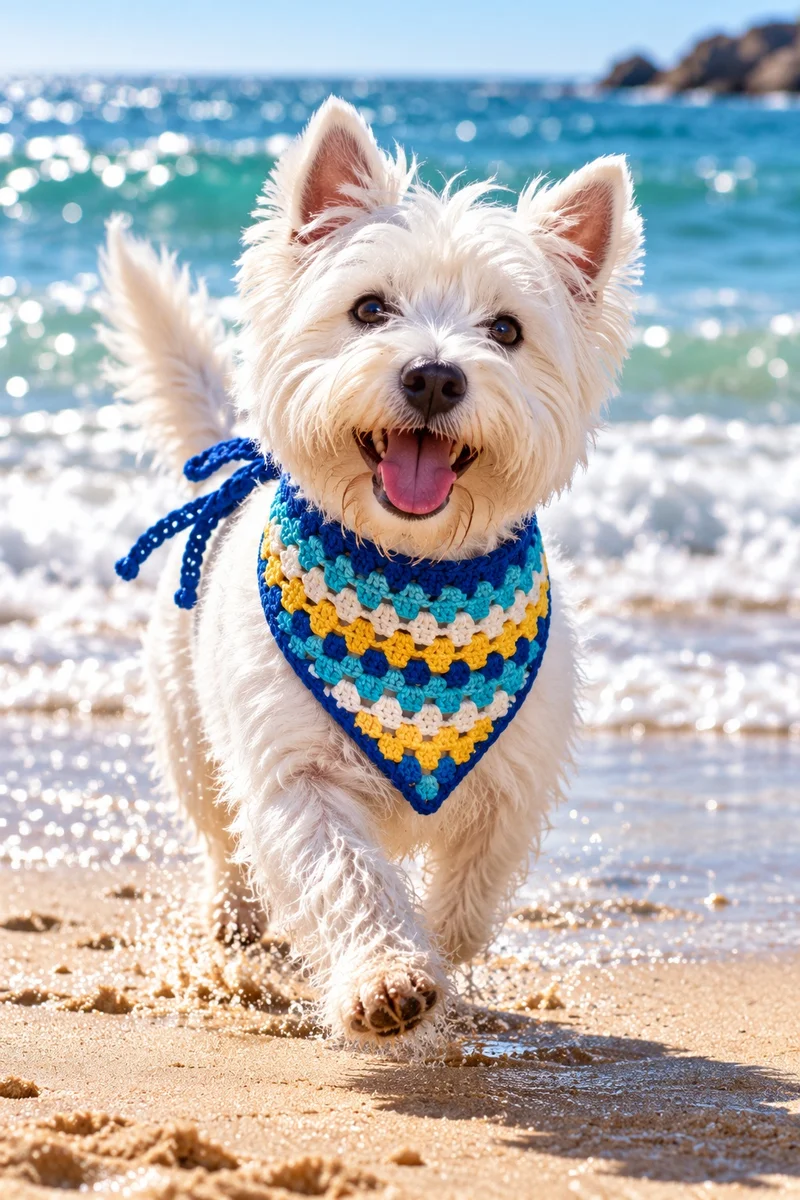
The granny stitch was made for color — and the Cozy Waves Dog Bandana proves it. Royal blue, turquoise, golden yellow, and cream ripple across a classic triangular bandana in cheerful two-row stripes, like ocean waves frozen mid-roll. It is bright, happy, and impossible to ignore at the dog park.
This is the perfect first granny-stitch project: one stitch (the 3-dc cluster) repeated in a simple triangle, with color changes doing all the visual heavy lifting. It comes in three sizes (S, M, L), ties on with sturdy crocheted ties — no sewing, no buttons, no fuss — and works up in a weekend from stash yarn. If you’ve ever wanted to try granny stitch but felt intimidated by a full blanket, this bandana is the ideal low-commitment introduction: you learn the cluster, the color changes, and the triangle shaping in a project small enough to finish before you lose steam.
Why the Waves Work
The cozy waves effect comes from two simple choices: the granny stitch’s natural scalloped edge, and stripes that change every two rows. Two rows is the magic number — one row looks choppy, three rows look blocky, but two rows lets each color read as a distinct wave while the overall fabric stays harmonious. The royal blue anchors it, the turquoise lifts it, the golden yellow warms it, and the cream gives your eyes a place to rest.
The triangle shape does the rest. Granny stitch naturally wants to ripple, and the decreasing edges emphasize the wave motion — each row slightly narrower than the last, like ripples reaching a shore. It is one of those rare patterns where the stitch, the shaping, and the color plan all push in the same direction.
Choose Your Colors
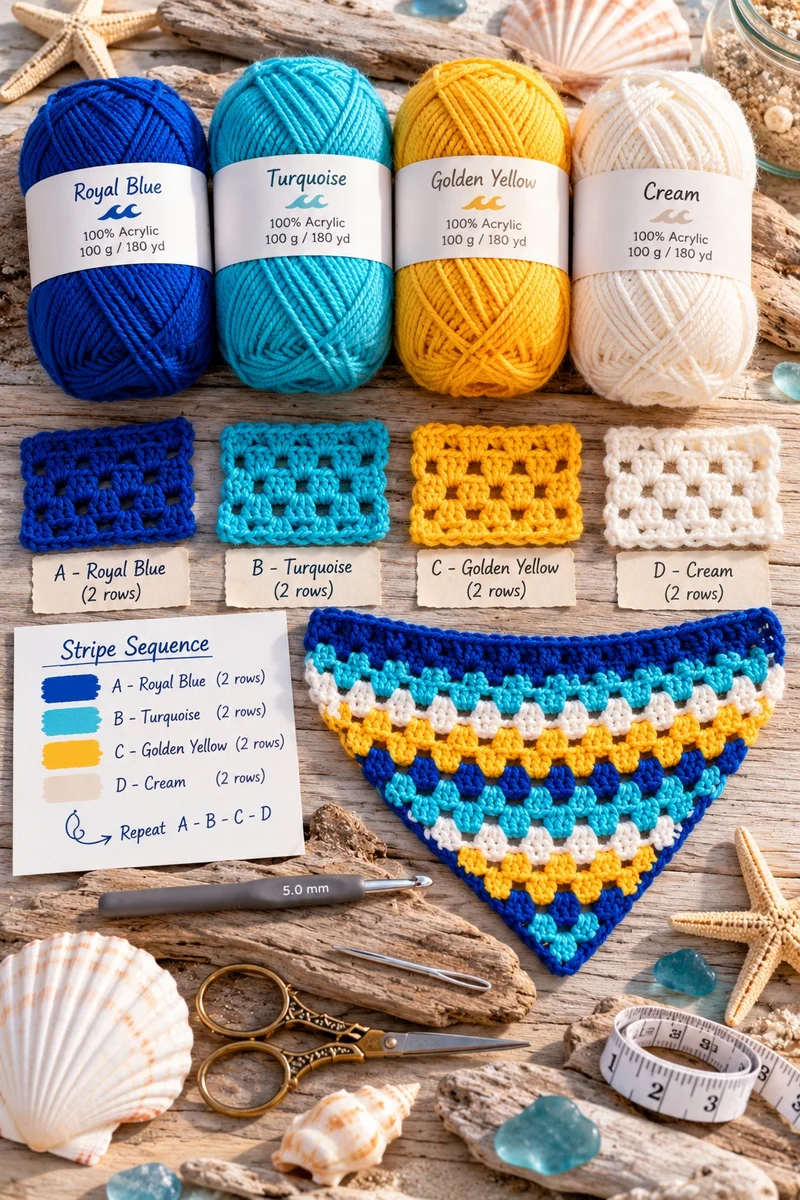
The sample bandana wears the Ocean Waves palette — royal blue, turquoise, golden yellow, and cream. But the stripe sequence is just “change every 2 rows,” so any four colors work. The key is contrast: pair two darks with two lights, or go tonal with four shades of one color family.
Try these combinations: sunset (coral, peach, gold, cream), forest (hunter green, sage, tan, cream), patriotic (navy, red, white, denim blue), or pastel spring (lavender, mint, peach, white). Variegated yarn in place of one solid adds beautiful complexity with zero extra effort — try it for color C, the golden yellow, to make the waves shimmer.
Pro tip: lay your four skeins together before you start. If you can’t tell them apart at arm’s length, swap one — the waves need distinct colors to read.
Before You Get Started
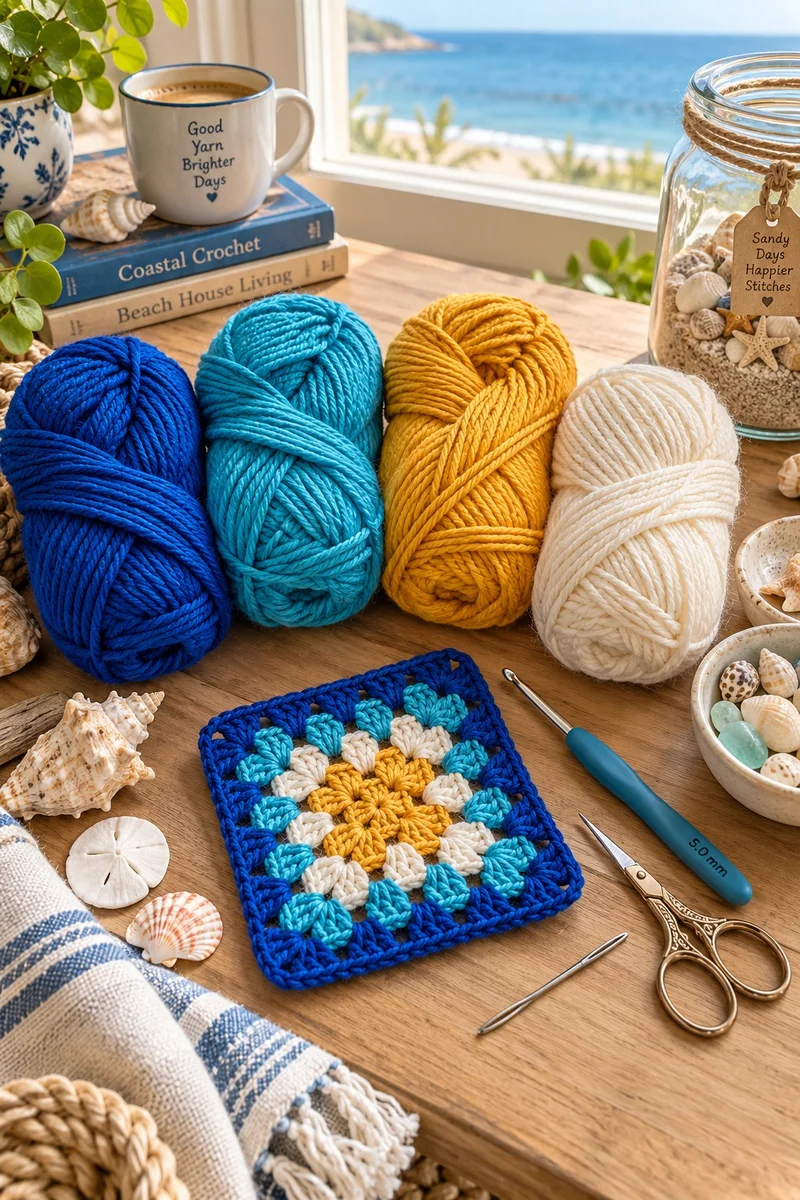
This bandana is a top-down granny triangle: you chain the full top width, work three plain rows, then decrease one cluster at the start of every row until a single cluster remains at the point. Two crocheted ties (simple chains worked back in single crochet) attach at the top corners. That is the entire project — no seaming, no picking up stitches, no complicated assembly.
You should be comfortable with double crochet and changing colors. The only trick is the decrease — slipping over the first cluster at the start of each row — and it becomes automatic after three rows. The first decrease feels strange (you’re deliberately skipping stitches!), but by the fifth row your hands know the rhythm. Any smooth worsted-weight yarn that meets gauge works; the four-color stripe sequence is written out row by row, so just follow along and enjoy the color show.
Fit & comfort check: Tie the bandana snugly enough that it does not slip, but loose enough to slide two fingers underneath. The ties should sit at the back of the neck, never under the chin where they could tighten.
Supervise your dog while wearing any tied accessory until you know they will not chew the ties. Trim tie ends to a safe length — long dangling ties can snag.
Tools & Materials Needed
Yarn
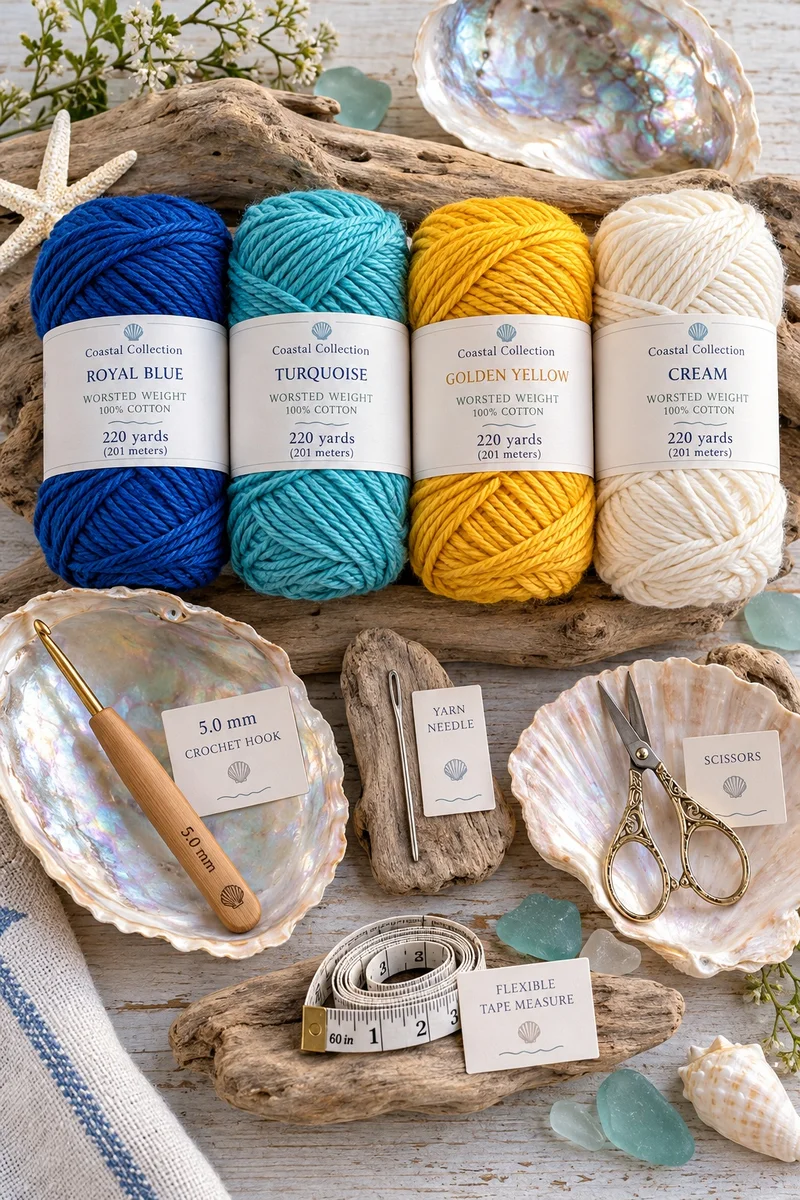
- Worsted-weight (#4) acrylic or acrylic-blend yarn, soft and machine-washable.
- Color A (royal blue), B (turquoise), C (golden yellow), D (cream): approx 100 (140, 180) yd TOTAL across all four colors for sizes S (M, L)
- Scrap-friendly! Each color needs only 25–45 yd — perfect for using up leftovers.
Hook & Notions
- US H-8 (5.0 mm) crochet hook, or size needed to obtain gauge
- Yarn needle with a large eye, scissors, flexible tape measure
Size Info and Gauge
S
Neck: 10–12″
Bandana: 10″ wide × 6″ long
Terriers, Dachshunds, Min Pins
M
Neck: 14–16″
Bandana: 13″ wide × 7.5″ long
Beagles, French Bulldogs, Shelties
L
Neck: 18–20″
Bandana: 16″ wide × 9″ long
Labradors, Goldens, Boxers
Gauge: one 3-dc granny cluster = 1″ wide; one granny row = 0.5″ tall (US H-8 / 5.0 mm hook). Count your clusters after the foundation row — every size depends on this number.
Abbreviations (US Terms)
ch – chain • dc – double crochet • sc – single crochet • sl st – slip stitch • sp – space • st(s) – stitch(es) • cluster – 3 dc in the same space
Pattern Notes
- Sizes are written as S (M, L) throughout. Circle your size before you begin.
- A cluster means 3 double crochets in the same chain space, with ch 1 between clusters.
- Stripe sequence: change color every 2 rows — Rows 1–2: A, 3–4: B, 5–6: C, 7–8: D, 9–10: A, 11–12: B, 13–14: C, 15–16: D, 17–18: A.
- Decreases: at the start of every decrease row, slip stitch over the first cluster to the next ch-1 space. This drops one cluster per row.
- Ch 3 at the start of a row counts as the first double crochet.
- Weave in ends as you go — four colors means many tails.
Pattern Instructions
Triangle (worked top-down)
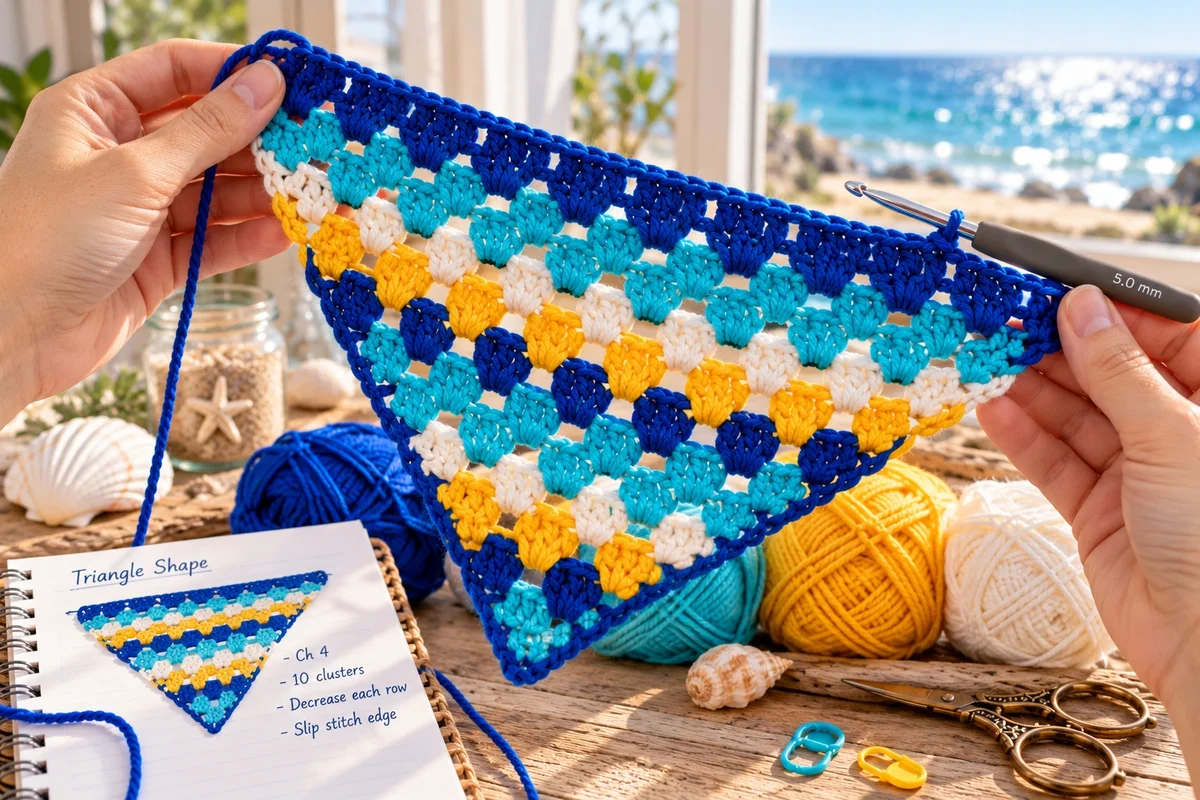
Foundation row (Row 1, color A): Chain 31 (40, 49). 2 dc in 4th ch from hook, *ch 1, skip 3 ch, 3 dc in next ch* repeat 8 (11, 14) times. (10, 13, 16 clusters)
- Rows 2–3: Ch 3, turn. *3 dc in next ch-1 sp, ch 1* across, ending with 1 dc in top of beginning ch-3. (10, 13, 16 clusters)
- Decrease rows (start Row 4): Turn, sl st in each of the first 3 dc, sl st into the next ch-1 sp, ch 3, *3 dc in next ch-1 sp, ch 1* across, ending with 1 dc in top of beginning ch-3. Each row drops 1 cluster.
- Continue decrease rows until 1 cluster remains: S: Rows 4–12 (12 rows total) M: Rows 4–15 (15 rows total) L: Rows 4–18 (18 rows total).
- Final row: Ch 3, 2 dc in the single ch-1 sp, sl st to top of ch-3. Fasten off.
Ties (make 2)

- With color A, chain 32 (40, 48). Sc in 2nd ch from hook and in each ch across. Fasten off. (8, 10, 12 in ties)
- Sew or tie one tie to each top corner of the triangle. Weave in all ends.
Finishing
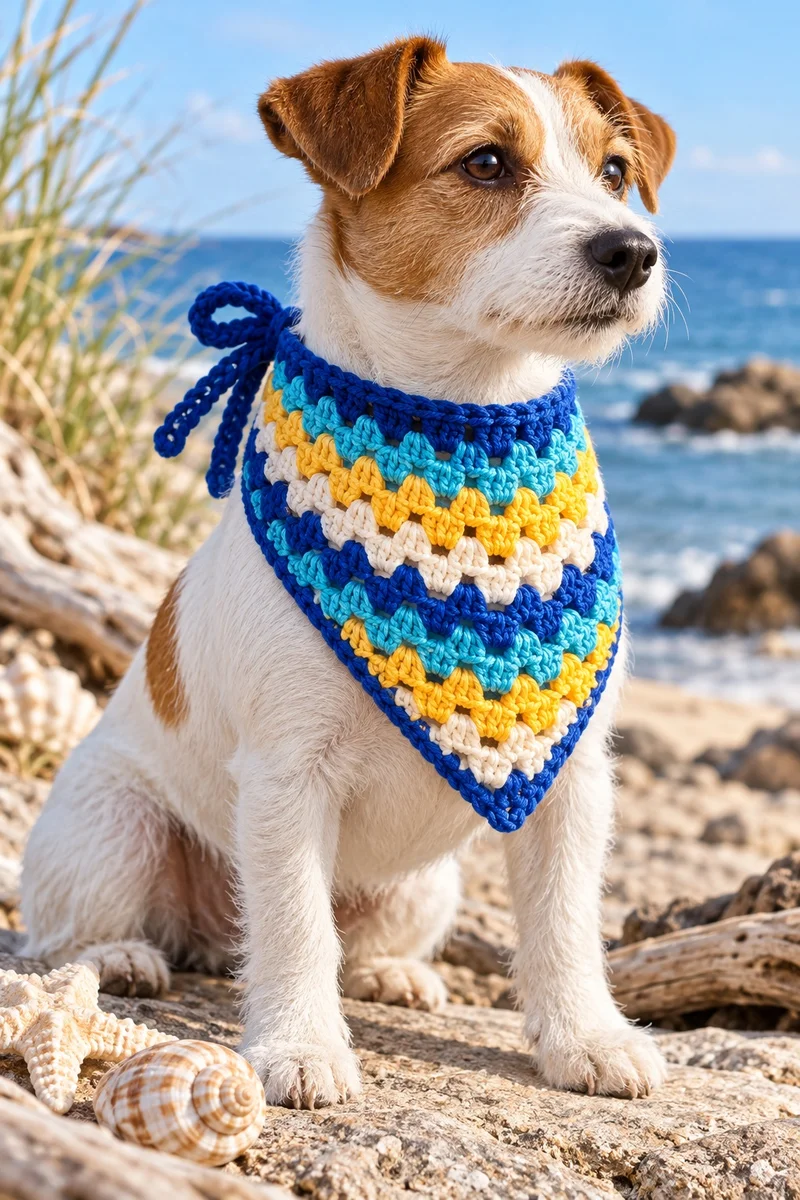
Weave in every end — with four colors, do this as you go to avoid a tangled finish at the end. A yarn needle and a few minutes per color change saves a frustrating hour later. Lightly steam-block the triangle (hover the iron, never press) so the edges lie straight, the point is crisp, and the stripes relax into even waves. Tie it on your dog with the point hanging down the chest, adjust the ties for a comfortable two-finger fit, and step back to admire the waves.
Customizing the Fit
Different colors: the stripe sequence works with any four colors — try pastels for spring, red-white-blue for the Fourth of July, or your sports team’s palette. Keep one light color (like the cream) for contrast.
Longer ties: add 8 chains per extra inch. For dogs who hate things tied, sew small snaps or Velcro to the top corners instead.
Bigger triangle: add 3 clusters to the foundation (9 chains) and 3 rows — each 3-cluster repeat adds about 1″ of width and 1.5″ of length. This is handy for deep-chested breeds where the standard triangle looks skimpy.
Edging option: for a fancier finish, work one round of single crochet in color D around the entire triangle (including the top edge) before adding ties. It frames the waves beautifully and gives the ties a sturdier anchor.
Frequently Asked Questions
Final Thoughts
The Cozy Waves Dog Bandana is the rare project that looks far harder than it is: one stitch, one simple decrease, and a color sequence that does the design work for you. It is the perfect weekend make — start Saturday morning, tie it on your dog by Sunday afternoon.
And because it is so stash-friendly, it is dangerously giftable. One skein of each color makes several bandanas; your friends’ dogs will all be wearing waves. Whip up a batch in different palettes and you’ll have birthday gifts handled for every dog lover you know.
For more colorful crochet, try the granny square dog sweater — same joyful stitch, bigger canvas — or the sunset granny sweater for a striped pullover.
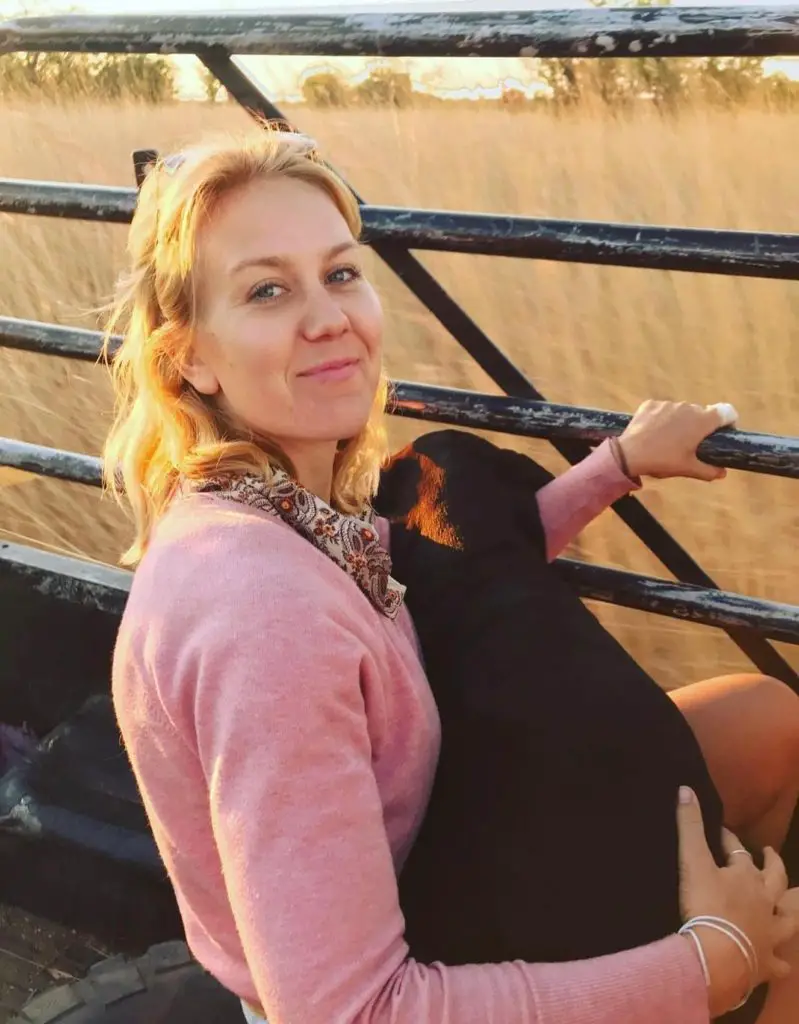
Izzy is an experienced ranch worker who has a passion for exploring nature and getting up close to wildlife. With her connections to various animal organizations, Izzy is well-versed in animal care and rehabilitation.