Crochet Granny Dog Sweater Pattern in Sunset Stripes (Free)
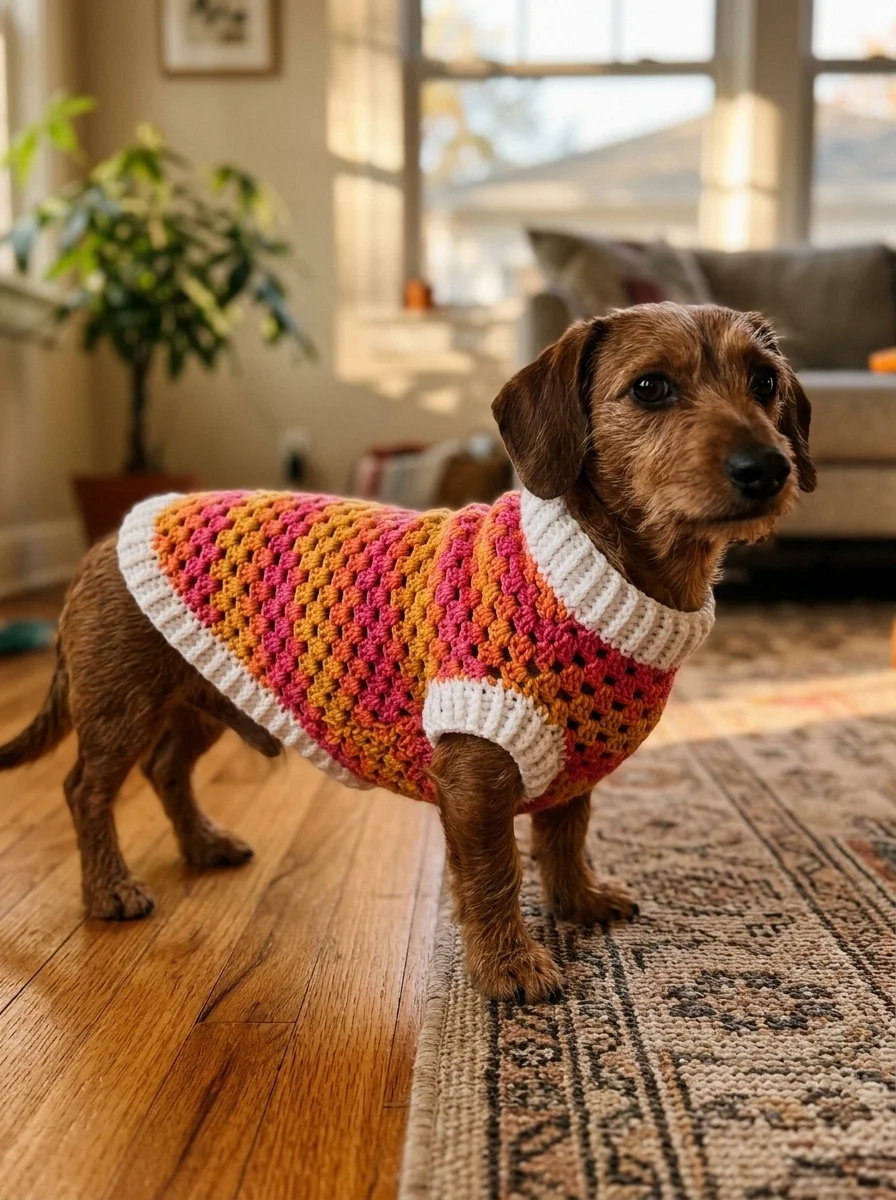
The granny stitch is the happiest stitch in crochet — open, breezy, and made for color. The Crochet Granny Dog Sweater Pattern works it in the round into a cheerful pullover striped in hot pink, tangerine orange, and golden yellow, finished with crisp white trim at the neck, leg openings, and hem. It is the sweater equivalent of a sunset.
It is a genuinely beginner-friendly project: if you can double crochet and change colors, you already know everything this sweater asks. It comes in four sizes, XS through L, and the stripe sequence is written in color letters — so the sunset sample is only the beginning. Pick any palette you love and the pattern follows.
Before You Get Started
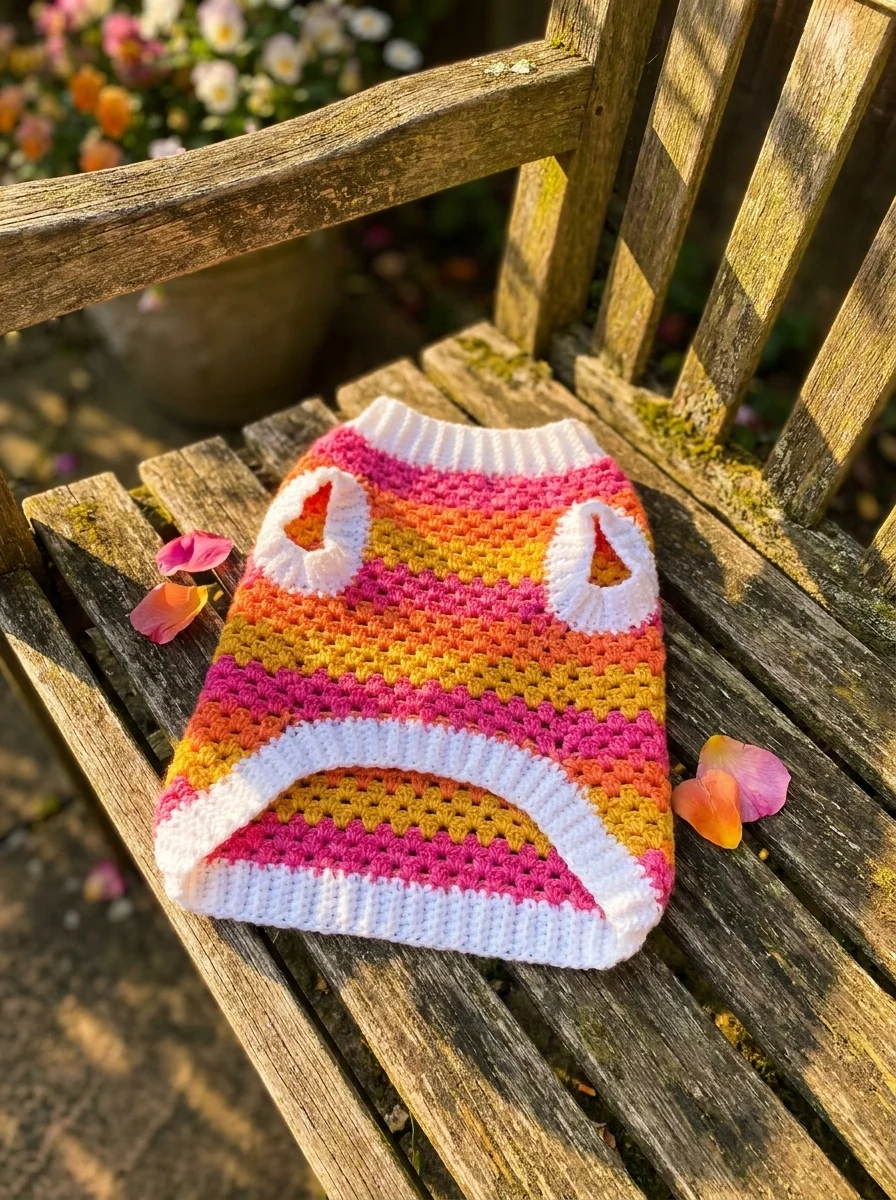
This sweater is worked top-down in the round using the classic granny stitch — clusters of three double crochets separated by chain spaces. You will start with a white neckband, work a yoke that increases to full chest width, divide for the two front-leg openings, then crochet the body straight down in repeating color stripes. White trim finishes the leg openings and the bottom edge.
You should be comfortable working joined rounds and changing colors at the end of a round. The only stitch beyond the basics is the granny cluster itself, and it is simply three double crochets in the same space. Any smooth worsted-weight yarn that meets gauge works beautifully.
Choose Your Colors
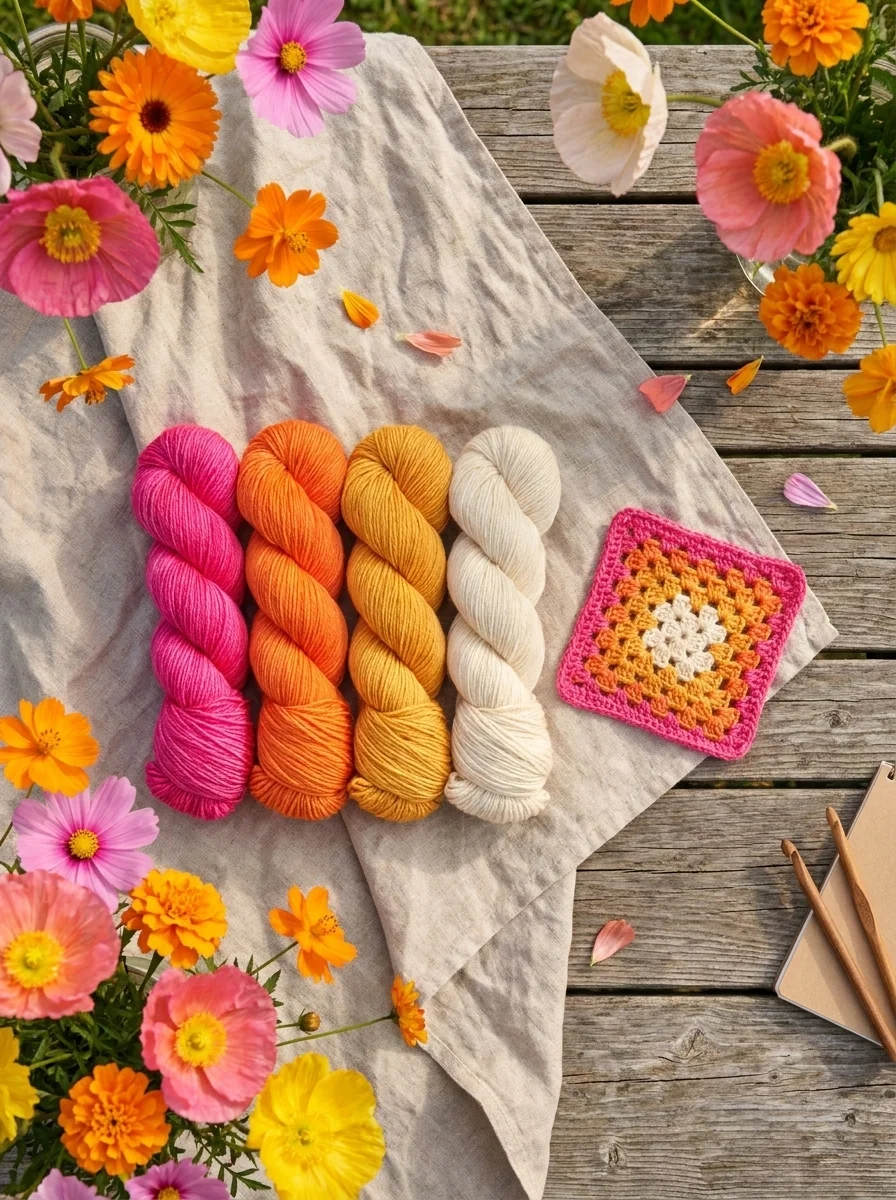
The sample sweater wears the Sunset palette — hot pink, tangerine orange, and golden yellow stripes with white trim. But the pattern is written in color letters (A, B, C for the stripes, D for the trim), so any three colors plus a trim will work. Swapping a single stripe color gives you a whole new sweater.
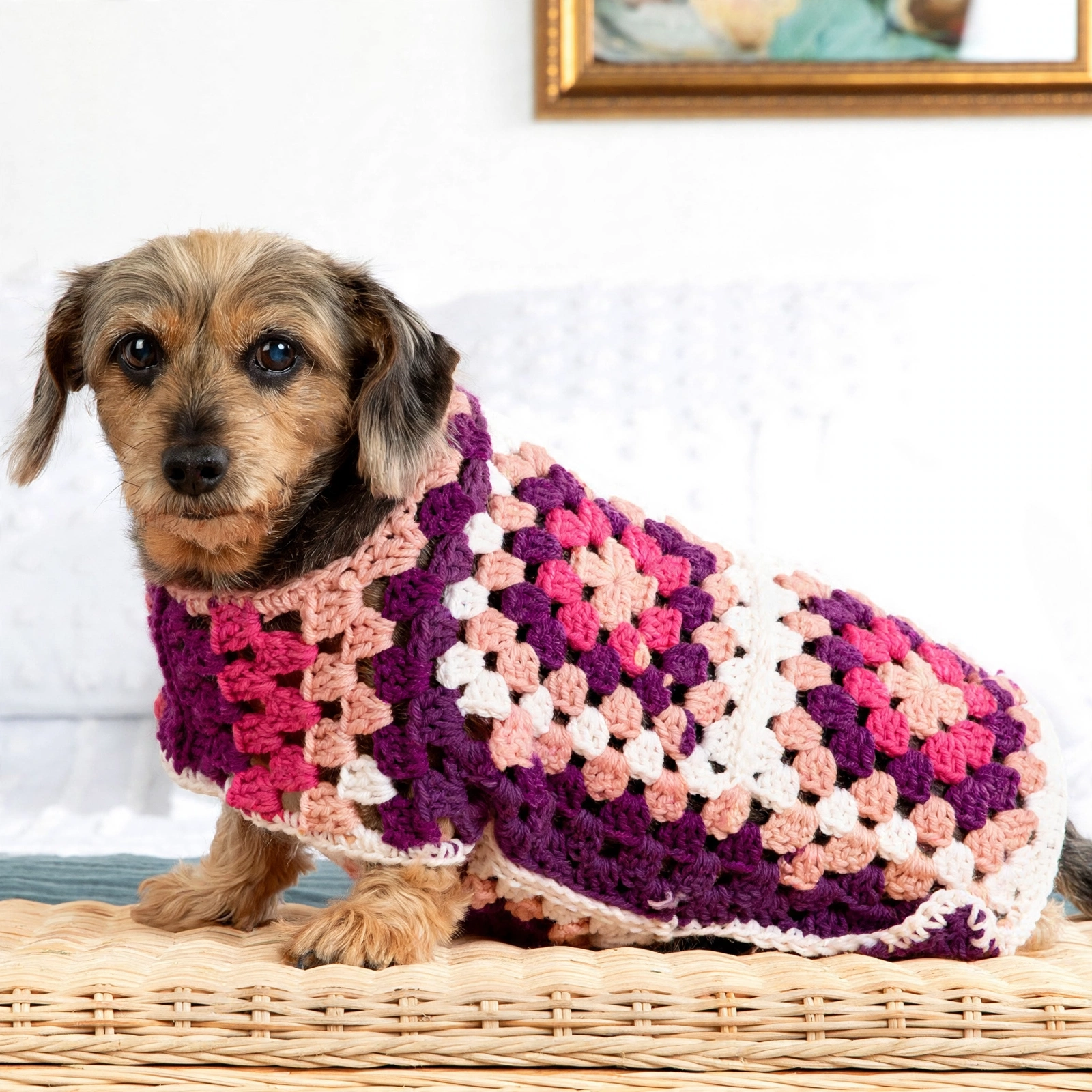
Berry Sorbet
Plum, raspberry, and blush pink stripes with a cream trim. Sweet, romantic, and gorgeous on light-coated dogs.
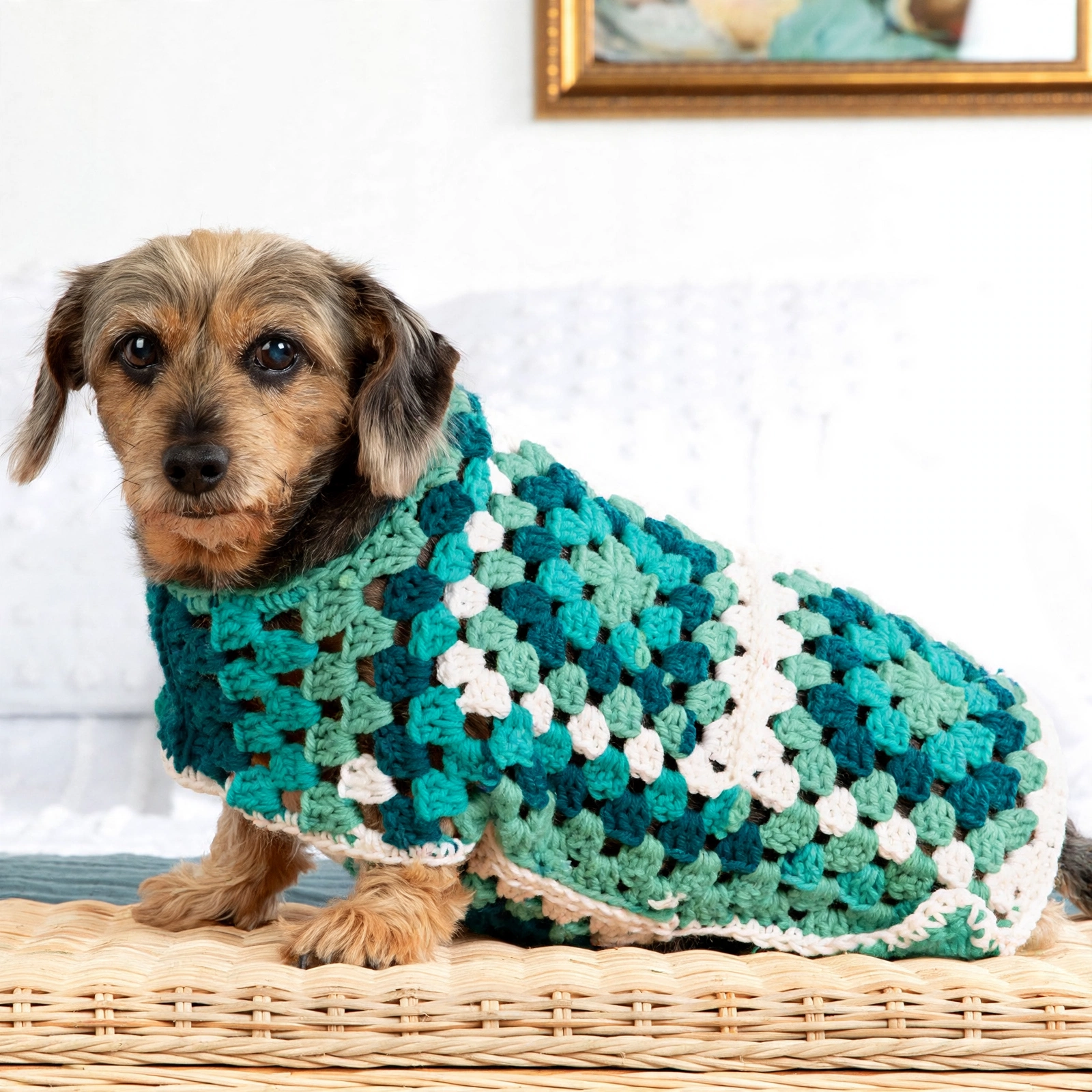
Ocean Breeze
Deep teal, turquoise, and seafoam stripes with a white trim. Fresh, coastal, and striking against the sunset sample.
Make it yours: keep the trim white and rotate any three colors through A, B, C — pastels for spring, jewel tones for winter, or your favorite sports team’s colors. The stripe order never changes, only the yarn.
Fit & comfort check: You should be able to slide two fingers comfortably between the sweater and your dog at the neck and chest. The granny stitch is open and stretchy, but check the leg openings for rubbing on the first wear.
Never leave a dog unsupervised in a handmade garment until you know they will not chew it. Sweaters can snag on crates and fences; the open stitch means little claws can catch, so check the fabric regularly and trim any snagged loops.
Tools & Materials Needed
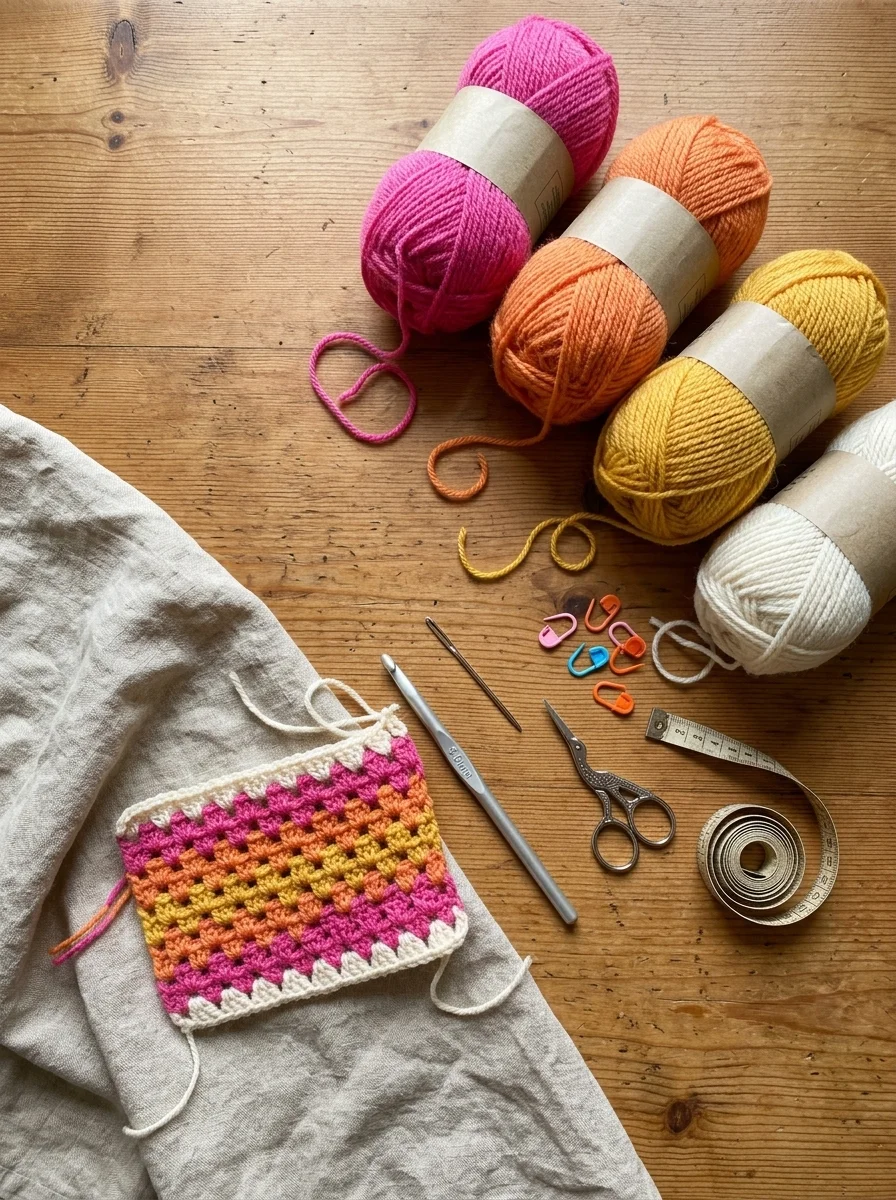
Yarn
- Worsted-weight (#4) acrylic or acrylic-blend yarn, soft and machine-washable. Colors A, B, C (stripes) and Color D (trim).
- Sample (Sunset): A = hot pink, B = orange, C = golden yellow, D = white
- Colors A, B, C: 1 (1, 2, 2) skeins each of 100 g / 200 m for sizes XS (S, M, L)
- Color D: 1 skein for all sizes
Hook & Notions
- US H-8 (5.0 mm) crochet hook, or size needed to obtain gauge
- Stitch markers (at least 2)
- Yarn needle with a large eye
- Scissors and a flexible tape measure
Size Info and Gauge
XS
Chest: 12″
Body clusters: 12
Chihuahuas, Yorkies, tiny terriers
S
Chest: 16″
Body clusters: 16
Mini poodles, Shih Tzus, small spaniels
M
Chest: 20″
Body clusters: 20
Beagles, French bulldogs, spaniels
L
Chest: 24″
Body clusters: 24
Labradors, pointers, large mutts
Gauge: one 3-dc granny cluster = 1″ wide; 12 dc = 4″ (US H-8 / 5.0 mm hook). Work a 4-inch granny swatch in the round and count your clusters — the whole sweater scales from this number.
Abbreviations (US Terms)
ch – chain • sc – single crochet • dc – double crochet • sl st – slip stitch • sp(s) – space(s) • st(s) – stitch(es) • RS – right side • cluster – 3 dc in the same space
Pattern Notes
- Sizes are written as XS (S, M, L) throughout. Circle your size before you begin.
- A cluster means 3 double crochets worked into the same chain space.
- Change colors at the end of each round: finish the joining slip stitch with the new color.
- The sweater is worked in joined rounds with the right side always facing.
- Count your clusters at the end of every round — in granny stitch, a missed space is invisible until three rounds later.
- Weave in ends as you go; every color change leaves two tails.
Pattern Instructions
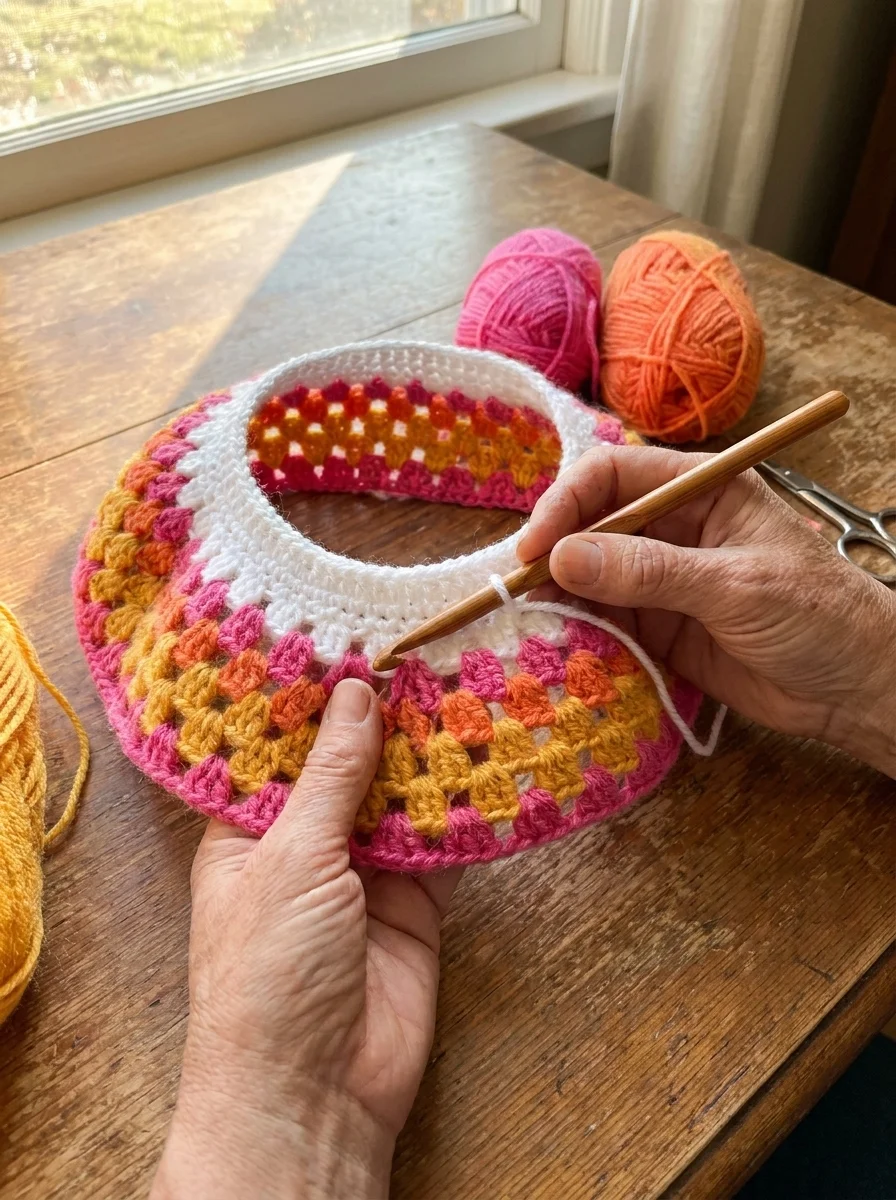
Work in continuous rounds; join each round with sl st to the first dc of the cluster at the start of the round. Begin at the top of the neck.
Neckband. With D, ch 36 (48, 60, 72) and join with sl st to form a ring, taking care not to twist.
Round 1: Sc in each ch around. Join with sl st to first sc. (36 (48, 60, 72) sc.)
Rounds 2–3: Sc in each sc around. Join. (36 (48, 60, 72) sc.) Do not turn; the yoke is worked with the RS facing throughout.
Yoke R1 — with A. *3 dc in next sc, ch 1, skip 1 sc* — repeat around. Join with sl st to top of first dc. (18 (24, 30, 36) clusters; 54 (72, 90, 108) dc.)
Yoke R2 — with B. *(3 dc, ch 1) in each ch-1 sp* — repeat around. Join. (18 (24, 30, 36) clusters.)
Yoke R3 — with C (increase round). *(3 dc, ch 1, 3 dc) in each ch-1 sp* — repeat around (2 clusters per space). Join. (36 (48, 60, 72) clusters; 108 (144, 180, 216) dc.)
Yoke R4 — with A. *(3 dc, ch 1) in each ch-1 sp* — repeat around. Join. (36 (48, 60, 72) clusters.)
Yoke R5 — with B. *(3 dc, ch 1) in each ch-1 sp* — repeat around. Join. (36 (48, 60, 72) clusters.)
> The yoke reaches the full body cluster count at Yoke R3 for every size. The body begins at the front leg openings.
Body with Leg Openings
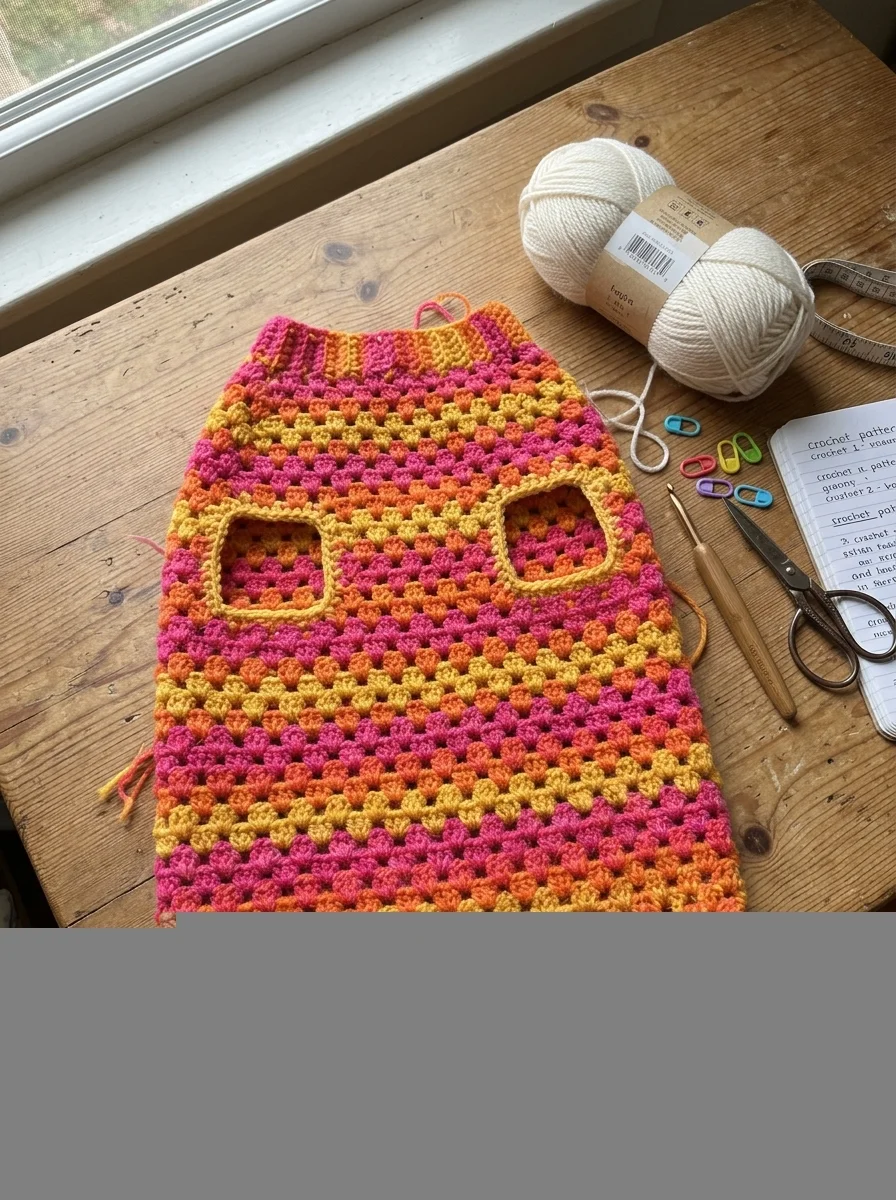
Continue in the round. Leg openings are formed by skipping four consecutive clusters at the front center.
Body R1 (divide for legs) — with A. Work (3 dc, ch 1) in each ch-1 sp as follows:
- XS: 20 clusters (back), ch 3 and skip 3 clusters (first leg opening), 10 clusters (belly), ch 3 and skip 3 clusters (second leg opening). Join.
- S: 26 clusters, ch 4 and skip 4, 14 clusters, ch 4 and skip 4. Join.
- M: 32 clusters, ch 5 and skip 5, 18 clusters, ch 5 and skip 5. Join.
- L: 38 clusters, ch 6 and skip 6, 22 clusters, ch 6 and skip 6. Join.
Body R2 — with B. *(3 dc, ch 1) in each ch-1 sp*, and 3 dc in each chain gap (the gap becomes a full cluster). Join. (36 (48, 60, 72) clusters; 108 (144, 180, 216) dc.)
Body R3 — with C. *(3 dc, ch 1) in each ch-1 sp* — repeat around. Join. (36 (48, 60, 72) clusters.)
Body R4 — with A. *(3 dc, ch 1) in each ch-1 sp* — repeat around. Join. (36 (48, 60, 72) clusters.)
Body R5 — with B. *(3 dc, ch 1) in each ch-1 sp* — repeat around. Join. (36 (48, 60, 72) clusters.)
Body R6 — with C. *(3 dc, ch 1) in each ch-1 sp* — repeat around. Join. (36 (48, 60, 72) clusters.)
Body R7 — with A. *(3 dc, ch 1) in each ch-1 sp* — repeat around. Join. (36 (48, 60, 72) clusters.)
Body R8 — with B. *(3 dc, ch 1) in each ch-1 sp* — repeat around. Join. (36 (48, 60, 72) clusters.)
*Continue in the A, B, C stripe sequence until the body measures 6 (8, 10, 12) inches from the leg openings, or try it on the dog — it should end mid-belly.*
Leg Trims — Work in D, in the Round
Work around each leg opening separately.
Leg R1. Join D at the top of a leg opening. Work sc evenly around the opening — 2 sc in each chain of the gap and 1 sc in each dc along the sides. Join with sl st. (Counts vary slightly; keep the round flat.)
Leg Rounds 2–3. Sc in each sc around. Join. Fasten off.
Bottom Edging — Work in D, in the Round
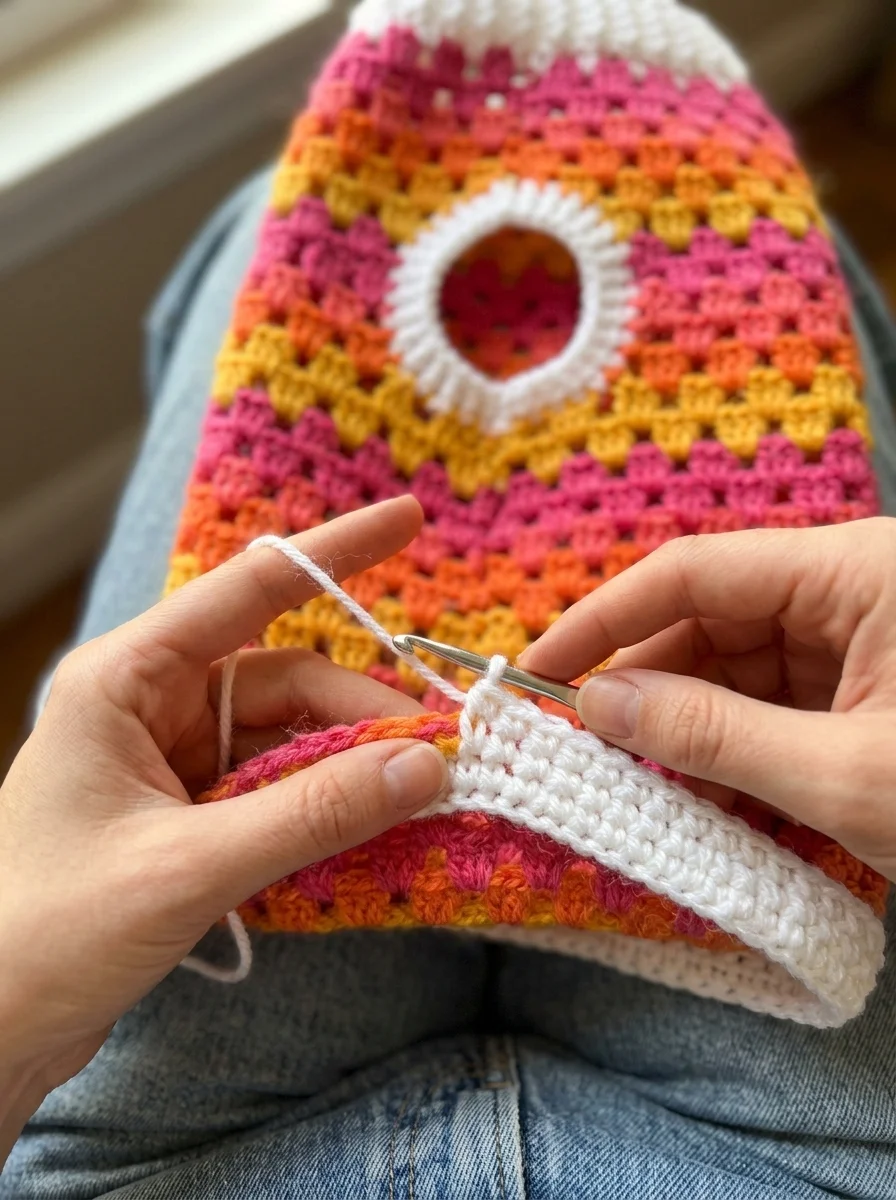
Work around the entire bottom circumference, including both leg openings, to encircle the sweater body.
Edging R1. Join D at the bottom edge. Work 1 sc in each ch-1 sp around the full bottom circumference. Join with sl st. (36 (48, 60, 72) sc.)
Edging Rounds 2–3. Sc in each sc around. Join. Fasten off.
Stripe Sequence
The sample repeats stripes in A, B, C order throughout the yoke and body, with D reserved exclusively for the neck trim, leg trims, and bottom edging.
Yoke: A, B, C, A, B, C
Body: A, B, C, A, B, C, A, B, C…
Edging: D, D, D
Finishing
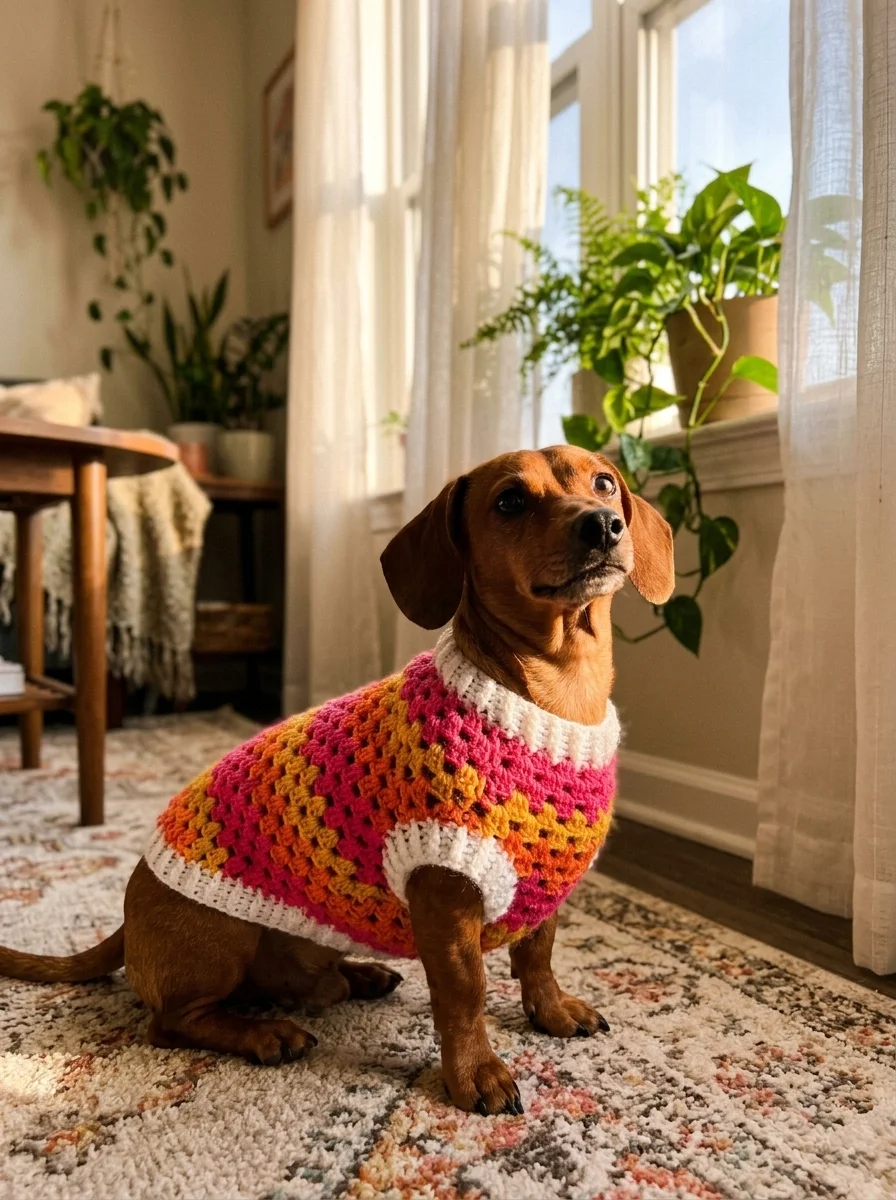
Weave in every end, working tails through the backs of stitches and trimming close. Give the sweater a light steam-block (hover — never press acrylic) so the clusters relax into even rows and the stripes lie flat.
Try it on your dog and check three fit points: two fingers under the neckband, leg openings sitting just behind the front legs without pulling, and the body ending mid-belly. The granny stitch has natural give, so a slightly snug sweater will relax with wear.
Customizing the Fit
Longer body: Add rounds in the A, B, C stripe sequence before the bottom edging — each round adds about an inch. Keep the stripe order going.
Wider chest: Go up a hook size for the whole sweater, or add one more increase round to the yoke working 2 clusters in every third space.
Between sizes: Choose the smaller size — the open granny stitch stretches generously.
Stripe play: Two colors instead of three, wider stripes (two rounds per color), or a solid body with striped yoke — the construction never changes, only the color changes.
Frequently Asked Questions
Final Thoughts
There is something deeply satisfying about watching sunset stripes grow round by round — pink into orange into gold, each one a small reward. And because the pattern speaks in color letters, your second sweater can be ocean, berry, or anything your yarn shelf suggests.
The math is checked, the construction is simple, and the result is pure joy. Make the sunset first. Then make the one that is unmistakably yours.
Happy crocheting — and save your brightest scraps. Granny stitch was invented for them.
Izzy is an experienced ranch worker who has a passion for exploring nature and getting up close to wildlife. With her connections to various animal organizations, Izzy is well-versed in animal care and rehabilitation.