Free Wildflowers Crochet Dog Sweater Pattern (4 Sizes)
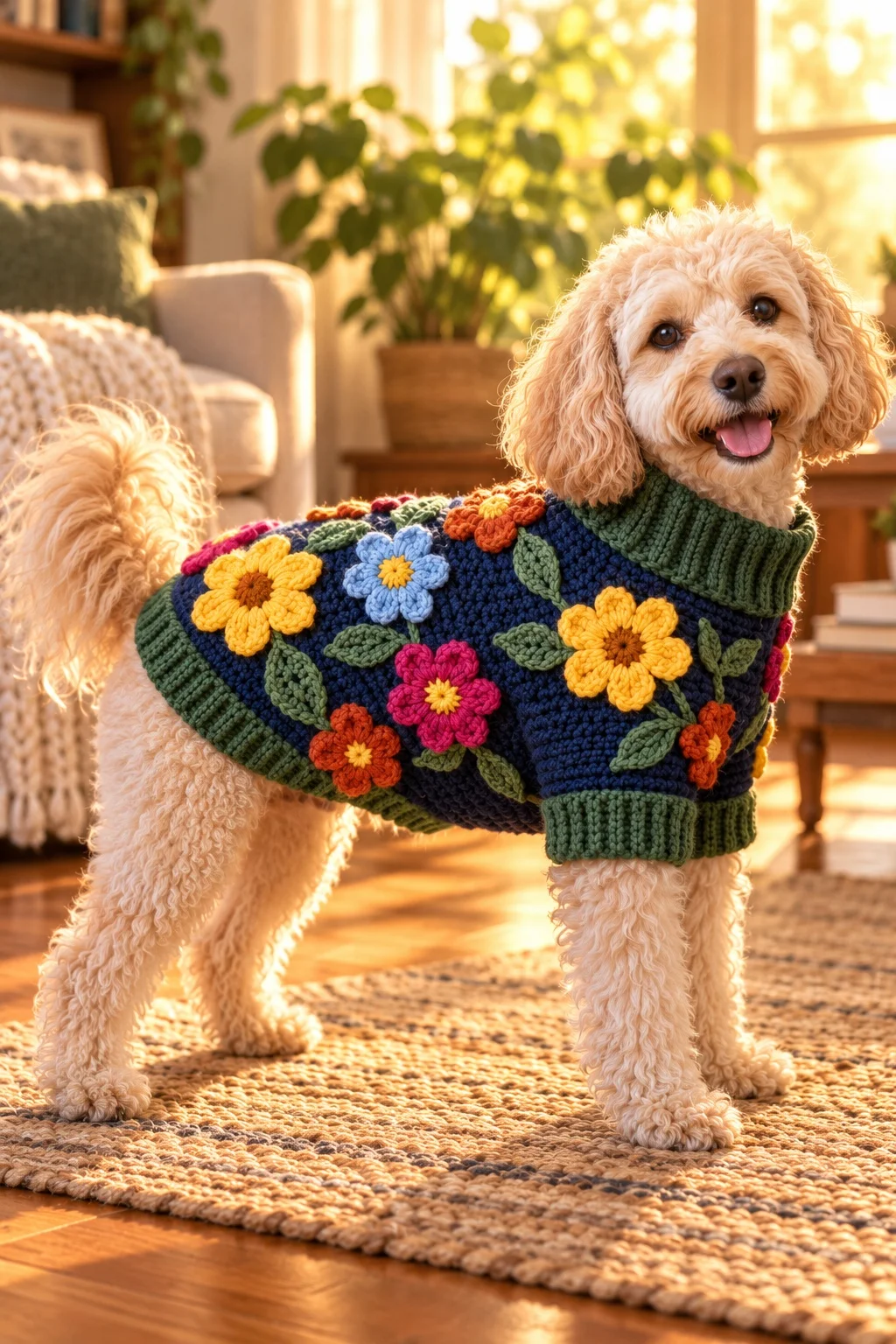
Some dog sweaters keep your pup warm. This one makes them the best-dressed dog at the park. The Wildflowers Crochet Dog Sweater Pattern pairs a classic navy pullover — green ribbed turtleneck, neat leg openings, stretchy belly band — with big, dimensional wildflower appliqués in sunny yellow, magenta, sky blue, and rust orange, plus little green leaves scattered like a meadow.
It is written for an adventurous beginner. If you can double crochet and work in the round, you can make every flower here. Four sizes, XS through L — make the sample’s meadow exactly, or invent your own wildflower mix from scraps.
Before You Get Started
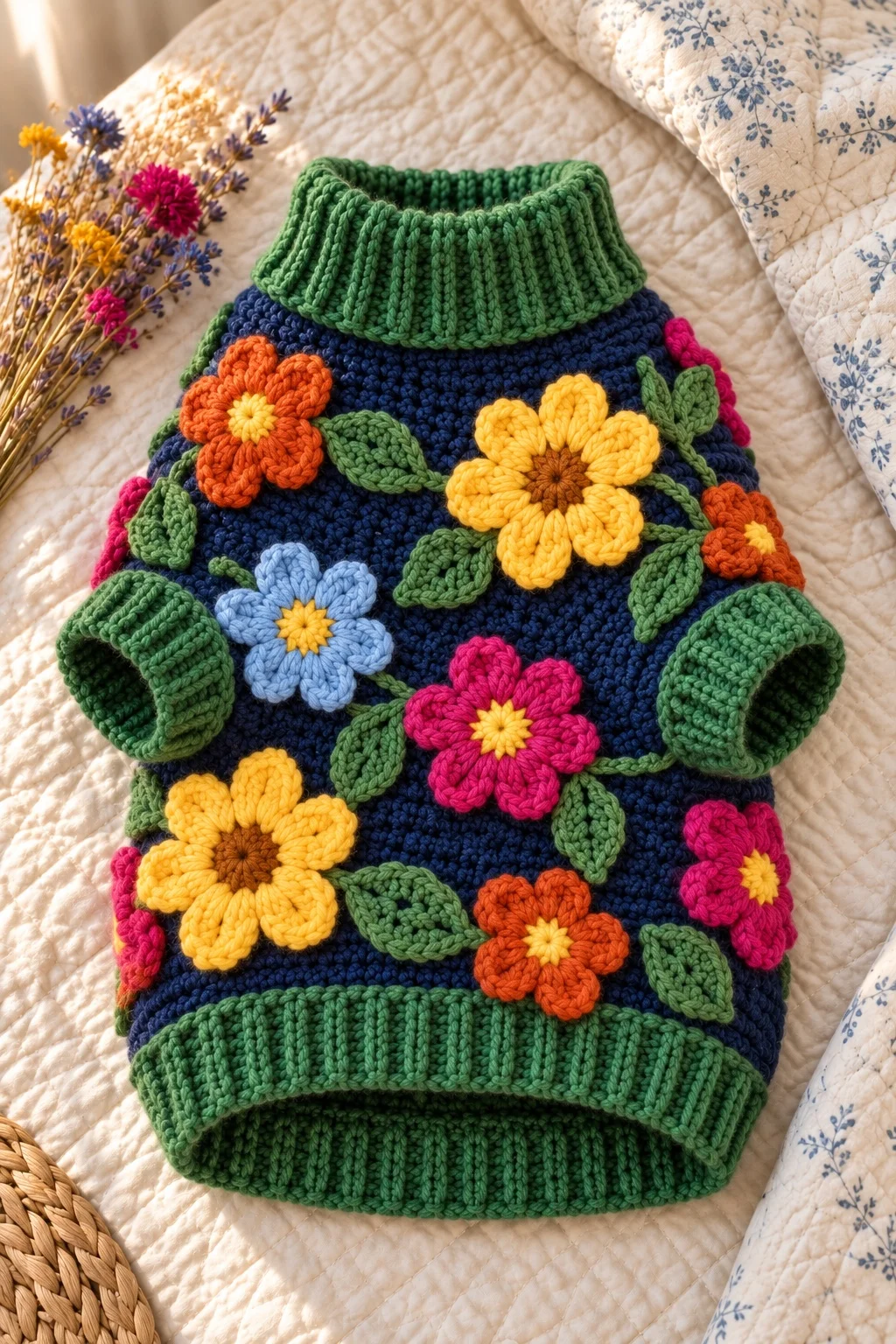
The Wildflower Sweater is worked top-down in one piece. You will start with a green ribbed collar, increase the navy yoke to full chest width, divide for the front-leg openings, then work the body straight down. Green ribbed cuffs finish each leg opening, and a green ribbed belly band closes the bottom edge. The flowers and leaves are crocheted separately — small, satisfying motifs — and sewn onto the finished sweater last, so you can arrange your meadow exactly how you like it.
You should be comfortable working joined rounds, changing colors, and counting stitches. The only new skill is the front-post double crochet in the ribbing. Any smooth worsted-weight yarn that meets gauge works; the flowers are perfect for scraps.
Fit & comfort check: You should be able to slide two fingers comfortably between the sweater and your dog at the neck and chest. The appliquéd flowers are sewn flat, but check them regularly — if your dog chews at them, remove the sweater and reinforce or reposition the motifs.
Never leave a dog unsupervised in a handmade garment until you know they will not chew it. Sweaters can snag on crates and fences; check the leg cuffs for rubbing on short-coated breeds, and skip buttons or beads anywhere near a curious mouth.
Tools & Materials Needed
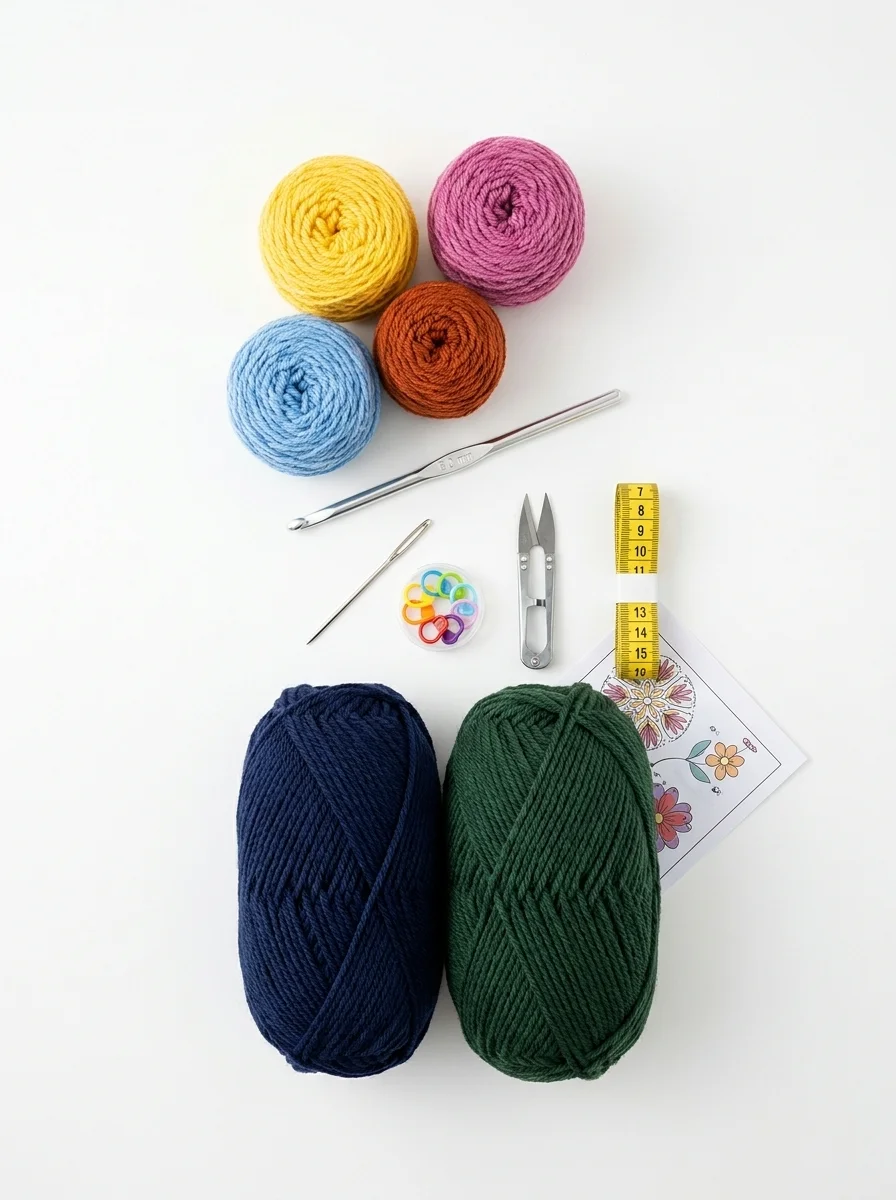
Yarn
- Worsted-weight (#4) acrylic or acrylic-blend yarn, soft and machine-washable. Color A navy (body), Color B forest green (collar, cuffs, belly band, leaves).
- Color A: 2 (2, 3, 3) skeins of 100 g / 200 m for sizes XS (S, M, L)
- Color B: 1 (1, 2, 2) skeins for sizes XS (S, M, L)
- Flower colors: small amounts of yellow, magenta-pink, light blue, and rust orange — scraps are perfect (sample uses 4 colors, you can use any).
Hook & Notions
- US H-8 (5.0 mm) crochet hook, or size needed to obtain gauge
- Stitch markers (at least 2)
- Yarn needle with a large eye for sewing appliqués
- Scissors and a flexible tape measure
Size Info and Gauge
XS
Chest: 12″
Back length: 8″
Flowers: 5
Chihuahuas, Yorkies, tiny terriers
S
Chest: 16″
Back length: 10″
Flowers: 5–6
Mini poodles, Shih Tzus, small spaniels
M
Chest: 20″
Back length: 12″
Flowers: 6
Beagles, French bulldogs, spaniels
L
Chest: 24″
Back length: 14″
Flowers: 7
Labradors, pointers, large mutts
Gauge: 12 dc × 7 rows = 4″ in double crochet (US H-8 / 5.0 mm hook). Swatch in the round if you can — most people crochet looser in the round than in rows, and this sweater never turns.
Abbreviations (US Terms)
ch – chain • sc – single crochet • hdc – half double crochet • dc – double crochet • tr – treble crochet • sl st – slip stitch • fpdc – front post double crochet • bpdc – back post double crochet • MR – magic ring • st(s) – stitch(es) • RS – right side
Pattern Notes
- Sizes are written as XS (S, M, L) throughout. Circle your size before you begin.
- The ch 2 or ch 3 at the start of a round counts as the first stitch where stated.
- The sweater is worked in joined rounds with the right side always facing.
- Flowers and leaves are made separately and sewn on last — arrange them with pins and try the sweater on your dog before committing.
- Sew appliqués with Color A and a yarn needle, using several secure stitches per piece so nothing lifts or dangles.
- Weave in ends as you go; color changes multiply quickly on the flowers.
Pattern Instructions
Ribbed Collar
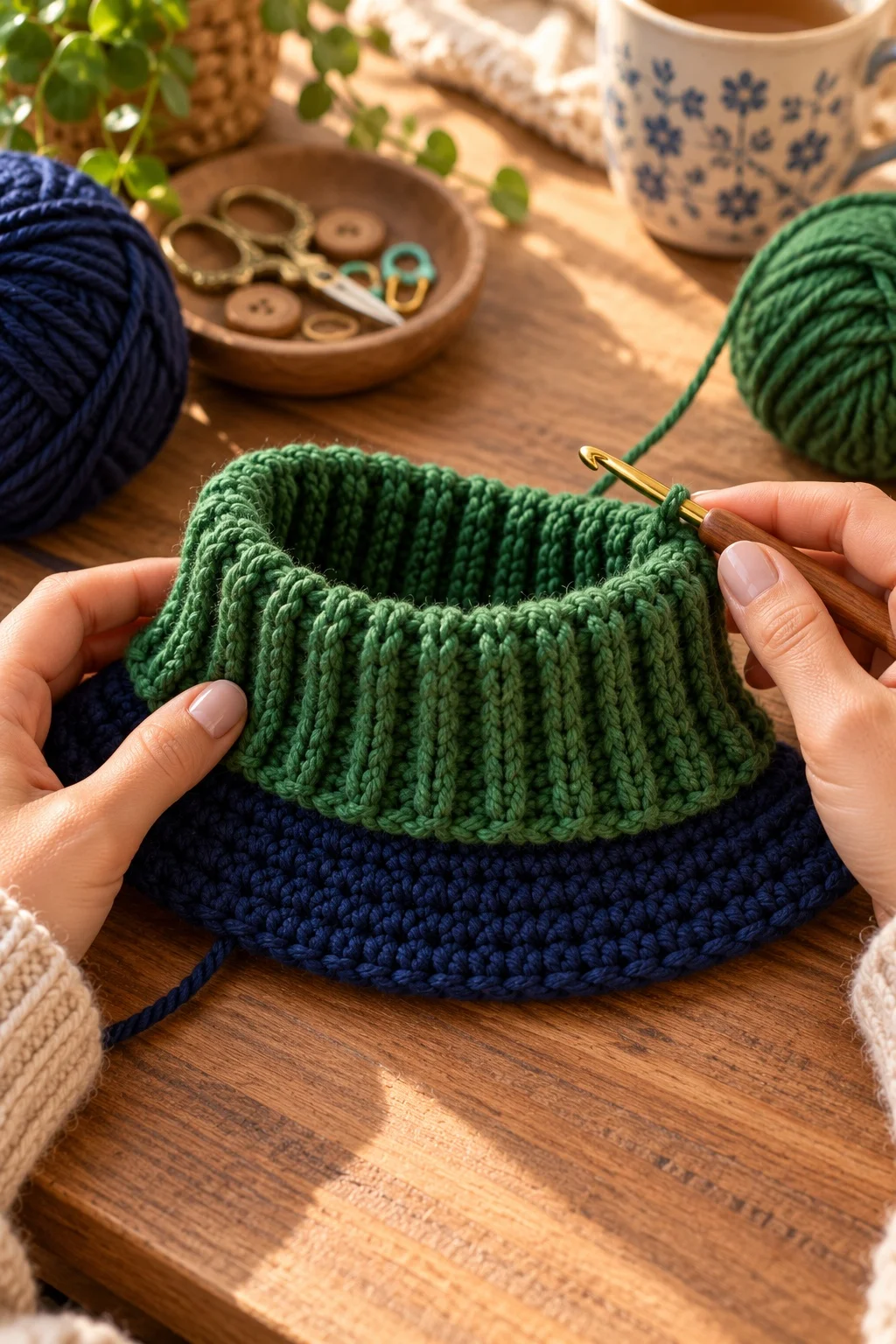
Using Color B, ch 24 (36, 48, 60) and join with a sl st to form a ring.
Round 1: Work 1 sc in each ch around. Fasten off. (24 sc; S: 36 sc; M: 48 sc; L: 60 sc.)
Round 2: Join yarn to any sc. Ch 2 (counts as first fpdc), *bpdc in next sc, fpdc in next sc* — repeat * around. Sl st to top of ch-2. (12 fpdc and 12 bpdc; S: 18 and 18; M: 24 and 24; L: 30 and 30.)
Rounds 3–6 (3–7, 3–10, 3–10): Work 1 fpdc in next fpdc, 1 bpdc in next bpdc; repeat *1 fpdc, 1 bpdc* around. Sl st to top of first fpdc. (12 fpdc and 12 bpdc; S: 18 and 18; M: 24 and 24; L: 30 and 30.)
Fasten off Color B.
Yoke
Join Color A to the last round of the collar, working into the first sc of the round.
Round 1 (increase):
- XS: *1 dc in next sc, 2 dc in next sc* around. Fasten off. (36 dc.)
- S: *1 dc in next 2 sc, 2 dc in next sc* around. Fasten off. (48 dc.)
- M: *1 dc in next 3 sc, 2 dc in next sc* around. Fasten off. (60 dc.)
- L: *1 dc in next 4 sc, 2 dc in next sc* around. Fasten off. (72 dc.)
Rounds 2–3 (2–4, 2–4, 2–5): Work 1 dc in each dc around. Sl st to the top of the first dc. (36 dc; S: 48 dc; M: 60 dc; L: 72 dc.)
Body with Leg Openings
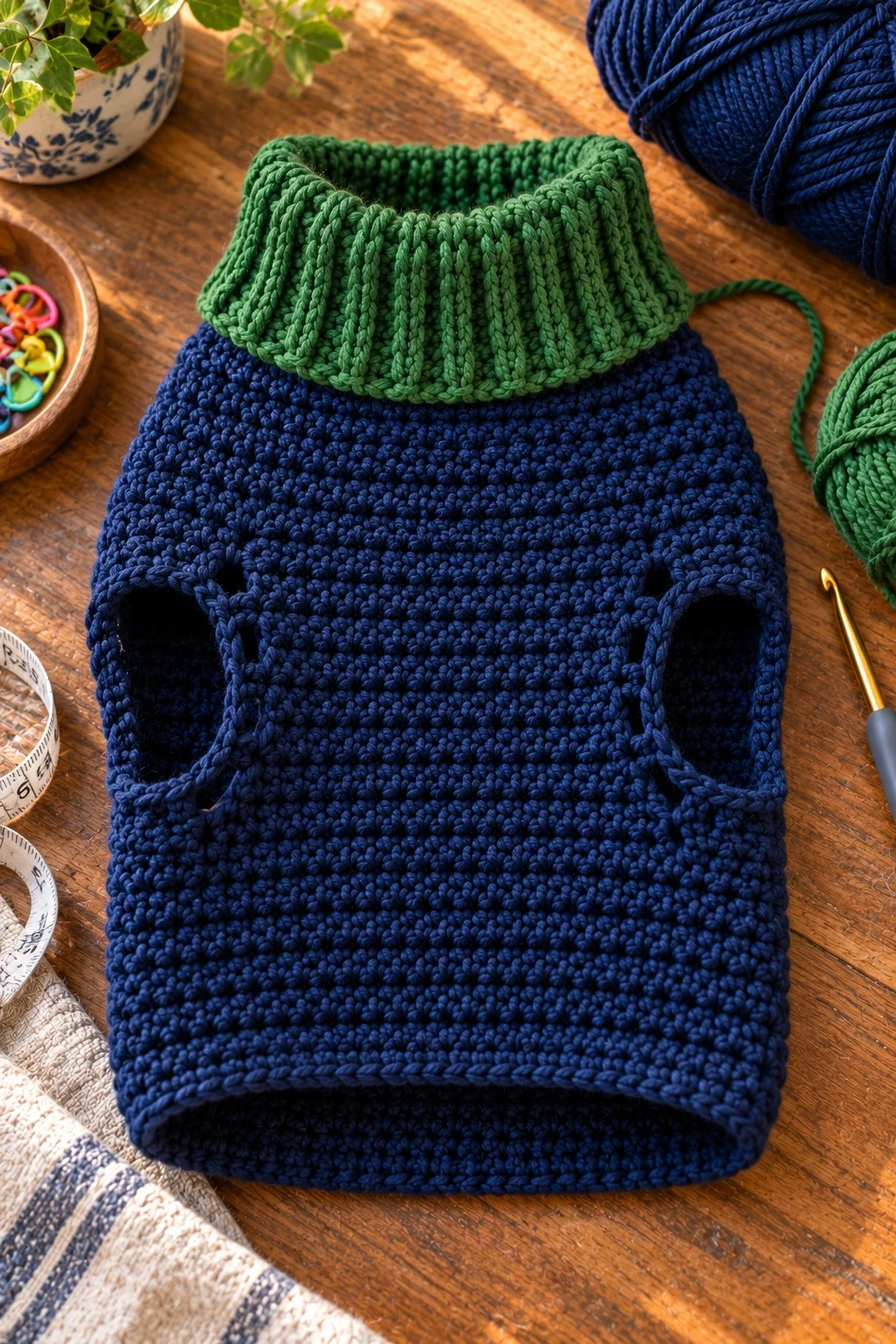
Divide Round:
- XS: Work 16 dc. Ch 6. Work 8 dc across the bottom (belly). Ch 6. Sl st to the top of the first dc of the divide round. (16 dc, 6 ch, 8 dc, 6 ch.)
- S: Work 20 dc. Ch 8. Work 12 dc. Ch 8. Sl st to the top of the first dc. (20 dc, 8 ch, 12 dc, 8 ch.)
- M: Work 26 dc. Ch 10. Work 14 dc. Ch 10. Sl st to the top of the first dc. (26 dc, 10 ch, 14 dc, 10 ch.)
- L: Work 32 dc. Ch 12. Work 16 dc. Ch 12. Sl st to the top of the first dc. (32 dc, 12 ch, 16 dc, 12 ch.)
Round 1: Work 1 dc in each dc and each ch around, closing each chain gap with a dc in each chain. (36 dc; S: 48 dc; M: 60 dc; L: 72 dc.)
Rounds 2–7 (2–9, 2–11, 2–13): Work 1 dc in each dc around. Sl st to the top of the first dc. (36 dc; S: 48 dc; M: 60 dc; L: 72 dc.)
Fasten off Color A.
Leg Cuffs
Work both leg cuffs identically.
Join Color B into the first dc of a leg opening.
Round 1: Work 1 sc in each dc around the opening. Fasten off. (12 sc; S: 16 sc; M: 20 sc; L: 24 sc.)
Round 2: Join yarn to any sc. Ch 2 (counts as first fpdc), *bpdc in next sc, fpdc in next sc* — repeat * around. Sl st to top of ch-2. (6 fpdc and 6 bpdc; S: 8 and 8; M: 10 and 10; L: 12 and 12.)
Rounds 3–4 (3–4, 3–4, 3–4): Work 1 fpdc in next fpdc, 1 bpdc in next bpdc; repeat *1 fpdc, 1 bpdc* around. Sl st to top of first fpdc. (6 fpdc and 6 bpdc; S: 8 and 8; M: 10 and 10; L: 12 and 12.)
Fasten off Color B.
Belly Band
Join Color B into the last round of the belly edge.
Round 1: Work 1 sc in each dc around. Fasten off. (36 sc; S: 48 sc; M: 60 sc; L: 72 sc.)
Round 2: Join yarn to any sc. Ch 2 (counts as first fpdc), *bpdc in next sc, fpdc in next sc* — repeat * around. Sl st to top of ch-2. (18 fpdc and 18 bpdc; S: 24 and 24; M: 30 and 30; L: 36 and 36.)
Rounds 3–5 (3–5, 3–5, 3–5): Work 1 fpdc in next fpdc, 1 bpdc in next bpdc; repeat *1 fpdc, 1 bpdc* around. Sl st to top of first fpdc. (18 fpdc and 18 bpdc; S: 24 and 24; M: 30 and 30; L: 36 and 36.)
Fasten off Color B.
Wildflower Appliqués
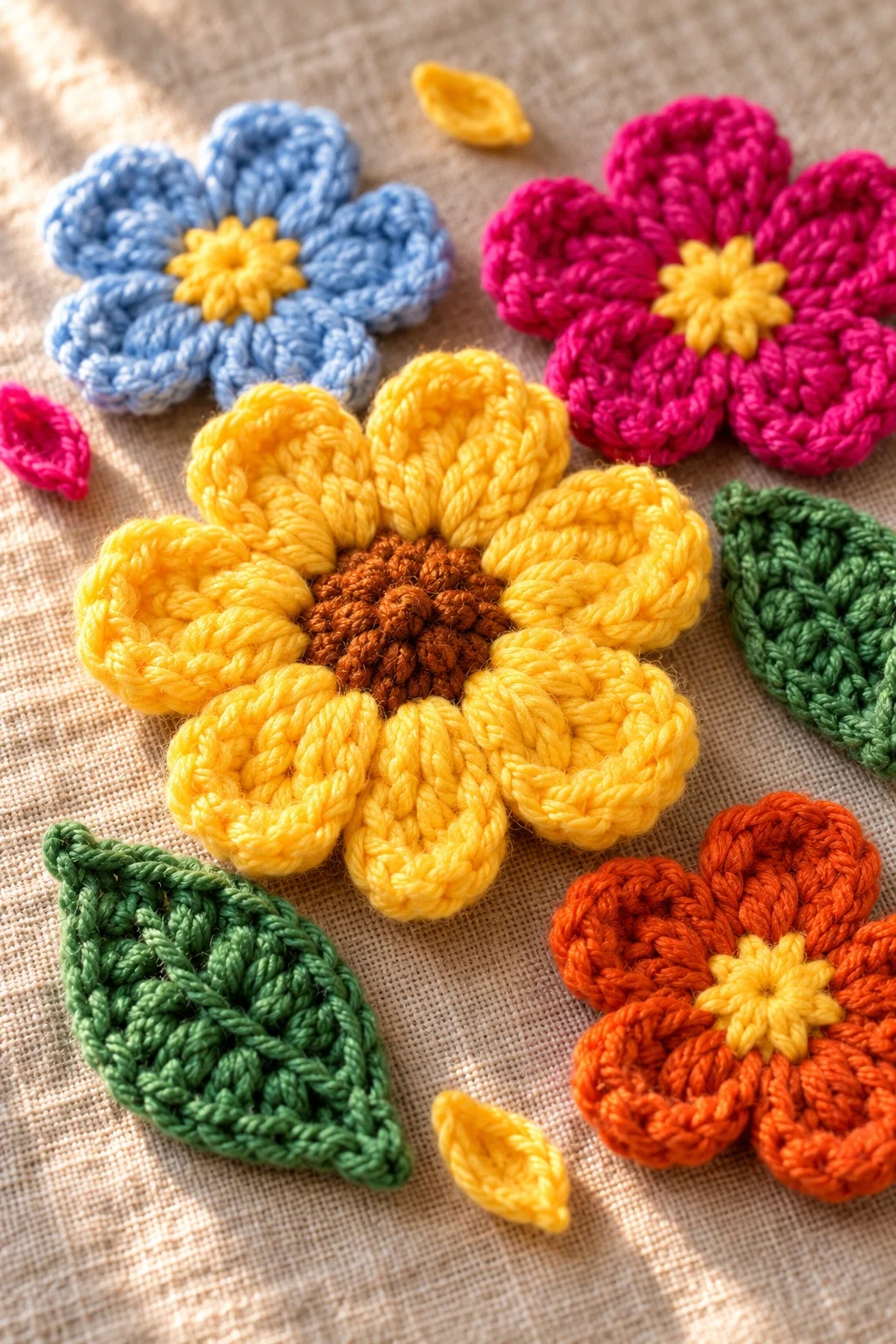
Make the flowers in mixed colors; use any letter assignment that suits your palette. For each flower, work the petals in the petal color and the center in the contrasting color, then sew the center onto the petals before attaching the finished flower to the sweater.
Daisy (petals in Color C, center in Color D):
- Petals: MR, *ch 2, 2 dc, ch 2, sl st in ring* repeat for 8 petals. Fasten off. (8 petals.)
- Center: MR, 8 sc, join with sl st. Fasten off. (8 sc.)
- Sew the center onto the petals with the yarn needle.
Layered Bloom (back layer in Color E, front layer in Color F, center in a contrasting color):
- Back layer: MR, 10 dc, sl st in first dc to join. Fasten off. (10 dc.)
- Front layer: MR, *ch 2, dc, ch 2, sl st in ring* repeat for 6 petals. Fasten off. (6 petals.)
- Center: MR, 6 sc, join with sl st. Fasten off. (6 sc.)
- Sew the front layer onto the back layer, then sew the center on top.
Simple Flower (Color D):
- MR, *ch 3, 2 tr, ch 3, sl st in ring* repeat for 5 petals. Fasten off. (5 petals.)
Make 5–7 flowers in any combination. The sample uses 6 flowers.
Leaves
Using Color B, ch 8. Work 1 sc in 2nd ch from hook, 1 hdc in next ch, 1 dc in next 2 ch, 1 hdc in next ch, 1 sc in last ch. Ch 1. Work 1 sc, 1 hdc, 1 dc, 1 dc, 1 hdc, 1 sc across the other side of the chain. Sl st in first sc to join, leaving a short tail. Fasten off.
Make 6–8 leaves.
Arranging and Sewing On
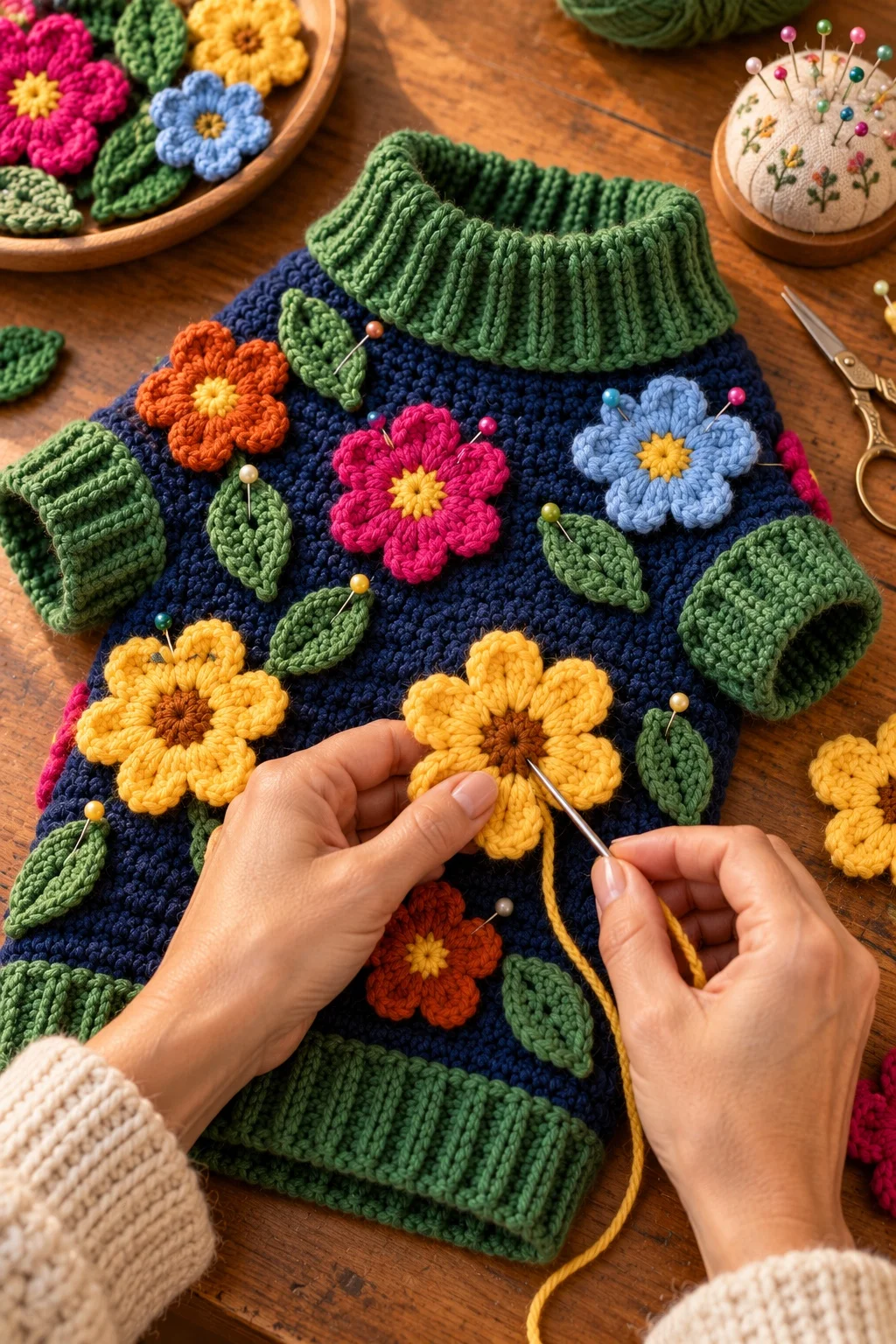
Arrange the flowers and leaves on the back and sides of the navy body, leaving the belly side free. Never place appliqués on the belly, where the dog rests against the ground.
Pin the pieces in place and try the sweater on the dog to confirm the layout before sewing. Sew each flower through its center and each leaf at its base, using Color A and a yarn needle. Use a few secure stitches per flower and leaf so the pieces stay flat and do not lift. Weave in all ends as you go.
Finishing
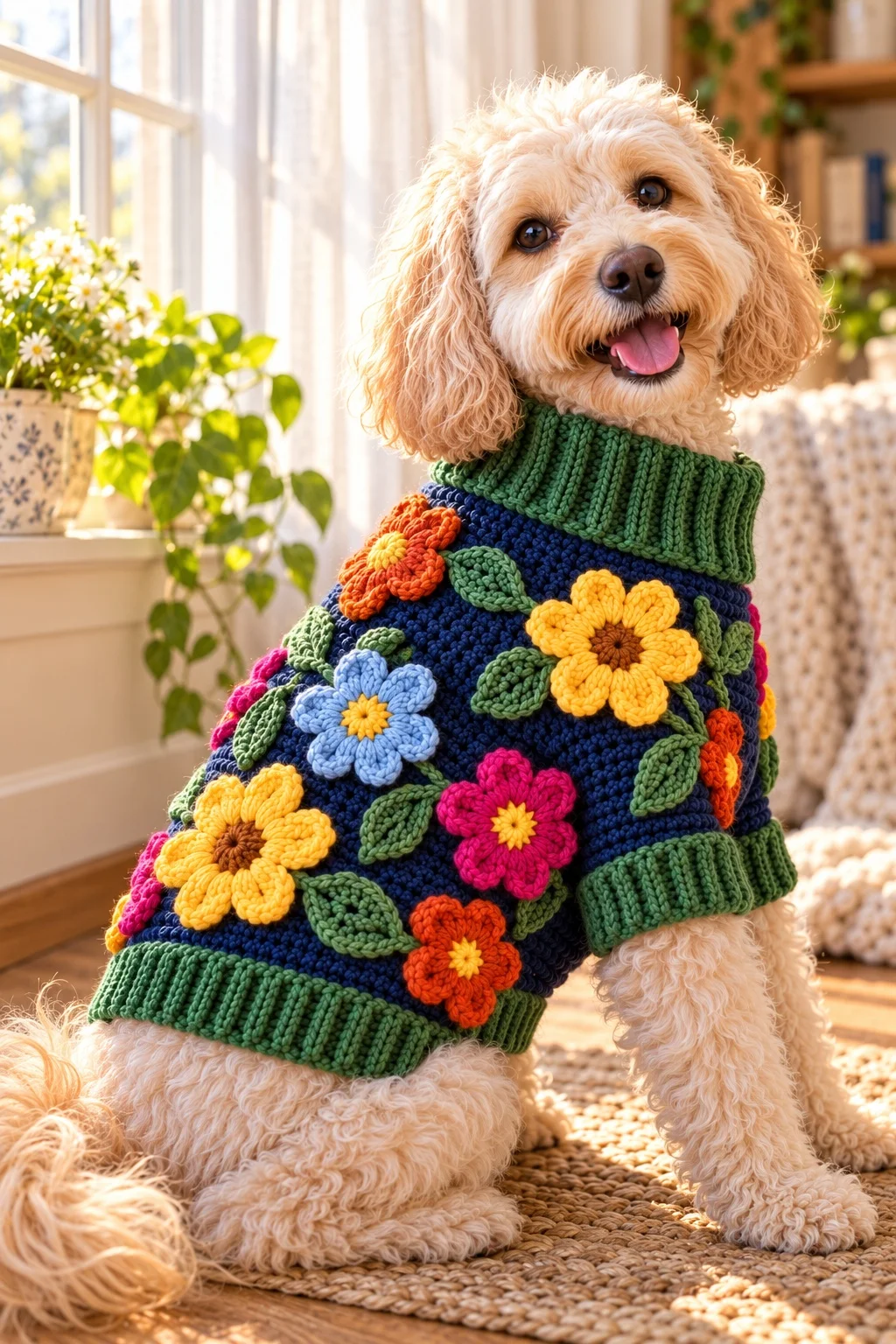
Weave in every remaining end, working tails through the backs of stitches and trimming close. Steam-block lightly (hover — never press acrylic) so the body relaxes into an even tube and the ribbing lies flat.
Arrange your flowers and leaves on the back and sides with pins, try the sweater on your dog, and adjust until the meadow looks balanced. Then sew each piece down firmly — a flower that lifts at the edge will catch on everything. Check three fit points: two fingers under the collar, leg openings just behind the front legs, belly band at mid-belly.
Customizing the Fit
Longer body: Add rounds to the body section before the belly band — each dc round adds about half an inch. Keep the flower arrangement clear of the new length.
Wider chest: Go up a hook size for the whole sweater, or add one more increase round to the yoke following the established pattern (increase 12 evenly).
Between sizes: Choose the smaller size — the ribbed collar and belly band stretch, and the flowers draw the eye, not the fit.
Flower play: This is where the sweater becomes yours. All one color for a monochrome meadow, pastels for spring, jewel tones for fall — or spell an initial in flowers down the back. The sweater construction never changes.
Frequently Asked Questions
Final Thoughts
A plain navy sweater is a fine thing. A navy sweater scattered with dimensional wildflowers is the thing strangers stop you to ask about. The appliqués are small, quick, and completely forgiving — and because they are sewn on last, you are the art director of your own meadow.
Make the sample palette stitch for stitch, or empty your scrap bag into something joyful. Either way, the math is checked and the construction is straightforward.
Happy crocheting — and save one flower for your own tote bag. You have earned it.
Izzy is an experienced ranch worker who has a passion for exploring nature and getting up close to wildlife. With her connections to various animal organizations, Izzy is well-versed in animal care and rehabilitation.