
Black GSD Training Tips Every New Owner Should Know
If you own a black German shepherd, you already know this dog turns heads everywhere it goes. But beyond that stunning all-black coat is one of the most powerful, intelligent, and driven dog breeds in the world.
That combination is exciting — and it comes with real responsibility.
Without the right training, a black GSD can develop bad habits fast. Excessive barking, leash pulling, reactivity toward strangers, and separation anxiety are all common complaints from owners who didn’t start on the right foot.
The good news? Black GSDs are among the most trainable dogs on the planet when you use the right approach. They are eager to please, highly motivated, and capable of learning over 200 commands.
This guide gives you 10 proven black GSD training tips — organized by topic — so you can raise a confident, well-behaved dog from day one.
Before You Start: Is Training a Black GSD Different?

A lot of people assume the black coat means a different dog. It doesn’t.
A black German shepherd is genetically the same as a standard tan-and-black GSD. The black color comes from a recessive gene — it affects coat color only, not temperament or behavior. You can see a full breakdown of the differences and similarities in this article on the black German shepherd vs normal German shepherd.
What does affect training is the breed’s core traits — and these apply to all GSDs, black or otherwise:
High intelligence — They pick up commands fast, but they also pick up your inconsistencies just as fast.
Emotional sensitivity — They shut down under harsh training. Yelling or physical correction makes them anxious, not obedient.
Strong protective drive — They need clear guidance on what is a real threat and what isn’t. Without it, they guard against everything and everyone.
Slow maturity — Black GSDs can take up to 3 years to fully mature. Patience is not optional here.
Understanding these traits is the foundation everything else builds on. Now let’s get into the tips.
Tip 1: Start Training the Day They Come Home
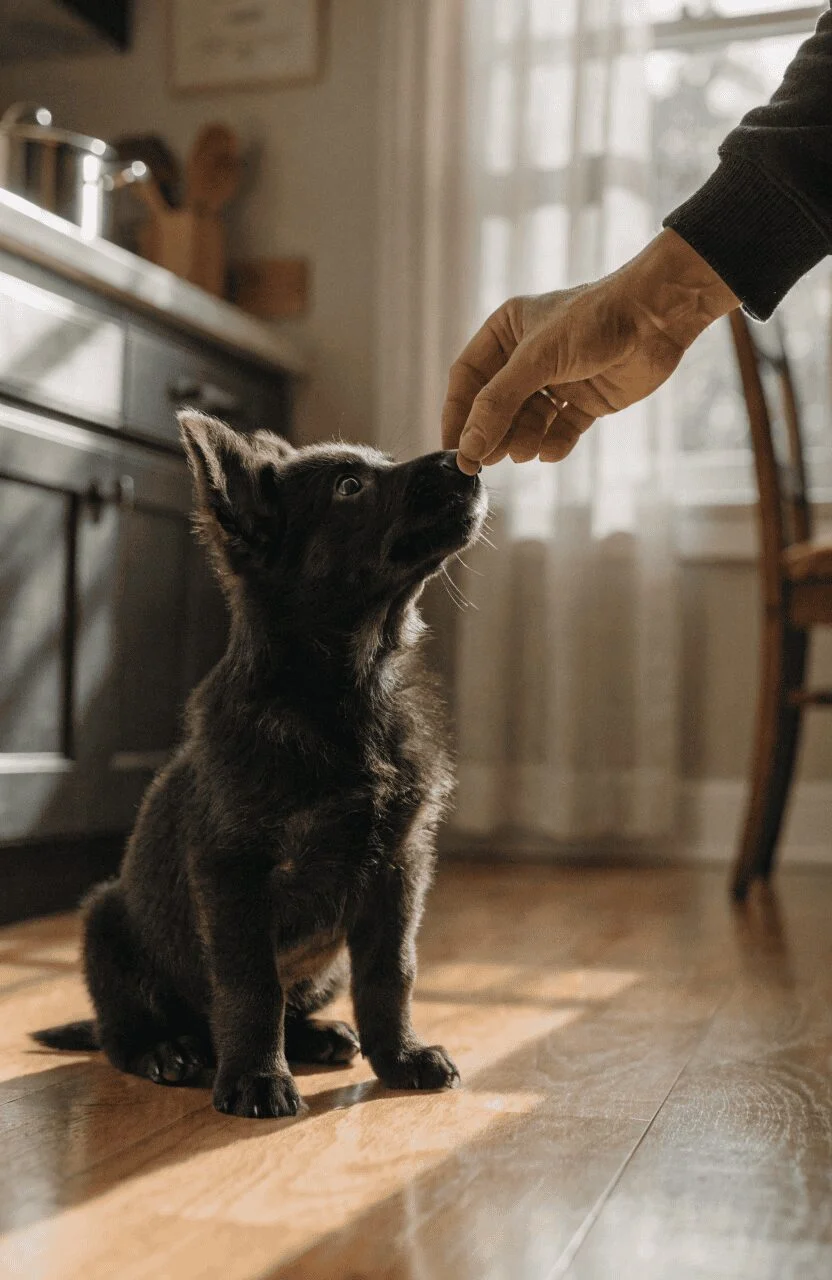
Most owners wait until their black GSD puppy is 4 to 6 months old before starting any real training. That is too late.
A puppy’s brain is most absorbent between 8 and 16 weeks of age. Every experience during this window shapes how they see the world for the rest of their life. If you wait, you miss the easiest and most powerful learning phase this dog will ever go through.
Start simple on day one. Teach your puppy their name — say it once in a cheerful tone and reward them when they look at you. That is training. Within the first week, you can introduce “sit.” Keep each session to just 3 to 5 minutes. Young puppies have very short attention spans, and a frustrated puppy learns nothing useful.
The rule here is simple: training starts the moment your dog walks through your door.
For a broader look at getting your puppy off to the right start, these essential puppy training tips are worth reading before you begin.
Tip 2: Use Positive Reinforcement — Always
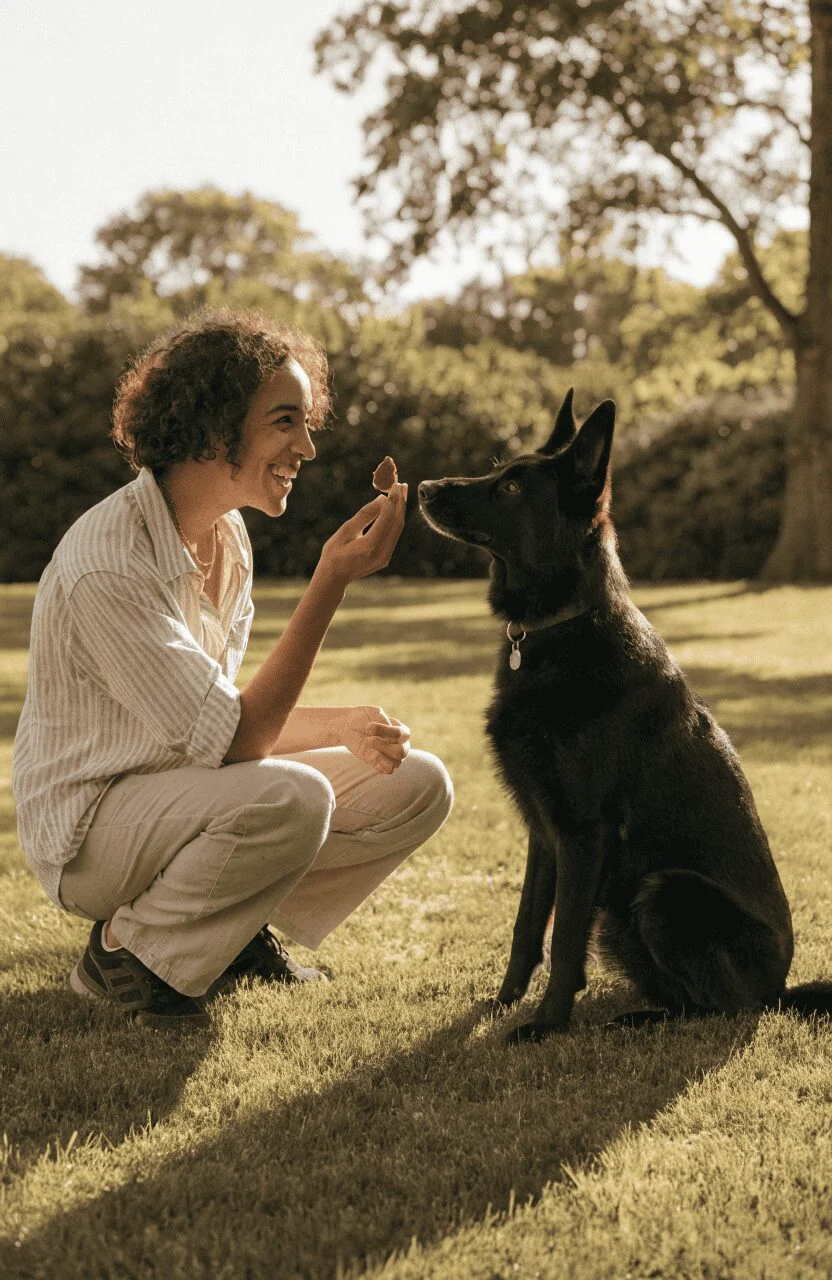
This is the single most important rule in black German shepherd training tips, so it deserves its own section.
Positive reinforcement means rewarding the behavior you want so your dog repeats it. The reward can be food, praise, or play — whatever your specific dog finds most motivating. For most black GSDs, small pieces of high-value food work best.
Here is why punishment-based training fails with this breed specifically:
Black GSDs are emotionally sensitive dogs. When you yell at them, jerk the leash hard, or use physical correction, they do not think “I need to behave better.” They think “my owner is a source of stress.” That reaction leads to anxiety, distrust, and in some cases, defensive aggression — the opposite of what you want.
Positive reinforcement creates a dog who actively wants to work with you — not one who obeys only because they fear what happens if they don’t.
The research supports this too. Reward-based training consistently produces faster learning, longer-lasting behavior change, and a stronger bond between dog and owner. For a detailed comparison of methods, this article on positive reinforcement vs traditional dog training breaks it down clearly.
The practical rule: The moment the correct behavior happens, mark it with a “yes!” or a clicker, then deliver the reward within 2 seconds. Timing is everything in dog training.
Tip 3: Teach Calmness as a Skill

Most training guides focus entirely on commands — sit, stay, come. But for a high-drive breed like the black GSD, one of the most valuable things you can teach them is how to simply be calm.
Black German shepherds have enormous energy reserves. If you only channel that energy into activity, you end up with a dog who is always “on” — constantly alert, restless, and difficult to settle even when there is nothing going on.
Teaching calmness is simpler than it sounds:
- Watch for a moment when your dog naturally relaxes or lies down on their own.
- The instant they are calm, quietly reward them — a soft voice and a slow treat delivery works better than excited praise here.
- Repeat this across many different settings throughout the day.
Over time, your dog learns that being calm earns rewards just like sitting or staying does. You can also formalize this with a “place” command — teaching your dog to go to a specific mat or bed and settle there on cue. This becomes one of your most useful real-world tools, especially when guests arrive or you are in a public space.
Tip 4: Socialize During the Critical Window
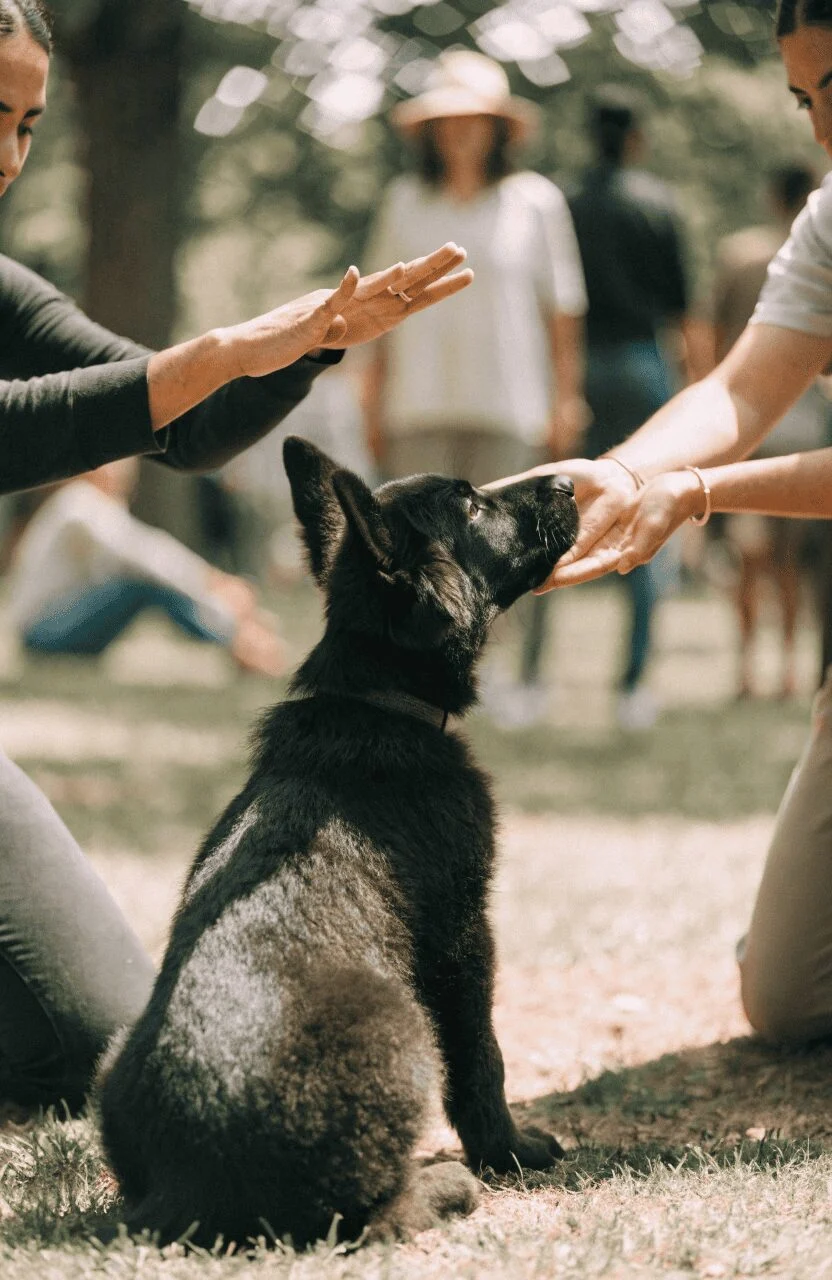
Here is something every black GSD owner needs to know: the critical socialization window closes around 14 to 16 weeks of age.
After that point, introducing your dog to new experiences becomes significantly harder. Dogs who miss this window often grow up fearful, reactive, or overly suspicious of anything unfamiliar — and for a breed as powerful as the black GSD, that creates real problems down the road.
Proper socialization is not just “letting your dog meet people.” It is a deliberate process of exposing your puppy to a wide variety of experiences while keeping everything positive and low-pressure.
Here is a basic checklist to work through before 16 weeks:
People: Men, women, children, people with hats or hoods, people in uniforms, people with beards
Sounds: Traffic, thunder recordings, vacuums, doorbells, crowds, babies crying
Surfaces: Grass, gravel, tile floors, metal grates, wooden stairs
Animals: Friendly adult dogs (vaccinated), cats if possible, other household pets
Environments: Cars, parks, pet stores, parking lots, anywhere safe and new
Keep every exposure short and relaxed. If your puppy shows fear — tucked tail, flattened ears, trying to back away — do not push them forward. Reduce the intensity and approach again more slowly next time.
Under-socialized black GSDs tend to see the world as a threat. Well-socialized ones are confident, friendly, and far easier to manage in every situation. For more on what makes this breed unique at a deeper level, check out these black German shepherd facts.
Tip 5: Master These 5 Core Commands First
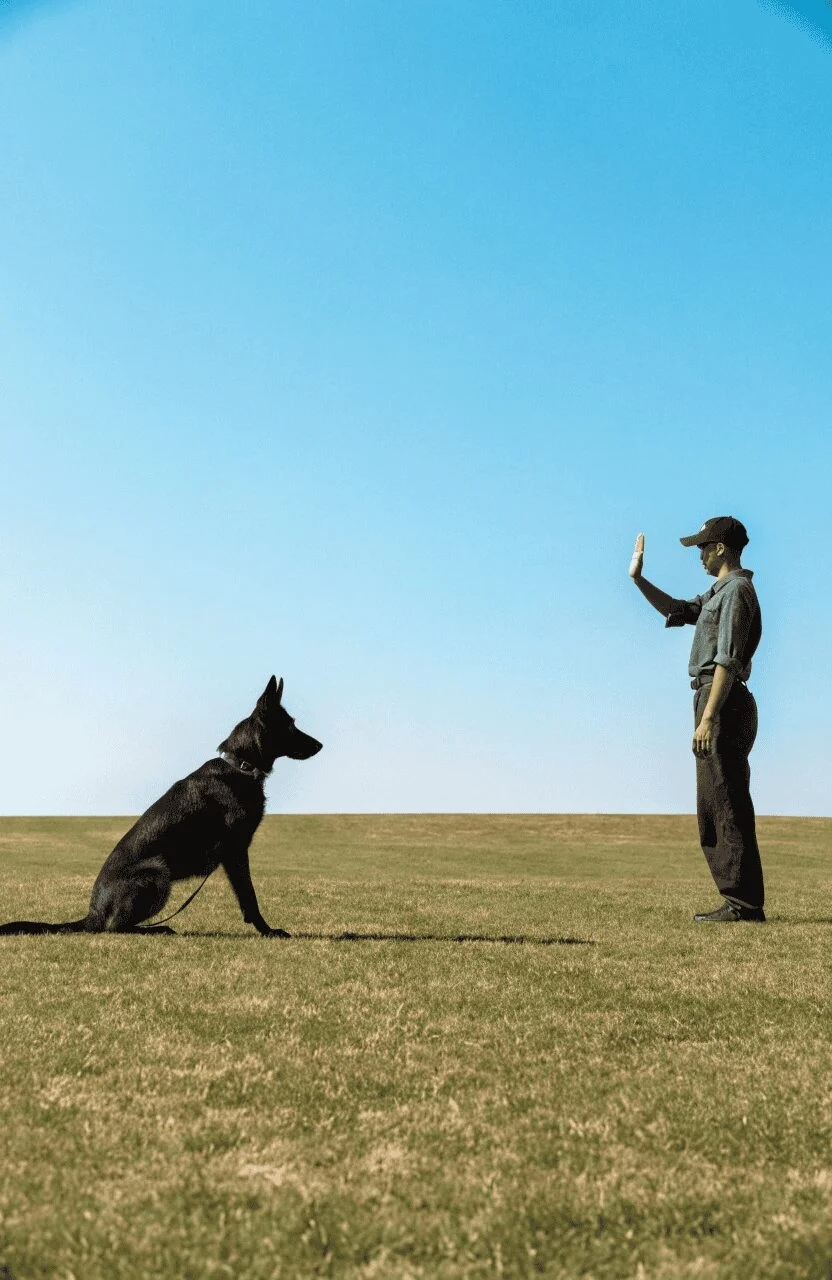
Every black GSD needs a foundation of reliable commands before anything else. These five are the building blocks for every skill that comes after.
Sit
Hold a treat just above your dog’s nose and slowly move it back over their head. As their nose follows the treat upward, their bottom naturally drops down. The moment it touches the floor, say “sit,” mark with “yes,” and reward. Practice in short bursts of 5 to 10 repetitions per session.
Stay
Ask your dog to sit. Open your palm toward them and say “stay.” Take one step back. If they hold position for even 2 seconds, return to them and reward. Build duration and distance very gradually over many sessions. Never increase both at the same time.
Come
Crouch down to your dog’s level, open your arms wide, and say “come” in the most enthusiastic tone you can manage. When they reach you, reward generously — this should feel like the best thing that ever happens to them. A reliable recall is a safety skill and deserves your strongest rewards.
Heel
Start walking with your dog on your left side. The moment they surge ahead or drift behind, stop completely and stand still. When they return to your side and release the tension on the leash, mark and reward, then resume walking. Repetition teaches them that staying in position is what keeps the walk going.
Leave It
Hold a treat in your closed fist and present it to your dog. They will sniff, paw, and lick your hand. Wait them out. The moment they pull their nose away, say “leave it,” mark, and reward from your other hand. This command manages prey drive and keeps your dog safe from picking up dangerous things.
Tip 6: Keep Sessions Short and Frequent
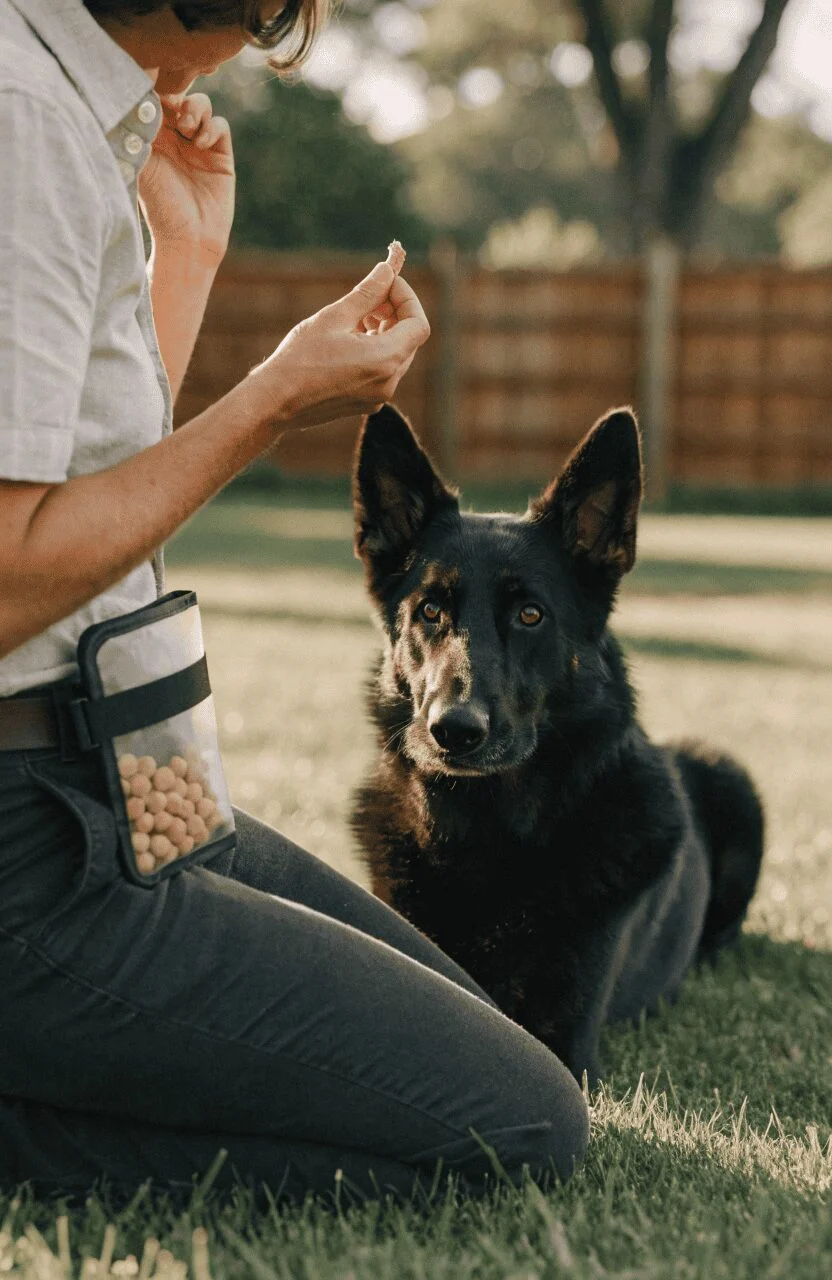
Long training sessions are one of the most common mistakes black GSD owners make.
Ten minutes of focused, engaged training produces far better results than an hour of going through the motions. After about 10 to 15 minutes, your dog’s focus drops off significantly — and anything practiced in a distracted state just reinforces distraction.
A practical daily schedule looks like this:
- 2 to 3 sessions per day
- 5 to 15 minutes each session
- Always end on a successful note — finish with a command your dog knows well so they end the session feeling confident
This is especially important with puppies under 6 months. Young black GSDs have rapidly developing brains, but they also hit mental fatigue much faster than adult dogs. Short and frequent keeps momentum going without burning them out.
Tip 7: Give Their Brain a Real Workout Every Day
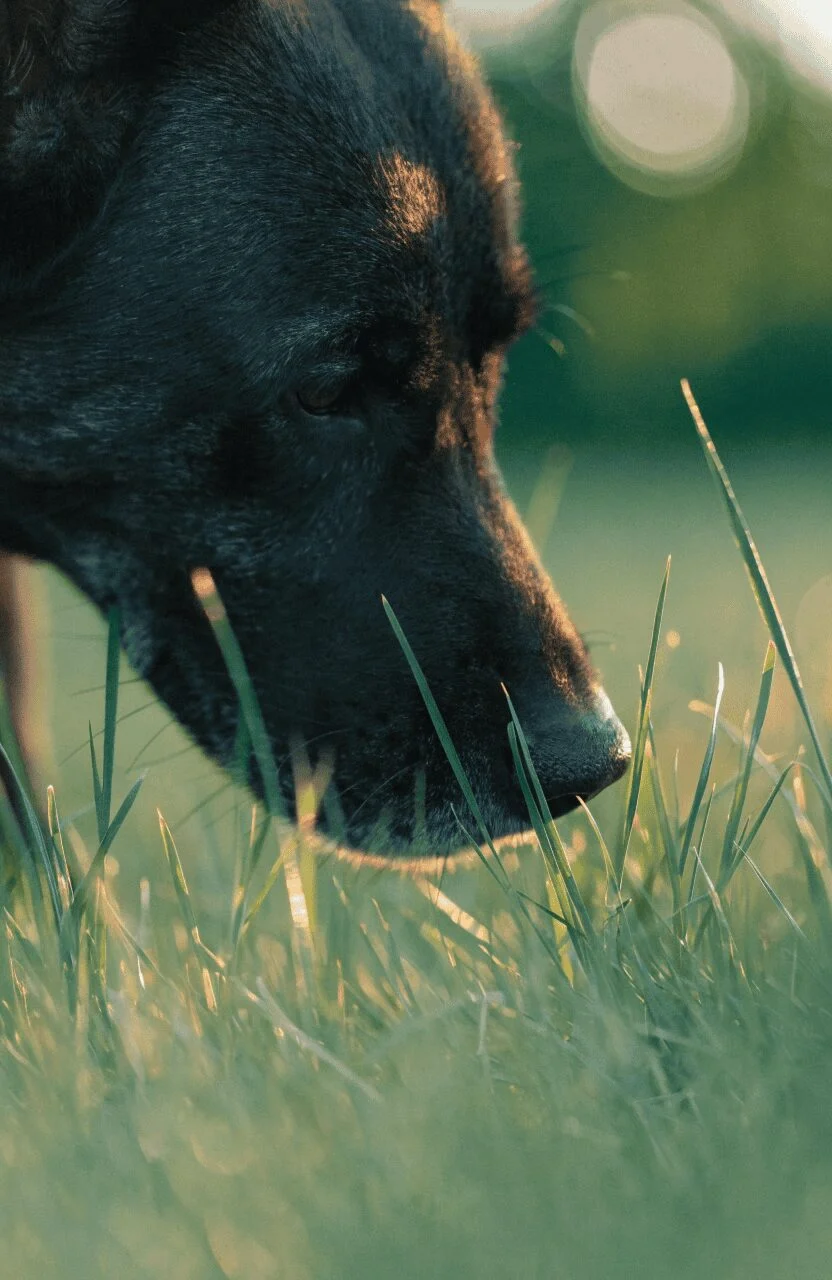
A physically tired black GSD is a good dog. A mentally tired black GSD is a great dog.
This breed was built to think and work. For generations, black German shepherds have served as police dogs, military dogs, search and rescue workers, and personal protection dogs — not just because of their size, but because of their mental capability.
If you only exercise their body and neglect their mind, you get a dog who is physically tired but still restless, still destructive, and still difficult to settle.
Here are practical ways to add mental work to your daily routine:
Nose work: Hide a treat or a toy somewhere in your home and let your dog use their nose to find it. Start easy and build complexity over time. This single activity can mentally exhaust a black GSD faster than a two-mile run.
Puzzle feeders: Kong-style toys stuffed with frozen food, snuffle mats, and lick pads all turn mealtimes into mental exercise.
Learning new skills: Teaching your dog something new — even a fun trick like “spin” or “touch” — is one of the most effective forms of mental stimulation you can offer.
Varied walks: Exploring new routes, letting your dog sniff freely for stretches of the walk, and mixing in obedience cues during the walk all add a mental dimension to physical exercise.
Even 15 minutes of nose work or puzzle time per day can take the edge off a high-drive black GSD and make the rest of your day much more manageable.
Tip 8: Crate Train From Week One

Crate training is not cruel. For a black GSD, it is genuinely one of the kindest foundations you can give them.
A well-introduced crate becomes your dog’s safe space — a quiet, den-like area where they can rest, decompress, and feel secure on their own. It also prevents destructive behavior during unsupervised time and speeds up potty training by using your puppy’s natural instinct to avoid soiling where they sleep.
Here is how to introduce the crate without stress:
- Place the crate in a busy room where your dog can still see family activity.
- Leave the door open and toss treats and meals inside throughout the day. Let your dog explore completely on their own terms.
- Once your dog is going in and out willingly, begin closing the door for 1 to 2 minutes at a time while you stay in the room.
- Slowly build up duration over several days before leaving them alone in it.
Never use the crate as punishment. Never force your dog inside. And never leave a puppy crated longer than their age in months plus one hour — so a 3-month-old puppy should not be crated longer than 4 hours at a stretch.
Tip 9: Proof Commands in New Environments
Here is something most guides skip: a dog who performs “sit” perfectly in your kitchen does not automatically know “sit” in a park full of distractions.
Dogs don’t generalize commands the way humans do. From your dog’s perspective, “sit” at home and “sit” next to a playground full of running kids are almost completely different experiences. This gap between knowing a command and reliably following it anywhere is one of the biggest frustrations black GSD owners face.
The solution is called proofing — and it is what separates a dog who sometimes listens from one who always listens.
To proof any command:
- Once your dog knows it reliably at home, practice in a slightly more distracting location.
- Drop your success expectations — 50% correct in a new environment is completely normal at first.
- Build the success rate back up to 80 or 90% before adding more distraction or distance.
- Progressively increase the challenge: busier locations, more noise, more people nearby, greater distance from you.
Being proactive about proofing is far easier than trying to fix a dog who has learned that commands are optional outside the house. This article on proactivity vs passivity in dog training explains exactly why getting ahead of problems always beats trying to fix them later.
Tip 10: Address Problem Behaviors the Moment They Appear
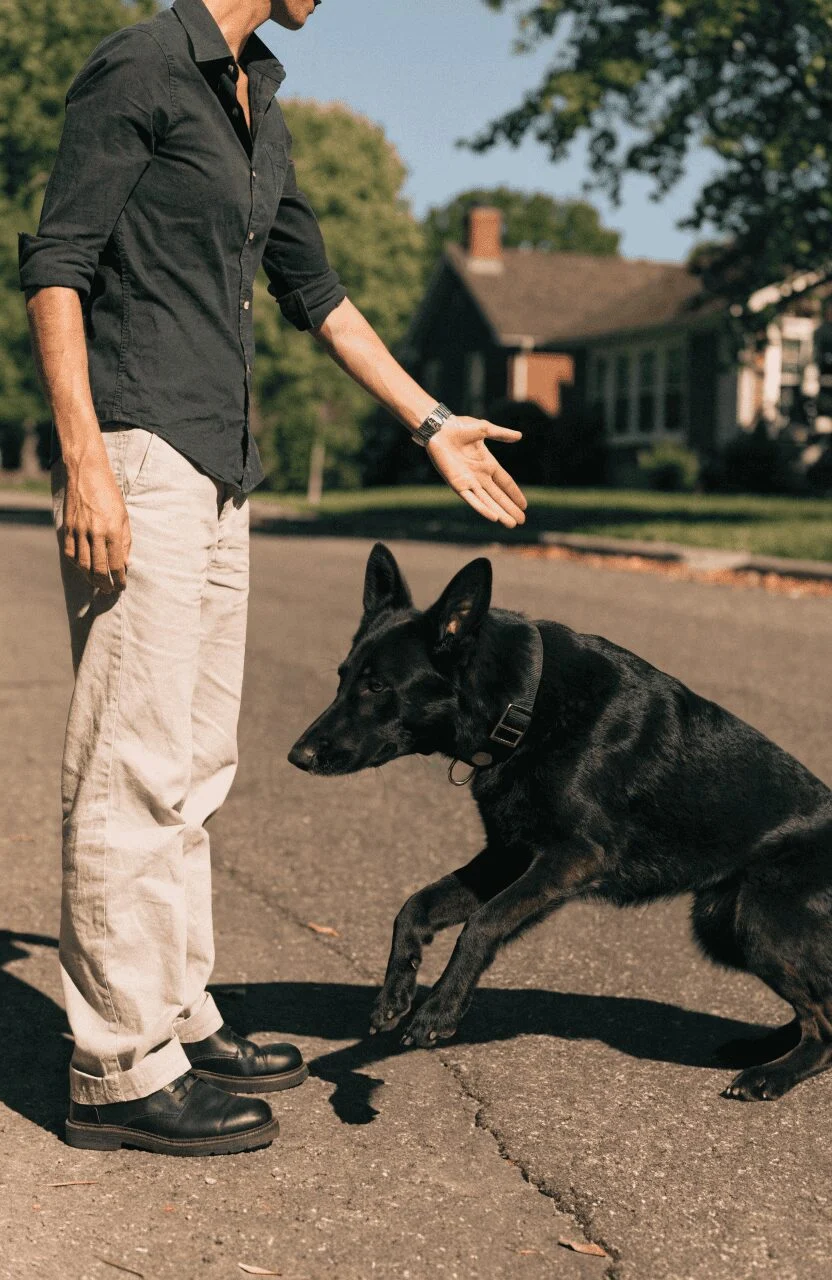
With black German shepherds, small problems rarely stay small.
A puppy who nips because it looks cute becomes a 90-pound adult who bites. A dog who barks at every guest becomes one you cannot trust when people visit. The earlier you address these behaviors, the easier they are to resolve.
Here is a quick, practical approach to the four most common issues:
Leash Pulling
Stop walking the instant your dog pulls. Stand completely still. When they come back to your side or release the leash tension, mark and reward, then resume walking. Every single step you take while being pulled teaches your dog that pulling works.
Nipping and Mouthing
When your puppy bites down, give a sharp, clear “ouch” and immediately stop all interaction for 30 seconds — turn away, go still, cross your arms. Then re-engage calmly. Repeat this every single time without exception. Puppies learn bite inhibition through consistent social feedback, not through fear.
Barking at Strangers
Shouting “no” or “quiet” does not work — to your dog, you are just barking alongside them. Instead, redirect to a calm behavior like “sit” or “place,” wait for silence, then reward the quiet. Over time, pair the arrival of new people with treats so your dog learns that strangers predict good things, not threats.
Separation Anxiety
Build alone time gradually from day one. Even if you work from home, have your dog spend short periods alone in another room or crate. Keep your arrivals and departures low-key — no dramatic goodbyes or big excited greetings. For a dog already showing significant anxiety, a structured desensitization program with a qualified trainer is the most reliable path forward.
When to Bring in a Professional Trainer

There is no shame in working with a trainer. Even experienced dog owners do it.
Consider professional help if your black GSD is showing aggression toward people or other animals, is unable to be left alone without destructive behavior or panic, remains reactive on leash despite consistent work, or is over 6 months old with very little prior training or socialization.
When choosing a trainer, look for someone who has specific experience with working breeds and uses methods that are clear, consistent, and humane. Avoid anyone who relies on intimidation, choke chains, or punishment as their primary tools — these approaches tend to backfire badly with the emotionally sensitive black GSD.
Final Thoughts on Black GSD Training Tips
Training a black German shepherd is one of the most rewarding things you will ever do as a dog owner.
This is not a breed that is happy sitting on the couch all day. The black GSD wants to work with you, learn from you, and play a genuine role in your daily life. Give them clear rules, consistent training, real mental challenges, and thorough early socialization — and you will end up with a dog that is confident, loyal, and genuinely a pleasure to live with.
The most important black German shepherd training tip of all is simply this: start today.
Not next week. Not when they are a little older. Today — because every single day without training is a day your dog is learning something on their own, and it may not be what you want them to learn.
Be patient, stay consistent, and enjoy the process. The black GSD you are working toward is absolutely worth it.

Izzy is an experienced ranch worker who has a passion for exploring nature and getting up close to wildlife. With her connections to various animal organizations, Izzy is well-versed in animal care and rehabilitation.