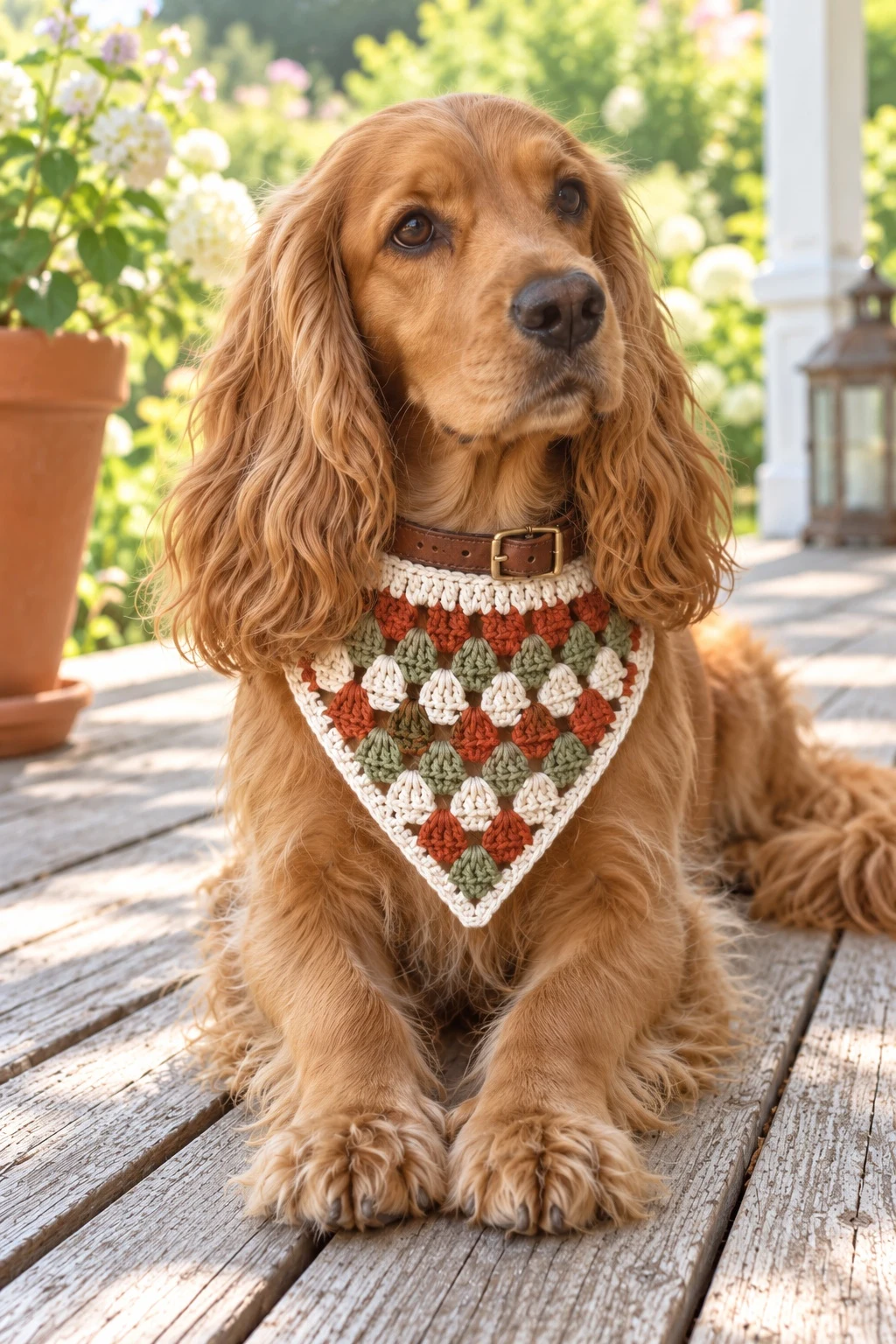
Slide-On Crochet Bandana for Dogs — Over-the-Collar & Easy
There is something quietly satisfying about a dog accessory that just works. No knots to re-tie after every walk, no ribbon flapping loose at the back of the neck, no bow slowly rotating under the chin. A slide-on bandana simply threads onto the collar your dog already wears and settles into place — you can put it on with one hand while the other holds the leash.
The collar channel is built right into the fabric. Instead of sewing loops onto a finished triangle, this pattern works a short cream band first, grows the granny-stitch triangle out of it, then folds the band to the back and stitches it closed to form a soft channel. The collar slides through like a sleeve. Nothing to snag, nothing to chew off, nothing tied.
And the stitch is where the charm lands: classic granny clusters in rust, sage, and cream, worked in straight rows that narrow by one cluster at a time until the triangle fans down to a single cluster at the point. It looks handmade in the best way — sun-warmed, a little nostalgic, and endlessly giftable.
It is also a kind project for your yarn shelf. Each color needs well under a hundred yards, the whole bandana works up from leftovers of three balls, and the most complicated moment in the entire pattern is remembering which color comes next in the rotation. If you are looking for a first granny project that ends as something a dog actually wears every day, this is the one.
Why Slide-On Beats Tie-On
First, comfort and safety. A tied bandana parks a knot somewhere around the neck — a lump for the dog to rub against, a loop a paw or leash clip can catch, and a fit that shifts every time the dog turns its head. The slide-on channel has none of that: nothing tied, nothing knotted, nothing loose. The fabric just rides the collar and spreads its (tiny) weight evenly.
Second, it stays put and stays centered. Because the channel is a fixed tube sized to the collar itself, the bandana cannot rotate around the neck, slide sideways, or bunch up the way a tied one does. The point hangs where you placed it, through wags, head turns, and park zigzags. Owners of tie-shredders will appreciate the corollary: there is no knot presented at the back of the neck like an invitation, and nothing dangling at the front to be chewed during a quiet moment in the car.
Third, it is fast to make and fast to gift. One repeated row does nearly all the work, and the finish is a single fold-and-stitch. A beginner can finish one in an evening, and gifting needs no size-matching ceremony — hand it over and say, “it goes on your pup’s collar.” If you enjoy this construction, the Cozy Waves Bandana and the Snowman Bandana are equally quick wins.
Color Palette Ideas
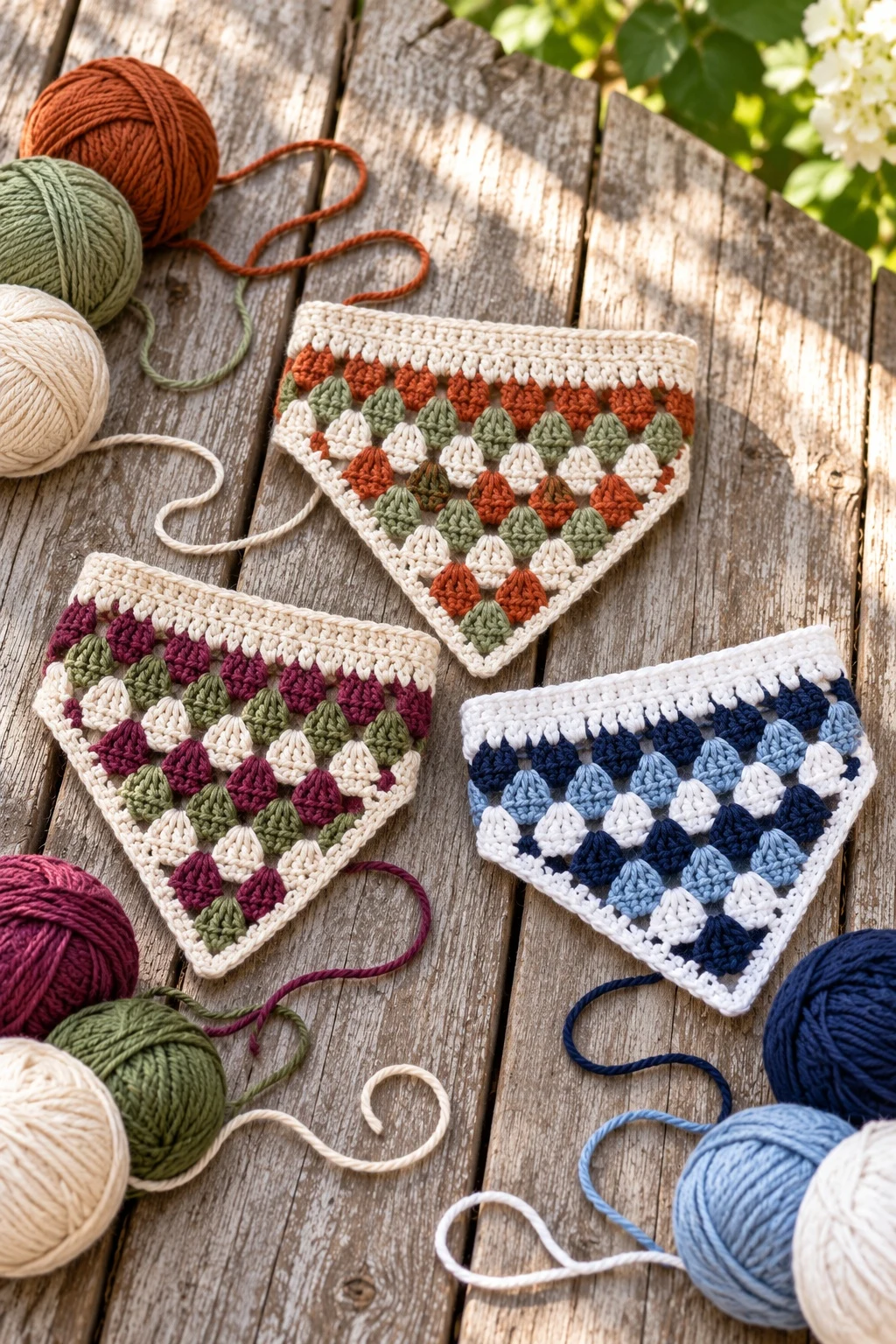
The photo bandana runs rust, sage, and cream in rotation, with a cream channel and edging to frame it. The three-color rotation takes new palettes beautifully — keep one pale shade (cream, ivory, white) in every set; it is the breathing room that makes the other two colors sing.
Rustic Autumn
Rust, sage green, and cream — the photo palette. Warm and earthy, it flatters every coat from black to blonde and suits the whole fall season.
Berry Meadow
Berry plum, leaf green, and ivory. Richer and moodier than the original, gorgeous on grey and silver coats, and lovely for late-summer photos.
Ocean Breeze
Deep navy, sky blue, and white. Crisp and coastal — the seaside version, bright against dark coats and made for beach-walk pictures.
Blush Garden
Dusty blush, rose, and ivory. The soft spring set — gentle on white and cream coats, and sweet for garden-party and Easter photos.
Before You Get Started
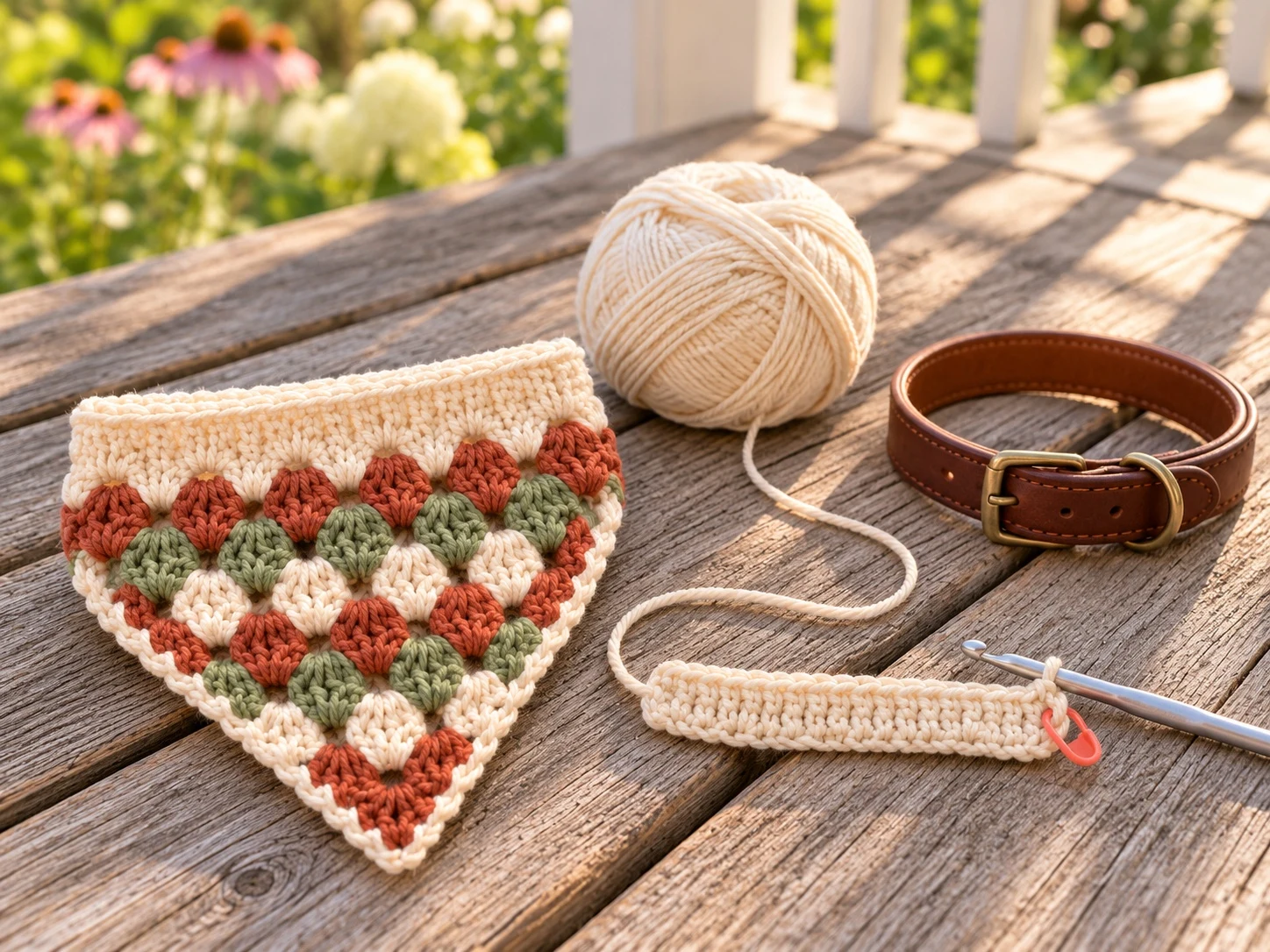
The construction runs in three clean phases. You begin with the collar channel — a short cream band of three double-crochet rows. Then you work the granny body directly into that band, dropping one cluster every row until a single cluster remains at the point. Finally you finish by edging the slanted sides, folding the channel rows to the back, stitching the edge down to form the tube, and threading the collar through. Everything the world sees from the front is the granny triangle; the channel lives quietly behind it.
Skill-wise the project is gentle: chains, double crochet, single crochet for the edging, and skipping stitches. If you can make a granny square, you already own this stitch. The Frog Snood and the Bunny Snood are similarly approachable first dog pieces.
Sizing starts with the collar on your dog’s neck right now, not a breed chart: unclip it, lay it flat, and measure its full length including the buckle. That number picks your size. For yarn, worsted (4) acrylic is the sweet spot: clean stitch definition in all three colors, forgiving for a first granny project, machine-washable, and easy to find in exactly the rust, sage, and cream you want. A cotton or cotton blend works too, with a slightly crisper drape.
Fit & comfort check: the bandana rides on the collar, so the collar’s own rules still apply — you should be able to slide two fingers under the collar at all times. Choose the size whose point hangs clear of the ground and the paws; if it brushes, size up or work fewer rows.
Safety notes: slide the bandana off for rough play, swimming, and unsupervised time, the same as any fabric accessory. Check the channel stitching now and then, and re-secure any loose thread before it becomes interesting to a curious mouth.
Tools & Materials Needed
Yarn
- Worsted-weight (#4) acrylic or acrylic-blend yarn, soft and machine-washable.
- Rust (terracotta): approx 60 (75, 90) yd for sizes S (M, L)
- Sage green: approx 50 (60, 75) yd
- Cream: approx 70 (85, 100) yd
Hook & Notions
- US H-8 (5.0 mm) crochet hook, or size needed to obtain gauge
- Yarn needle with a large eye, scissors, flexible tape measure
- 2 stitch markers, and your dog’s own collar for threading and fit checks
Size Info and Gauge
S
Collar/neck: 10–12″
Finished: 8.5″ wide × 7.5″ deep
Chihuahuas, Dachshunds, small terriers
M
Collar/neck: 13–15″
Finished: 10.5″ wide × 9.5″ deep
Beagles, Boston Terriers, French Bulldogs
L
Collar/neck: 16–18″
Finished: 12.5″ wide × 11″ deep
Spaniels, Basset Hounds, Corgis
Gauge: 13 dc × 7 rows = 4″ in double crochet. Each granny row adds about 0.8″ of depth — row count is your depth dial.
Sizes are written S (M, L) throughout. Measure the collar your dog actually wears, not just the neck: the channel must be a little shorter than the collar so the buckle and D-ring stay clear of the fabric. The finished depth is measured from the top of the folded channel to the point.
Abbreviations (US Terms)
ch chain · sc single crochet · dc double crochet · sl st slip stitch · st(s) stitch(es) · sk skip · rep repeat
Pattern Notes
Construction order: collar channel, granny body, edging, then fold and stitch the channel.
Color rotation: the channel is all cream. The granny rows rotate Rust, Sage, Cream — repeat the three-color cycle all the way to the point.
Counting clusters: one cluster = 3 dc in one stitch (or one space). Count clusters at the end of every row; the count must drop by exactly one each row.
The decrease: each new row works its clusters into the spaces between the previous row’s clusters, skipping the first and last space. Nothing fancier is happening — the triangle narrows itself.
Channel fold: the three cream channel rows fold to the back at the very end and are whipstitched down, so do not work them too tightly — a relaxed band folds and stitches more neatly.
Color-change ends: carry the yarn tails down the slanted edge as you go, or weave them in before edging — the cream edging covers the edge either way, so no ends ever show on the front.
Pattern Instructions
Collar Channel
With cream, ch 30 (36, 42).
- Row 1: Dc in the 4th ch from the hook and in each ch across, turn. (27, 33, 39 dc)
- Rows 2–3: Ch 2 (does not count as a st), dc in each st across, turn. (27, 33, 39 dc)
Fasten off. This band folds to the back at finishing to become the collar casing.
Granny Body
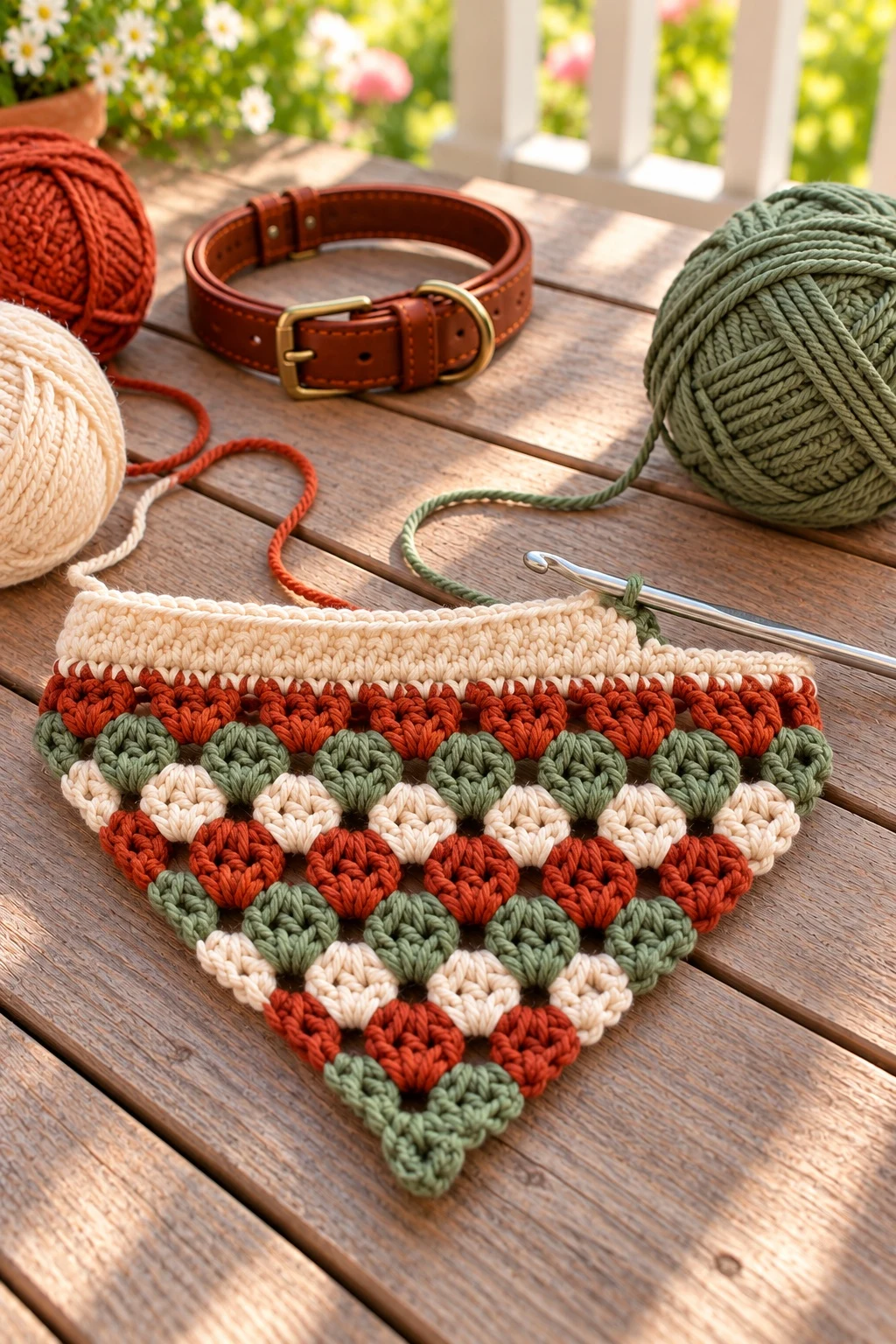
A cluster = 3 dc. Colors rotate Rust, Sage, Cream — Row 1 is Rust, Row 2 is Sage, Row 3 is Cream, then Rust again, and so on to the point.
- Row 1 (Rust): Join rust in the first st of the channel’s last row. Ch 3 (counts as dc), sk 1 st, *3 dc in the next st, sk 2 sts; rep from * across, dc in the last st, turn. (8, 10, 12 clusters)
- Row 2 (Sage): Ch 3 (counts as dc), work 3 dc in each space between the clusters of the previous row, SKIPPING the first and last space, dc in the last st, turn. (7, 9, 11 clusters)
- Rows 3+: Repeat Row 2, following the color rotation, until only 1 cluster remains. Size S works 8 rows in total (8, 7, 6, 5, 4, 3, 2, 1 clusters); size M works 10 rows (10 down to 1); size L works 12 rows (12 down to 1).
Fasten off and weave in the color-change ends along the edges — the edging will cover them.
Edging
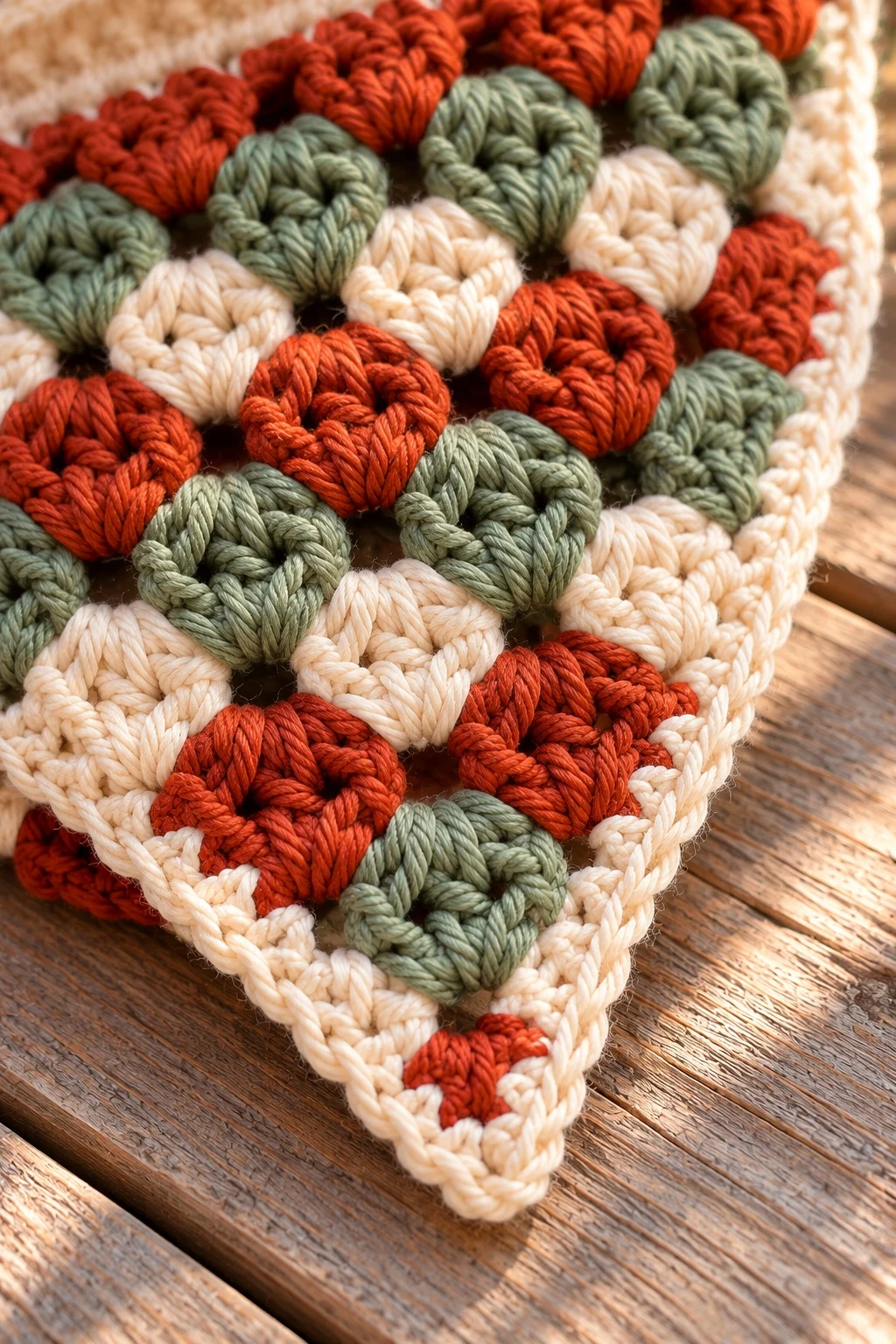
- With cream, join yarn at one top corner of the triangle. Work sc evenly down the slanted side, work 3 sc into the single point cluster, then sc evenly up the other slanted side to the top corner. Fasten off and weave in the ends.
Finishing and Threading the Collar
- Fold the three cream channel rows to the BACK of the bandana so the foundation edge meets the back of Granny Row 1.
- With cream and the yarn needle, whipstitch the foundation edge to the back of Granny Row 1 across the full width, closing the tube — this is the collar casing. Fasten off and weave in the end.
- Thread your dog’s collar through the casing, buckle it on as usual, and center the bandana so the point hangs at the front of the chest.
Finishing
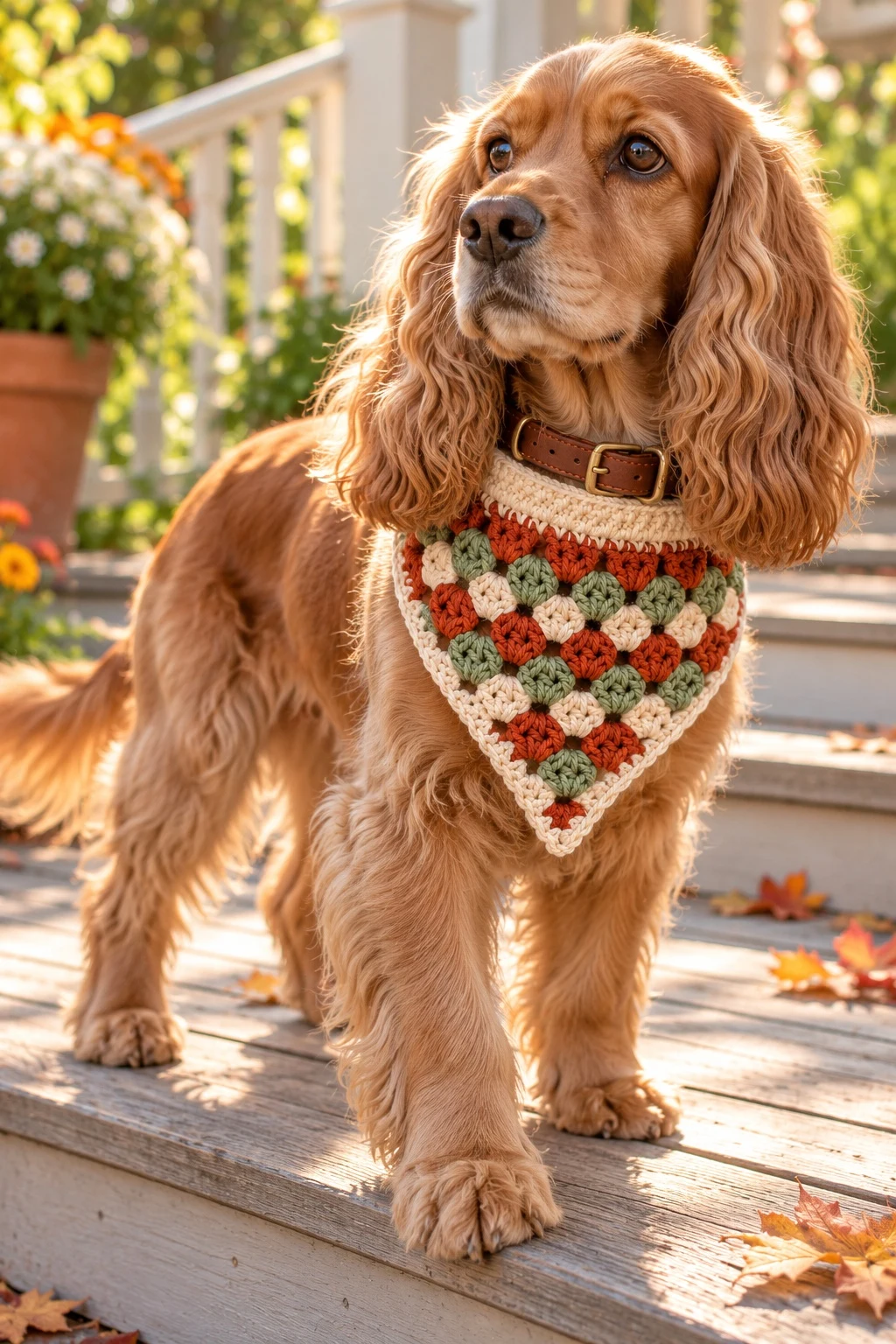
Give the bandana a gentle block: mist it lightly, lay it flat, coax the triangle into a clean fan, and let it dry. Check the channel against the collar once more — it should slide on with a little ease, never stretched tight, and the collar’s buckle and D-ring should sit clear of the fabric. On the first wear, watch for a few minutes: the point should hang centered and clear of the ground, with no flapping or rubbing that invites scratching. If it earns a place in the regular rotation, the Dandy Dog Sweater Crochet Pattern pairs with it beautifully on colder days.
A practical note from experience: make the second bandana before you need it. Bandanas collect burrs, mud, and mystery park substances at a heroic rate, and having a clean spare threaded and ready turns laundry day from a negotiation into a thirty-second collar swap. Most makers end up with a small drawer of them, one per palette.
Customizing the Fit
Deeper or shallower: the triangle’s depth is just row count. Each granny row adds about 0.8 inches, so stopping two rows early gives a shorter, sportier bandana, and working the full ladder gives the long dramatic point. Whatever you choose, end on a single cluster so the tip stays neat.
Wider or padded collars: collar thickness is a channel-depth question, not a width question. For a chunky or padded collar, work one extra channel row (four rows total) before the granny body — the deeper fold makes a roomier tube. The granny counts do not change.
One color, or two: the rotation is a suggestion, not a rule. A single-color body in rust with the cream channel and edging reads bold and classic; a two-color rotation (rust and cream, or sage and cream) softens the look and stretches leftover yarn further.
Frequently Asked Questions
Final Thoughts
The slide-on granny bandana earns its place in the making rotation quickly: an evening of easy clusters, a fold, a few stitches, and your dog has a bandana that goes on in seconds and never needs tying again. The rust, sage, and cream rotation gives it that handmade, sun-warmed look that photographs as well as it wears — and the palette cards above mean the second and third versions never have to repeat the first.
Make the first one in Rustic Autumn, like the photo. It is the version that goes with everything.
Then pick a palette for the season ahead — Ocean Breeze for summer, Berry Meadow for fall. One bandana now, a small wardrobe by winter.
Izzy is an experienced ranch worker who has a passion for exploring nature and getting up close to wildlife. With her connections to various animal organizations, Izzy is well-versed in animal care and rehabilitation.


