Crochet Dog Snood Free Pattern: Frog Hood in 3 Sizes
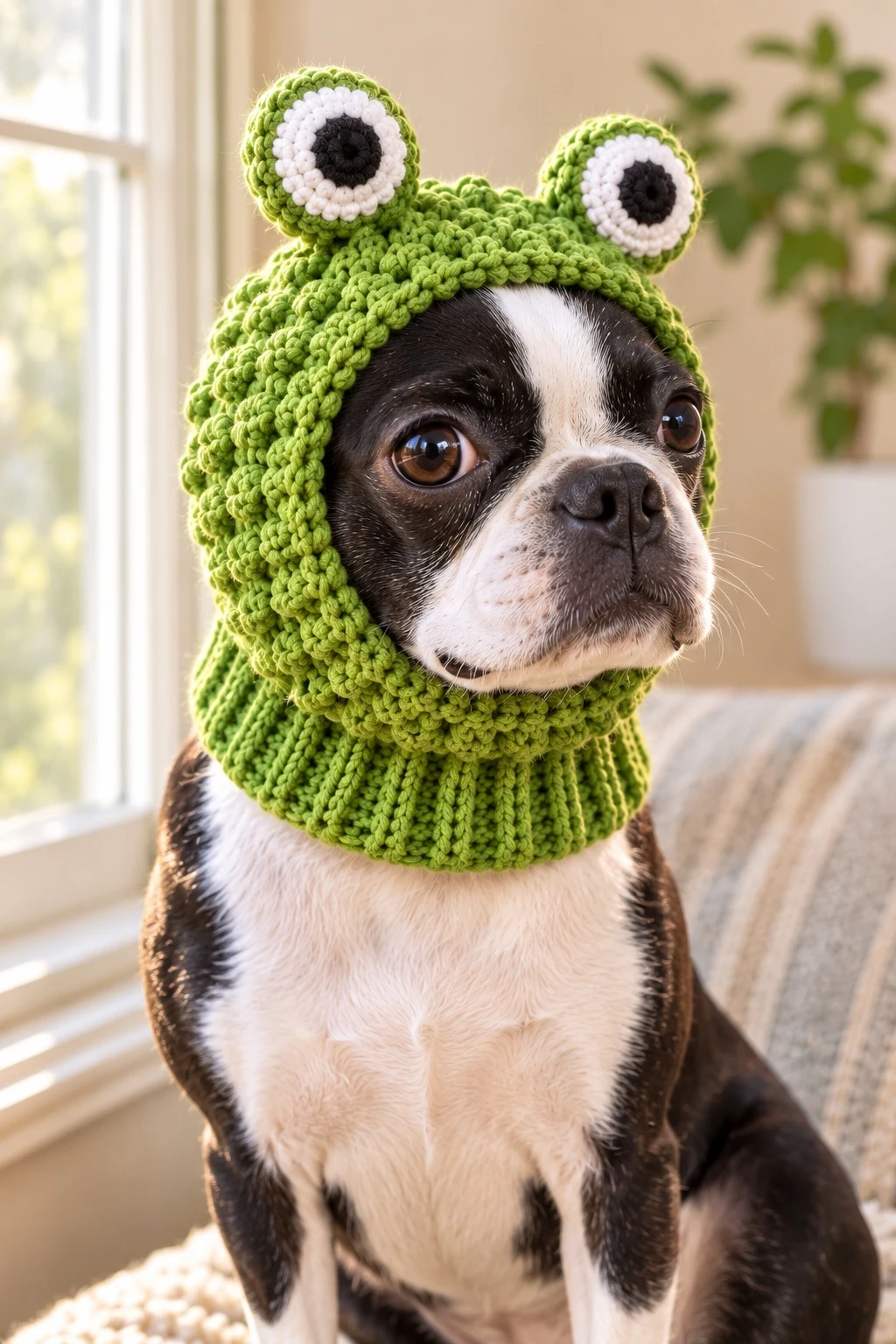
Some crochet projects are useful. Some are adorable. This frog dog snood is unapologetically both: a leaf-green hood that slips over your dog’s head, frames their face, and tops it all off with two round frog eyes on stalks. On the Boston terrier in our photos it takes about three seconds to go from “dog wearing a snood” to “that is clearly a frog,” and that is exactly the reaction this pattern is built for.
A snood is more than a costume, though. It keeps ears warm on winter walks, holds long ears up out of food and water bowls, and calms more than a few dogs who find gentle pressure around the head soothing. This pattern is worked in one piece from the neck up in lemon peel stitch, comes in three sizes by neck measurement, and uses only single crochet, double crochet, and post stitches. If you can work in the round, you can make a frog.
Why a Frog Snood Works So Well
The frog is the perfect snood animal because the design does the work for you. A dog’s head already has the right shape — the hood provides the round green silhouette, and the two stalk eyes are the only appliqué the whole project needs. There are no ears to shape, no muzzle to fit, and no color changes mid-row. Two small eyes, sewn on at the end, transform a plain green cowl-hood into a character.
The construction is just as honest. The ribbed neck band keeps the snood in place without anything tight around the throat, the hood section simply continues upward from the band, and the face opening is created by working a few rows back and forth instead of in the round. Nothing is seamed except the eyes. If your dog already loves the Snowman Dog Bandana from our holiday set, this is its year-round cousin.
Before You Get Started
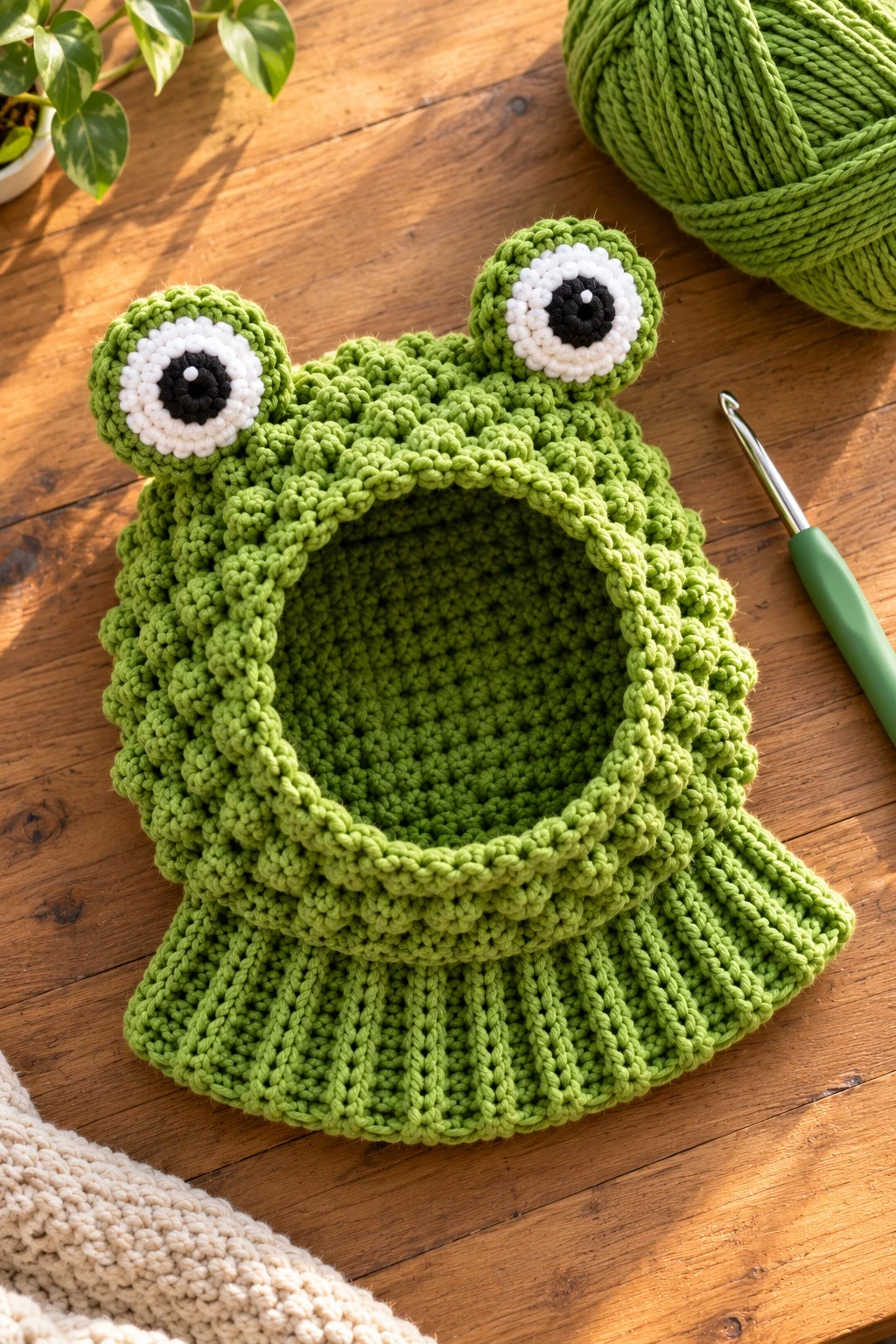
The snood is worked in one piece from the bottom up: a ribbed neck band in the round, a short body section, the face opening worked in turned rows over the back stitches only, a decreased crown that closes the top, and a neat single-crochet edging around the face opening. The frog eyes are made separately and sewn on last.
Skills used are single crochet, double crochet, front- and back-post double crochet (for the ribbing), single-crochet decreases, and a magic ring for the eyes. The body stitch is lemon peel — alternating single and double crochet — which gives the hood its slightly nubby, frog-skin texture and a fabric with very little stretch sideways, so the hood keeps its shape on the head. Any smooth worsted-weight yarn that meets gauge works; a soft acrylic is kindest against the neck and washes easily. If your dog prefers something flatter around the neck instead, the Cozy Waves Dog Bandana uses the same weight of yarn.
Fit & comfort check: you should be able to slide two fingers comfortably between the neck band and your dog’s neck at all times. Measure the neck before choosing a size, and if your dog is between sizes, make the larger one — a snood should drape, never squeeze.
Safety notes: the frog eyes are sewn on, so stitch them through the stalk base several times and check them before every wear. For strong chewers and puppies, embroider the eyes and pupils with yarn instead of crocheting separate pieces. Always supervise your dog while it wears the snood, and take it off for sleep and rough play.
Tools & Materials Needed
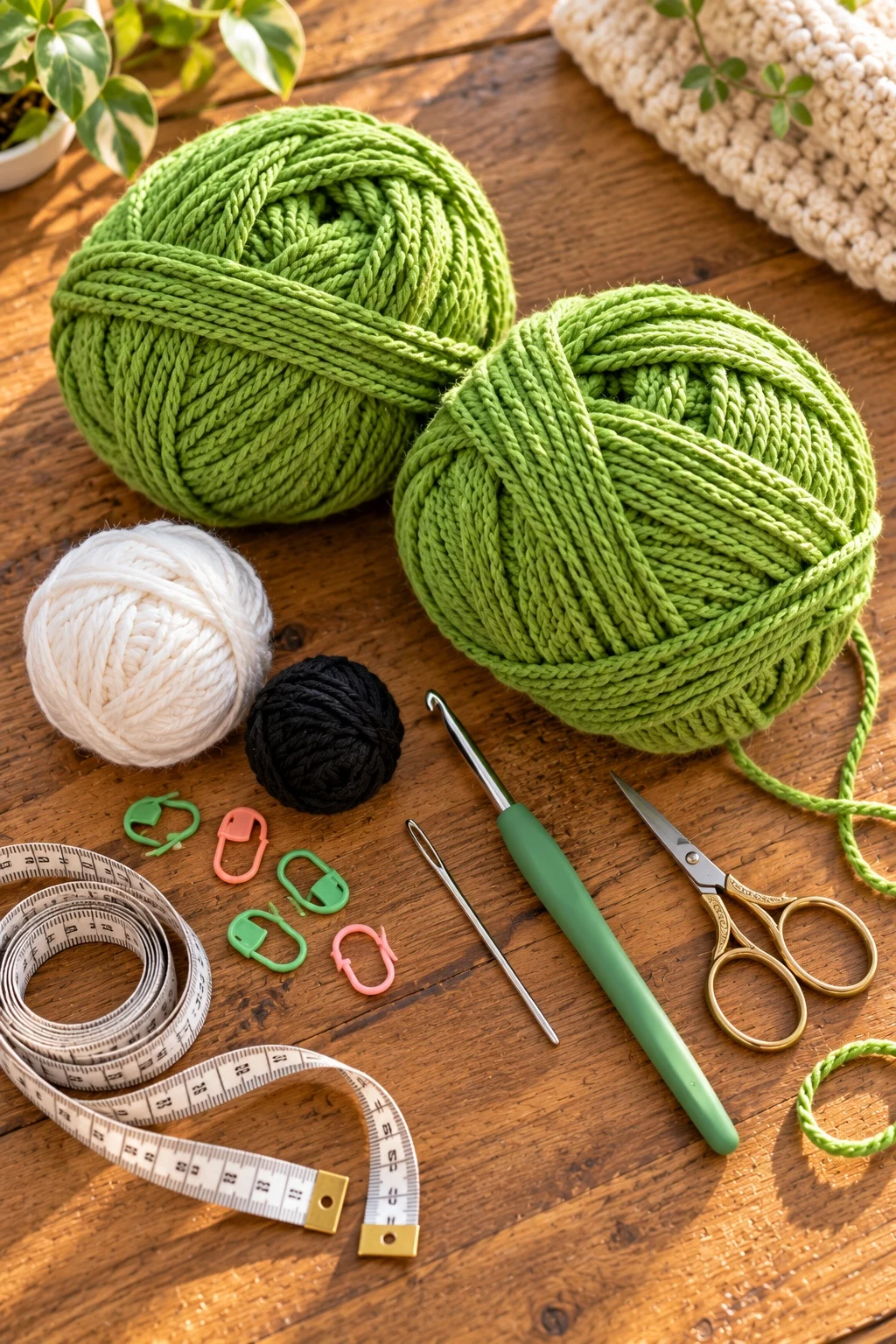
Yarn
- Worsted-weight (#4) acrylic or acrylic-blend yarn, soft and machine-washable.
- Leaf green: approx 130 (150, 170) yd for sizes S (M, L)
- White: approx 10 (12, 14) yd
- Black: approx 5 (6, 8) yd
Hook & Notions
- US H-8 (5.0 mm) crochet hook, or size needed to obtain gauge
- Yarn needle with a large eye, scissors, flexible tape measure
- 2 stitch markers, small amount of stuffing or yarn scraps for the eyes
Size Info and Gauge
S
Neck: 10–12″
Finished: 12″ around × 7.25″ tall
Chihuahuas, Dachshunds, small terriers
M
Neck: 13–15″
Finished: 14″ around × 7.5″ tall
Boston Terriers, French Bulldogs, Beagles
L
Neck: 16–18″
Finished: 16″ around × 7.75″ tall
Spaniels, Basset Hounds, Corgis
Gauge: 16 sts × 13 rows = 4″ in lemon peel stitch. Make a swatch first — every stitch count in this pattern depends on it.
Sizes are written S (M, L) throughout. The finished circumference is a little larger than the neck range because the snood must pass over the head; the ribbed band is what holds it in place once it is on. Long-eared breeds get the most from a snood — it is the same reason the Dog Hoodie Crochet Pattern fans ask for ear room — so if your spaniel is between sizes, go up.
Abbreviations (US Terms)
ch chain · sc single crochet · dc double crochet · sl st slip stitch · st(s) stitch(es) · inc 2 sc in one stitch · dec single crochet 2 together (sc2tog) · FPdc front-post double crochet · BPdc back-post double crochet · MR magic ring
Pattern Notes
Construction order: neck band, body, face opening, crown, face edging, then the eyes.
Center back: the joining seam sits at the center back of the neck. The markers for the face opening are placed by counting from that seam.
Lemon peel rhythm: alternate sc, dc around. At the row turns of the face opening, the alternation may shift by one stitch — this disappears into the texture and is not a mistake.
Crown finish: the crown rounds switch to single crochet so the decreases stay smooth and even. The eyes sit right on top and cover the transition completely.
Pattern Instructions
Neck Band
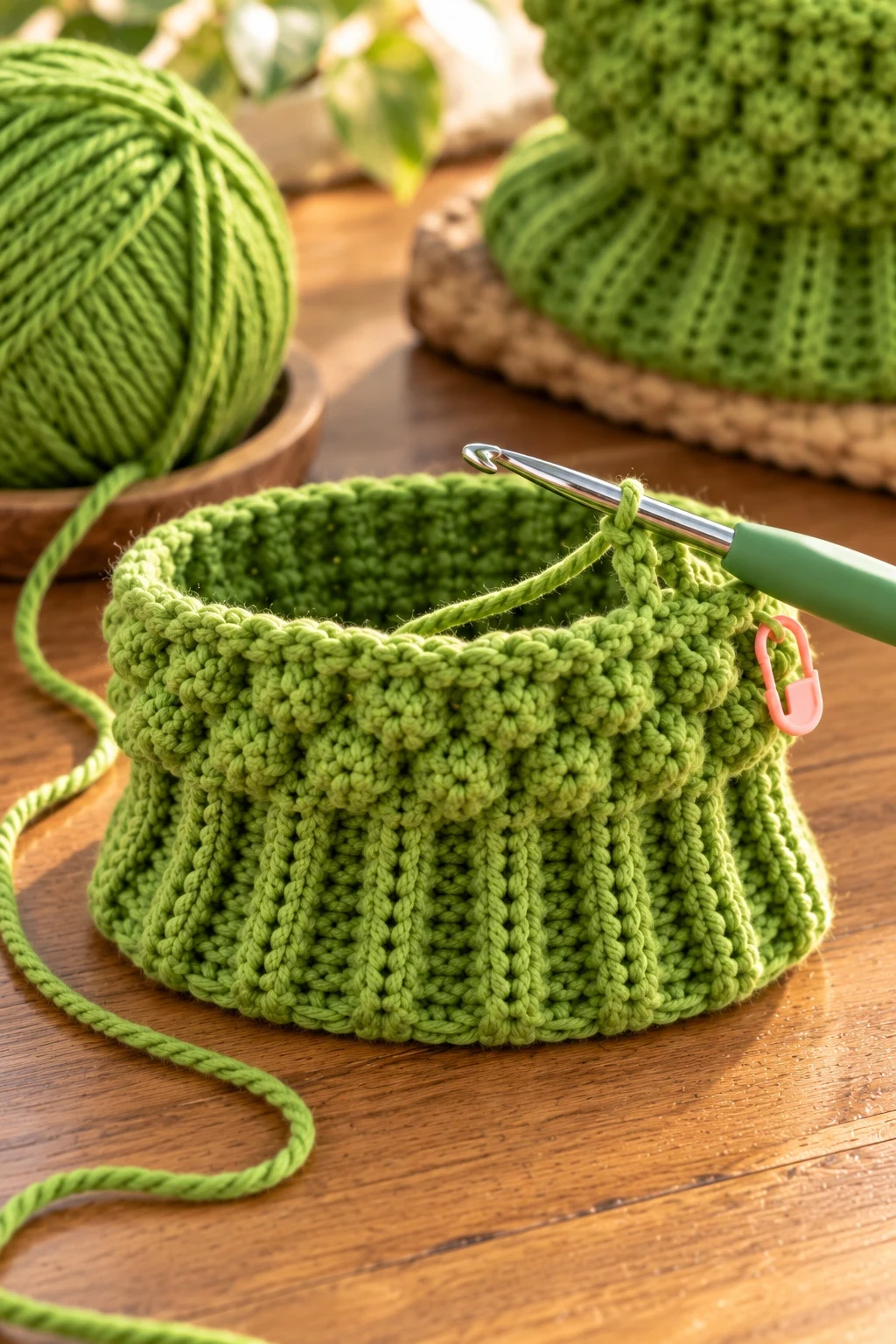
Ch 48 (56, 64). Join with a sl st to the first ch to form a ring, being careful not to twist the chain.
- Round 1: Ch 2 (does not count as a st), dc in each st around, sl st to the first dc. (48, 56, 64 sts)
- Round 2: Ch 2, (FPdc in the next st, BPdc in the next st) around, sl st to the first FPdc. (48, 56, 64 sts)
- Round 3: Repeat Round 2. (48, 56, 64 sts)
Body
- Rounds 4–6: Ch 1 (does not count), (sc in the next st, dc in the next st) around, sl st to the first sc. (48, 56, 64 sts)
Face Opening
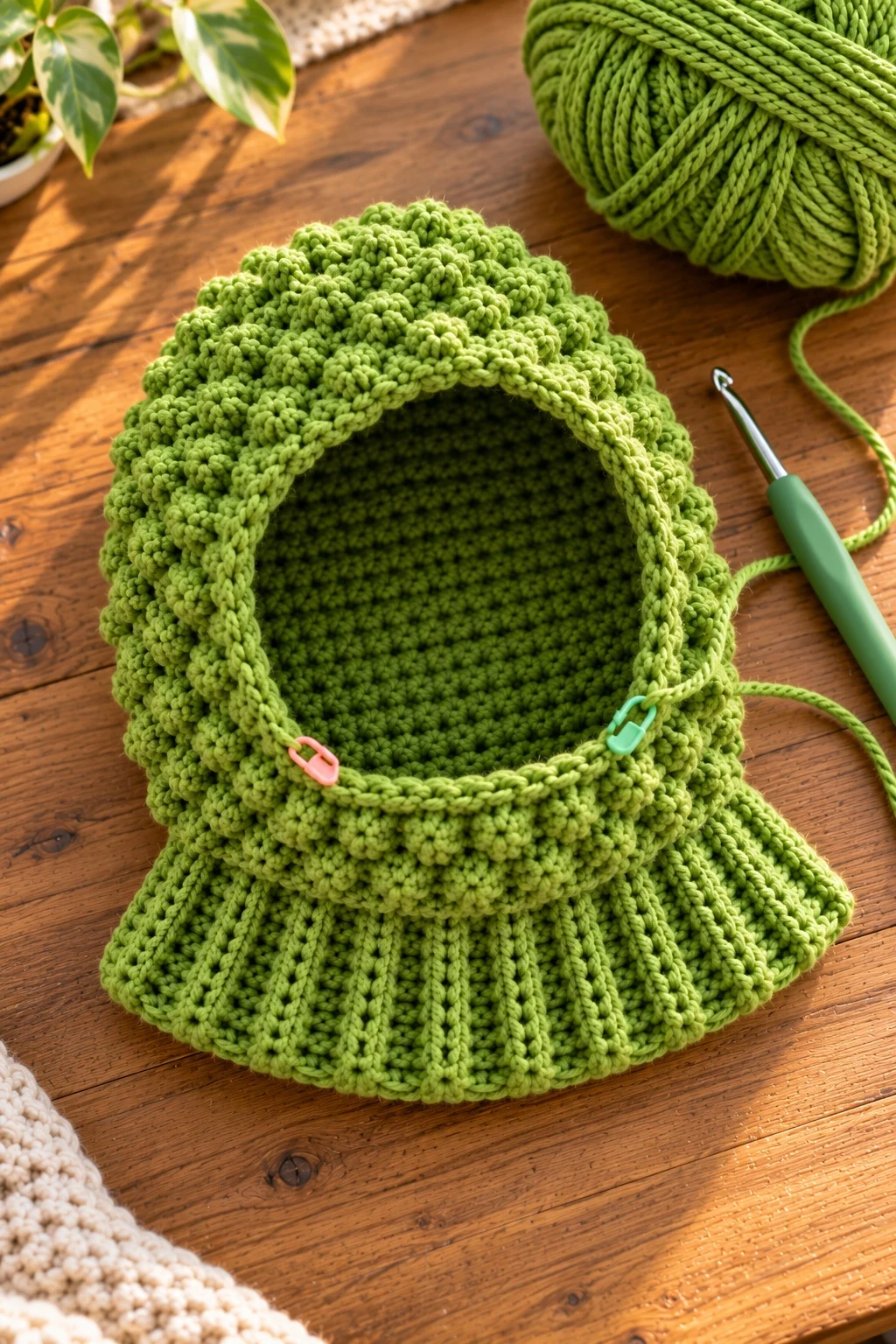
Count the back 32 (38, 44) sts centered on the joining seam and place a marker in the first and last back st. The front 16 (18, 20) sts between the markers form the face opening and are not worked in this section.
- Row 1: Continue in lemon peel from the last body round, working across the back sts only from the first marked st: (sc, dc) across, turn. (32, 38, 44 sts)
- Rows 2–10 (11, 12): Repeat Row 1, turning at the end of each row. (32, 38, 44 sts)
Crown
- Round 1: Ch 1, work lemon peel across the back sts, then continue in lemon peel across the front 16 (18, 20) sts to close the round, sl st to the first sc. (48, 56, 64 sts)
- Round 2: Ch 1, (sc in the next 6 sts, sc2tog) 6 (7, 8) times. (42, 49, 56 sts)
- Round 3: Ch 1, (sc in the next 5 sts, sc2tog) 6 (7, 8) times. (36, 42, 48 sts)
- Round 4: Ch 1, (sc in the next 4 sts, sc2tog) 6 (7, 8) times. (30, 35, 40 sts)
- Round 5: Ch 1, (sc in the next 3 sts, sc2tog) 6 (7, 8) times. (24, 28, 32 sts)
- Round 6: Ch 1, (sc in the next 2 sts, sc2tog) 6 (7, 8) times. (18, 21, 24 sts)
- Round 7: Ch 1, (sc in the next st, sc2tog) 6 (7, 8) times. (12, 14, 16 sts)
- Round 8: Ch 1, sc2tog around. (6, 7, 8 sts)
Fasten off, leaving a long tail. Thread the tail through the remaining 6 (7, 8) sts, pull to cinch the top closed, and secure.
Face Edging
- Join the green yarn at one bottom corner of the face opening. Ch 1 and work sc evenly all the way around the opening — up the row ends on one side, across the front sts, and down the other side — about 36 (40, 44) sc in total. Add or skip a stitch or two if needed to keep the edging lying flat. Sl st to the first sc.
- Optional: work a second round of sc for a firmer, rounder edge. Fasten off and weave in the ends.
Frog Eyes (Make 2)
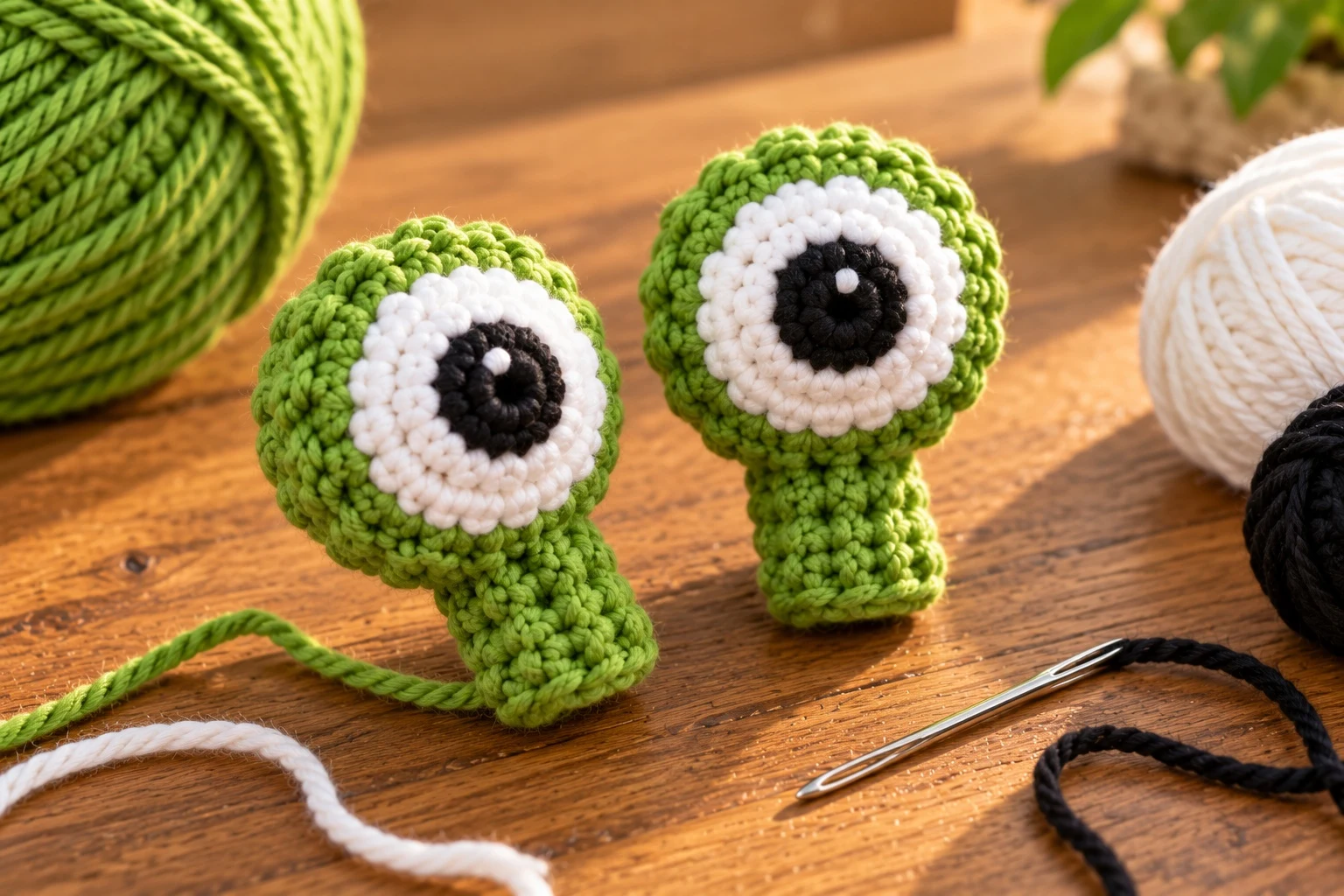
Stalk (leaf green):
- Round 1: 6 sc in a magic ring. (6 sts)
- Round 2: Inc in each st around. (12 sts)
- Rounds 3–5: Sc in each st around. (12 sts)
Eyeball (change to white):
- Round 6: (Sc in the next st, inc) 6 times. (18 sts)
- Rounds 7–8: Sc in each st around. (18 sts)
- Round 9: (Sc in the next st, sc2tog) 6 times. (12 sts) Stuff the eyeball lightly.
- Round 10: Sc2tog around. (6 sts) Fasten off, thread the tail through the remaining sts, and cinch closed.
Pupil (black, make 2):
- Round 1: 6 sc in a magic ring. (6 sts)
- Round 2: Inc in each st around. (12 sts) Fasten off, leaving a tail for sewing.
Assembly
Sew one pupil to the front center of each eyeball. Sew the two eyes onto the crown at the front of the top, spaced about 1.5 (2, 2.5) inches apart, stitching securely through the base of each stalk. Weave in all remaining ends.
Finishing
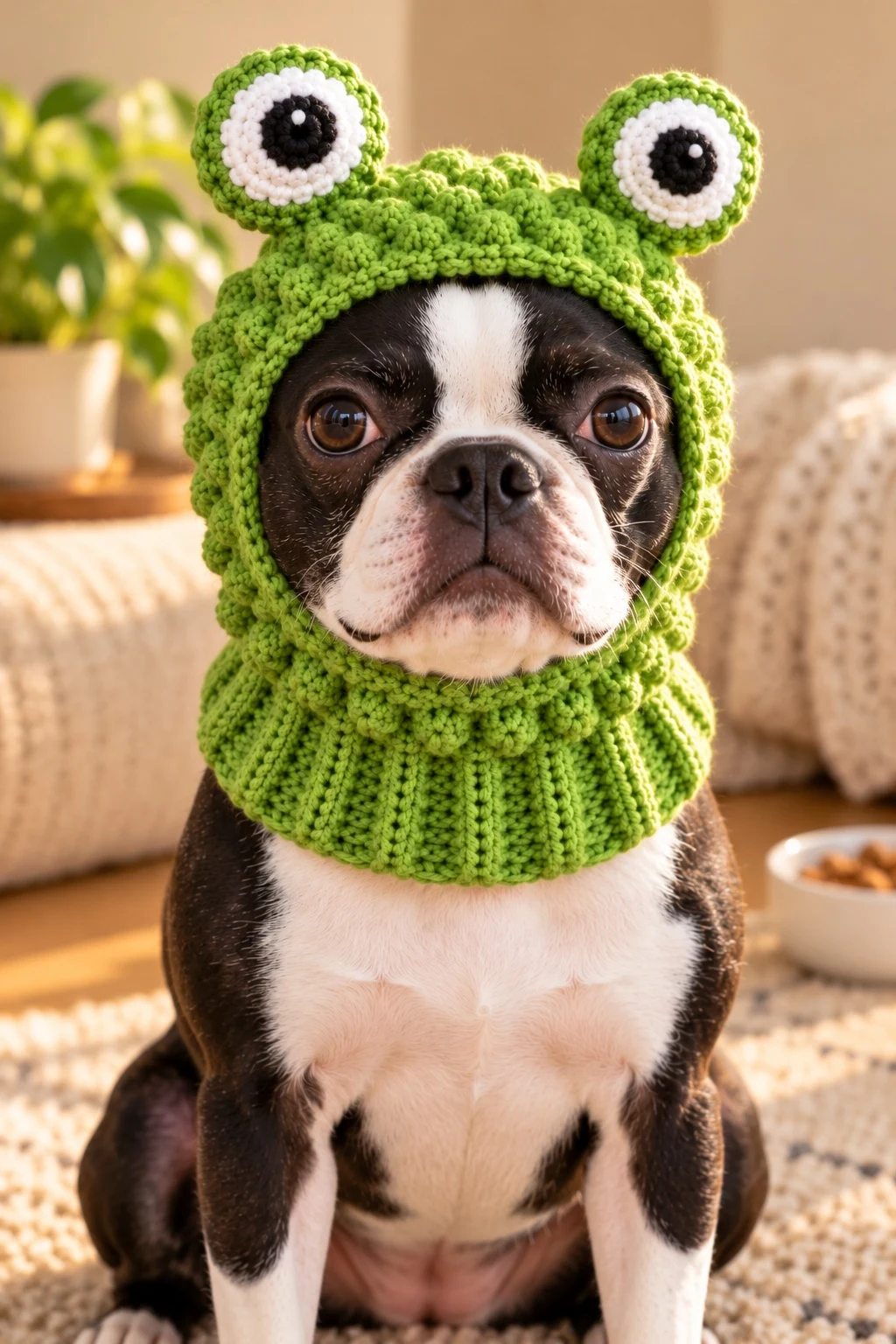
Weave in every end, checking the inside of the hood where little mouths explore. The snood needs no hard blocking — a gentle steam or a few hours folded flat will relax the lemon peel texture if your gauge ran tight. Try the snood on your dog before the first outing: it should slip over the head easily, the band should sit on the neck without sliding forward over the muzzle, and your dog should be able to open its mouth, bark, and shake its head freely. A few treats during the first fitting turn the whole thing into a game, which is exactly the spirit of a frog snood. For a full cold-weather set, pair it with the Dandy Dog Sweater Crochet Pattern.
Customizing the Fit
Taller hood: for long-headed breeds like Greyhounds and Dachshunds, add 1–2 extra lemon peel rounds to the body before starting the face opening.
Wider face opening: for broad-headed breeds, work the face rows over 2 fewer back sts and leave 2 more front sts unworked — 30 (36, 42) back sts instead. The total stitch count, and the crown, stay exactly the same.
Different animal: swap the leaf green for brown and replace the stalk eyes with two small round ears (a 12-st circle, folded and sewn) and you have a bear snood. The base hood never changes. The Granny Square Dog Sweater uses the same change-the-colors, keep-the-construction trick.
Frequently Asked Questions
Final Thoughts
There are more serious crochet projects in the world, and most of them are less fun than this one. The frog snood takes an evening, a ball of green yarn, and a dog willing to be looked at — and it pays you back every single walk, in smiles from strangers, in warm ears, and in photos you will keep forever. It is also a genuinely useful little garment for long-eared and cold-sensitive dogs, which makes the silliness feel almost responsible.
Make the first one in classic leaf green, like the photo. It is the version everyone recognizes instantly.
Then, if your house is anything like ours, there will be requests — a second color, a smaller one for a friend’s dog, a bear for autumn. The hood never changes. That is the beauty of a good base pattern.
Izzy is an experienced ranch worker who has a passion for exploring nature and getting up close to wildlife. With her connections to various animal organizations, Izzy is well-versed in animal care and rehabilitation.