
12 Side-Yard Dog Run Ideas That Work Even in Narrow Yards
Does your dog have nowhere to go outside except the main yard — which now looks like a battlefield? You’re not alone. Most dog owners overlook one of the best pieces of real estate their property already has: the side yard.
That narrow strip of land between your house and the fence is almost always wasted. But its shape — long, enclosed on two sides, and separate from your main living space — makes it nearly perfect for a dog run. The best part? You don’t need a huge budget or a landscaper to make it work.
In this guide, you’ll find 12 side-yard dog run ideas organized by budget and style, plus a layout section, a ground cover comparison, and a simple maintenance schedule. We’ll also cover things most articles skip entirely — like what to do with an ultra-narrow yard, whether you need a permit, and how to make the whole thing look good from the street.
Let’s dig in.
Before You Pick an Idea — 4 Things to Figure Out First
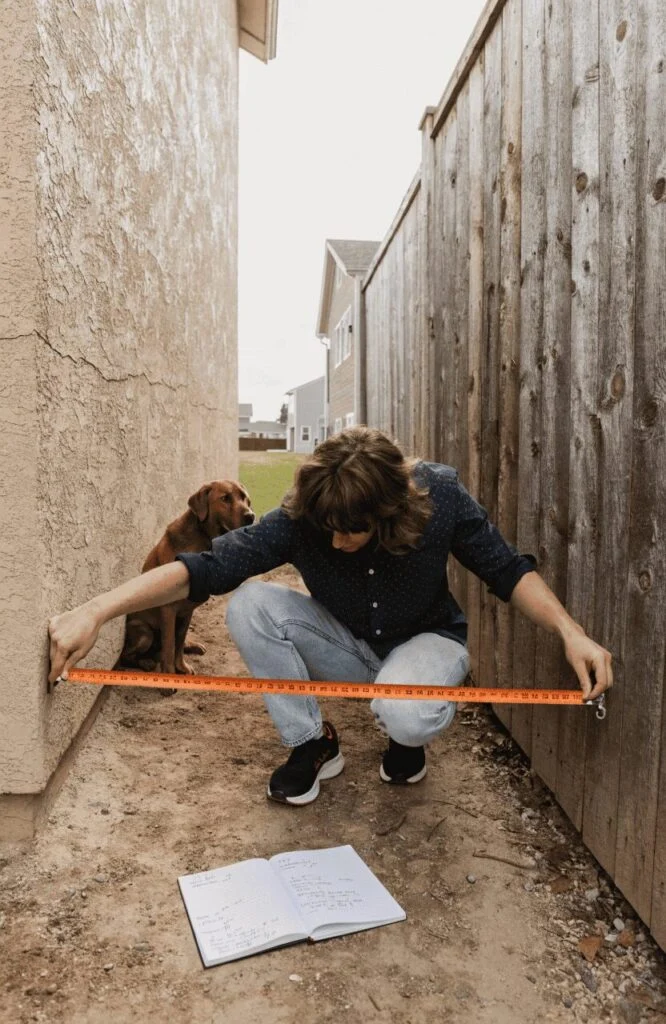
Jumping straight into design ideas is tempting, but a few quick planning steps now will save you a lot of money and frustration later.
1. How Wide Is Your Side Yard, Really?
Go outside and measure the actual usable width — not just the gap between structures, but the flat, buildable space.
Here’s a simple guide by dog size:
- Small dogs (under 25 lbs): A minimum of 3 feet wide works, though 4 feet is more comfortable
- Medium dogs (25–60 lbs): Aim for at least 4–5 feet of width
- Large dogs (60+ lbs): You want 5–6 feet minimum so they can turn around and move freely
If your side yard is under 3 feet wide, don’t give up. Ideas 11 and 12 at the end of this list are built specifically for ultra-narrow spaces.
Length matters more than width. A 3-foot-wide run that’s 20 feet long gives your dog far more real exercise than a 6-foot-wide run that’s only 8 feet long.
2. Check HOA Rules and Local Permits
This is the step everyone skips and then regrets.
If you live in a neighborhood with a homeowners association, check the rules before buying a single fence post. Many HOAs have restrictions on fence height, materials, colors, and structures near property lines.
Even without an HOA, your city or county may require a permit for permanent fencing or structures. Side yards often sit close to property lines, which can trigger setback regulations. A quick call to your local planning office takes 10 minutes and can save you from tearing down a finished project.
3. Know Your Dog’s “Problem Behavior”
Your dog’s personality should drive your design choices more than anything else. A golden retriever and a husky need very different setups.
Ask yourself:
- Is my dog a digger? (You need a buried wire apron or concrete footer along the fence base)
- Is my dog a jumper or climber? (Fence height and angled toppers become critical)
- Is my dog an escape artist? (Roof panels or double-gate entry systems are worth it)
- Does my dog get anxious when alone? (Privacy screening and shade make a big difference)
Understanding your dog’s behavior first leads to smarter design. For a deeper dive into how behavior shapes dog space decisions, check out this guide on behavior-driven design.
4. Think About Drainage Now, Not Later
Side yards are notorious for collecting water. They sit along your house foundation, have limited sunlight to dry things out, and often have compacted soil from years of foot traffic.
The fix is simple in principle: the ground should slope slightly away from your house — about 1 to 2 inches of drop for every 10 feet of length. This is called a 1–2% grade, and it keeps water from pooling against your foundation.
If your yard already floods badly, consider a basic French drain (a gravel-filled trench with a perforated pipe) before laying any ground cover. It’s a $100–$300 DIY project that prevents years of mud, odor, and standing water.
12 Side-Yard Dog Run Ideas (Organized by Budget and Style)
Budget-Friendly Ideas
Idea 1 — The Gravel and Timber Frame Run (~$200–$500)
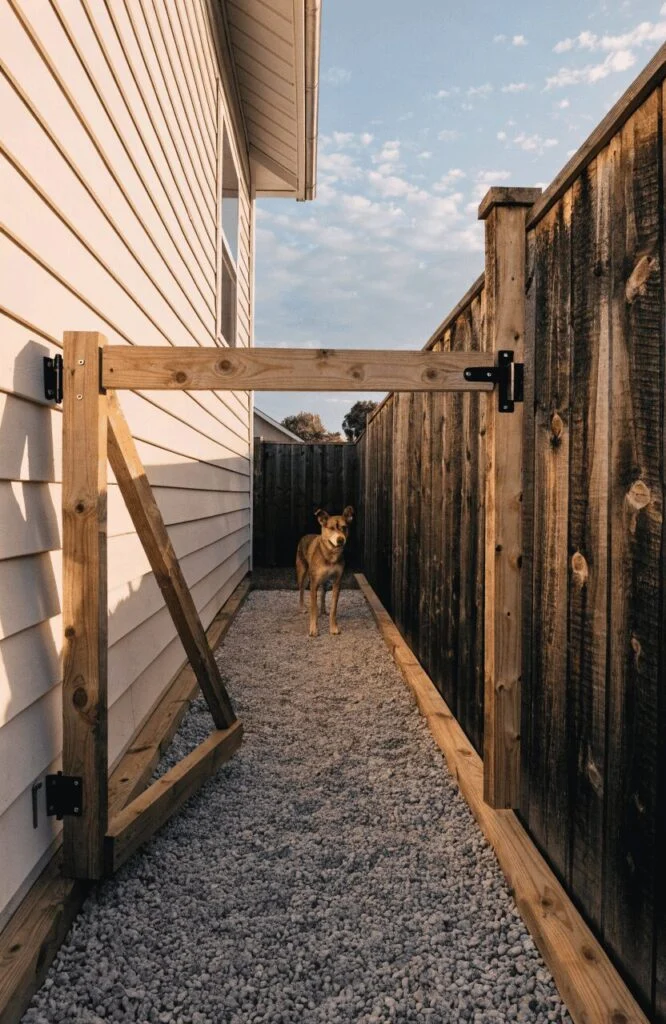
This is the most practical starting point for most homeowners. You install pressure-treated timber edging (4×4 boards work great) to create a clean border, then fill the space with pea gravel or crushed granite.
Pea gravel drains beautifully, doesn’t hold odor the way soil does, and is easy to rake clean. It’s also one of the cheapest materials available.
The timber framing gives the whole space a finished, intentional look instead of a patchy yard. Add a simple gate at one or both ends, and you have a fully functional dog run for under $500 in most cases.
Best for: Budget-conscious owners with medium to large dogs who aren’t heavy diggers.
One tip: Use a landscape fabric layer under the gravel to prevent weeds from pushing through and keep the gravel from sinking into the soil over time.
Idea 2 — The Repurposed Chain-Link Makeover (~$150–$300)
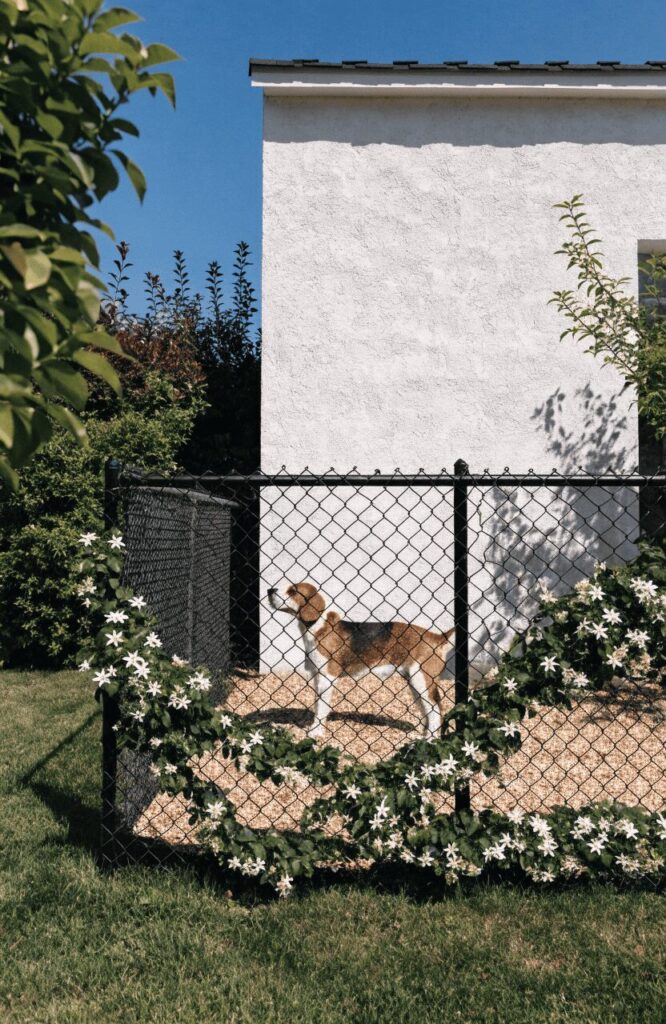
Chain-link fencing has a reputation for being ugly — but that’s mostly a paint problem. A coat of matte black or dark green spray paint on chain-link transforms it from industrial to intentional.
If you already have chain-link along your property boundary, you may only need to add gates at each end of the side yard to fully enclose the run. That cuts the material cost dramatically.
Add some climbing plants like jasmine or clematis along the outside of the fence, and within a season it looks like a designed garden feature rather than a dog cage.
Best for: Homeowners who already have chain-link and want to minimize spending.
Idea 3 — The Mulch and Paver Combo (~$100–$250)
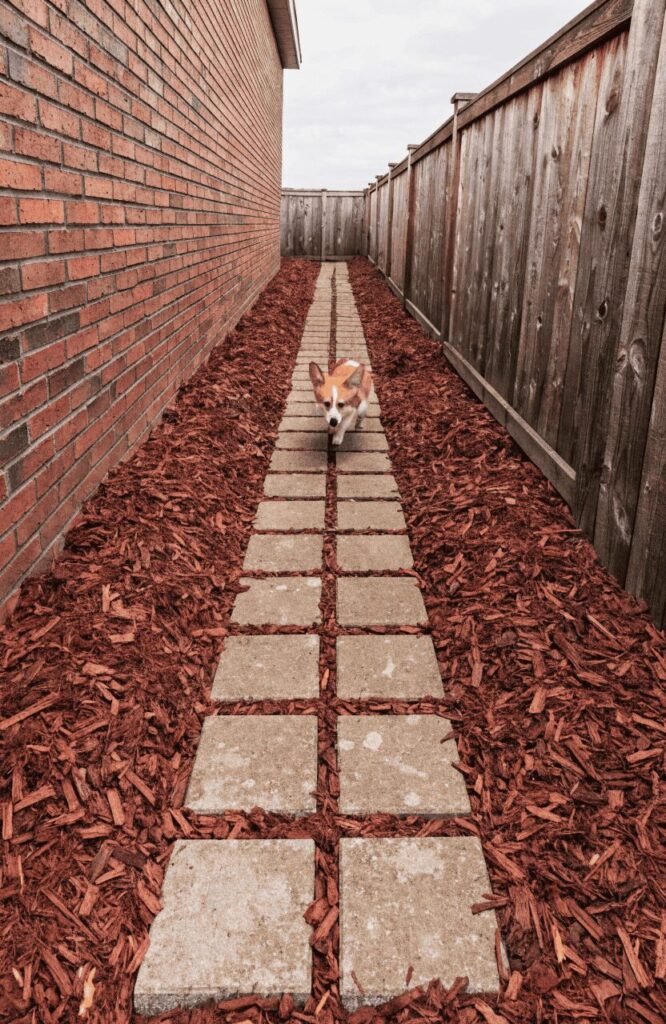
This is one of the easiest DIY options. You lay a row of concrete stepping pavers down the center of the run as a walking path, then fill the sides with cedar mulch or wood chips.
The pavers give you a clean surface for walking in to clean up or refill water. The mulch is soft on paws, drains reasonably well, and smells pleasant — at least at first.
Replace the mulch once or twice a year, and it stays fresh. The whole thing costs very little and requires no professional help to install.
Best for: Small dogs, light-traffic runs, and renters who can’t make permanent changes.
Mid-Range Ideas
Idea 4 — The Artificial Turf Strip with a Dedicated Potty Zone (~$500–$1,200)
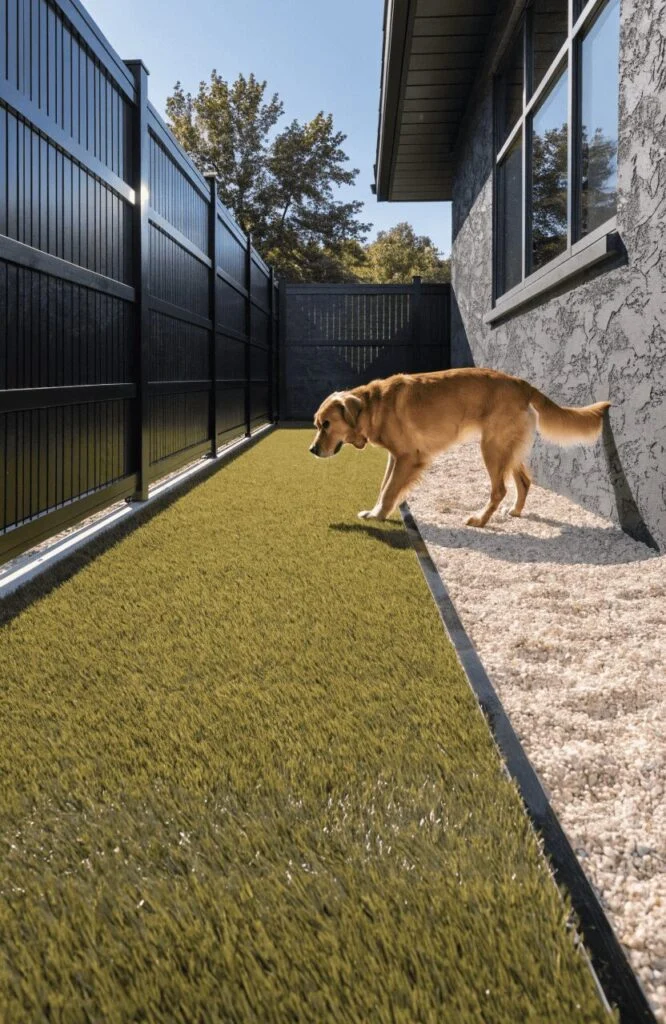
This is one of the most popular setups for a reason — it looks great, it’s low maintenance, and it solves the muddy paws problem entirely.
You install pet-grade artificial turf along most of the run for playing and lounging, then use a small section of pea gravel at the far end as a dedicated potty zone. Dogs naturally learn to use the gravel section for bathroom breaks, which makes cleanup focused and fast.
Pet-specific turf has antimicrobial backing and a drainage layer built in. It doesn’t need mowing, watering, or reseeding. The upfront cost is higher, but the long-term maintenance is minimal.
For a detailed look at surface options for enclosed dog spaces, this flooring options guide covers what works best by dog size and use intensity.
Idea 5 — The Black Metal Fence and Stepping Stone Path (~$800–$1,500)
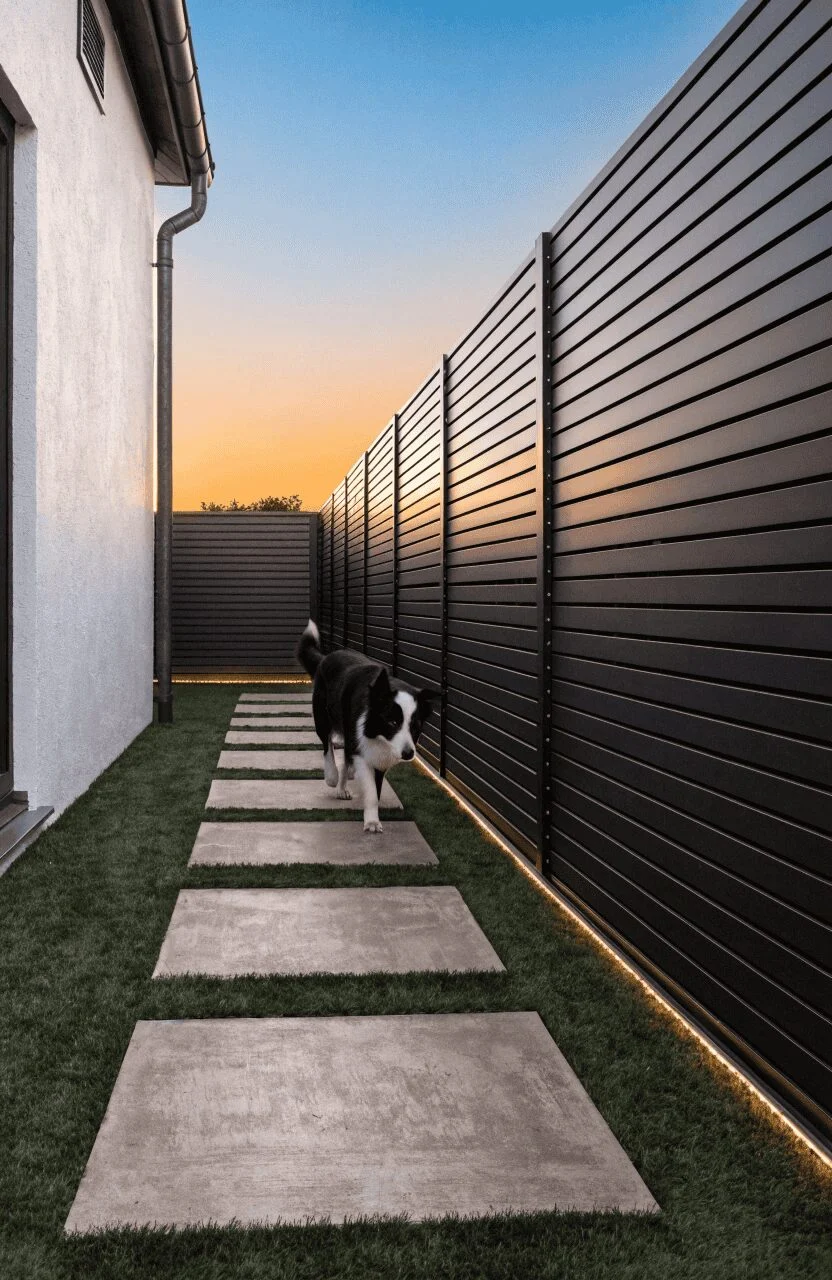
This is the modern minimalist approach. It uses powder-coated black aluminum or steel panels for fencing, large concrete stepping stones set into turf or gravel, and clean straight lines throughout.
It’s the design that looks best in photos and adds the most curb appeal. The dark fence color visually recedes, making the yard feel bigger. The stepping stones keep the design grounded and practical.
Add a wall-mounted water bowl and low-voltage LED strip lighting along the fence base, and this run looks just as good at night as it does during the day.
Best for: Homeowners who care about aesthetics and want the run to look like a designed extension of the yard.
Idea 6 — The Shaded Pergola Run for Hot Climates (~$700–$2,000)
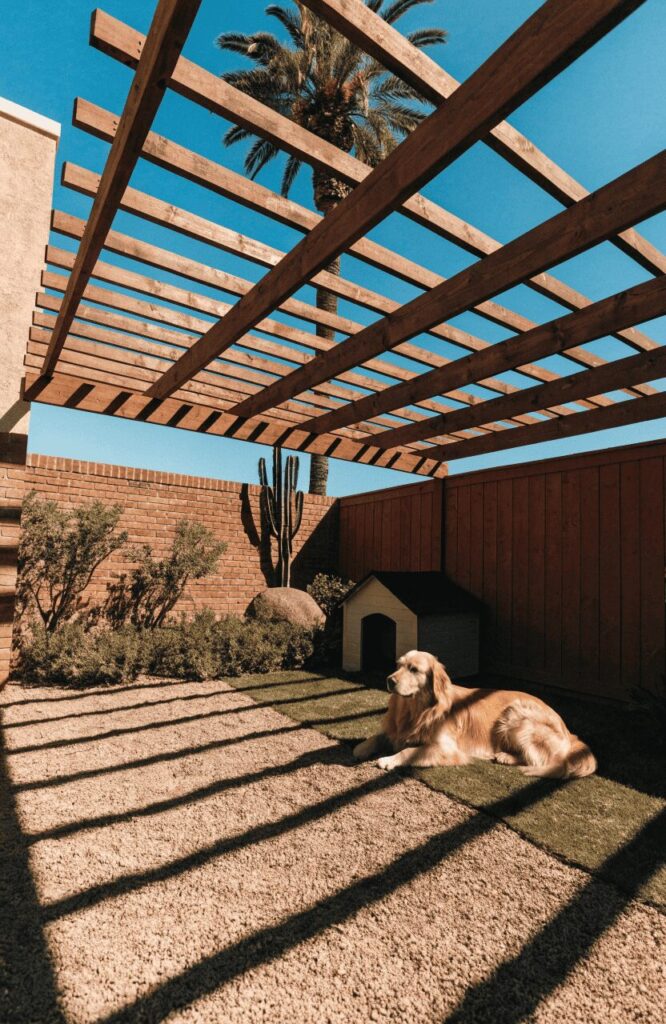
If you live somewhere with intense summer heat, shade isn’t optional — it’s a safety requirement. Dogs can overheat dangerously fast on hot days, especially in enclosed spaces with little airflow.
A pergola or shade sail stretched over part of the run solves this while also adding a genuinely attractive architectural element. You can build a simple pergola with 4×4 posts and lattice panels for a few hundred dollars, or buy a freestanding pergola kit for $300–$700.
Pair the shade structure with a doghouse or covered shelter at one end, and your dog has a cool retreat even on the hottest days.
Best for: Dogs in southern or desert climates. Also works well for senior dogs who regulate temperature less efficiently.
Idea 7 — The Garden-Style Run with Dog-Safe Plantings (~$400–$900)
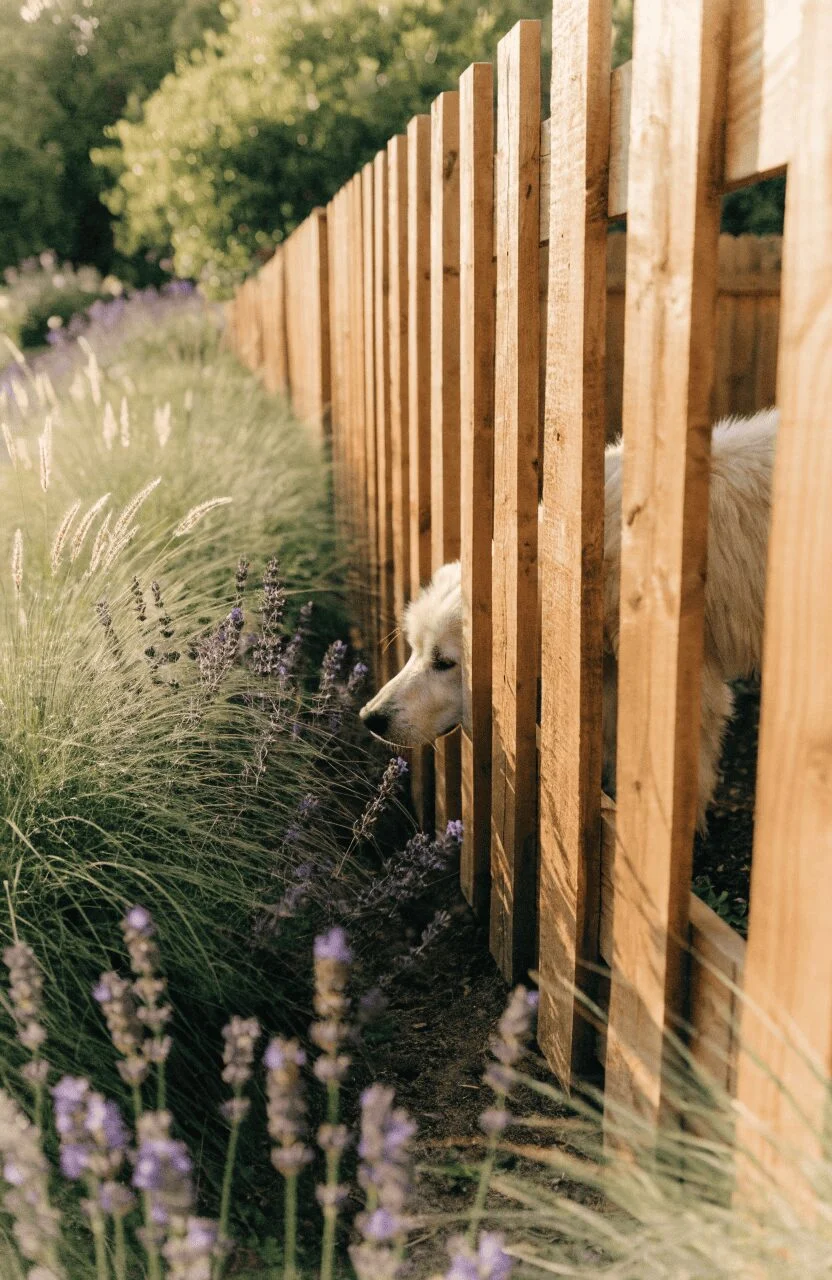
This idea blends the dog run into your landscaping so it doesn’t look like a dog run at all. You use a wooden fence with a natural finish, plant dog-safe perennials and shrubs along the outer perimeter, and use a soft ground cover like turf or mulch inside.
The key is choosing plants that are non-toxic to dogs. Lavender, rosemary, marigolds, and ornamental grasses all work well. Avoid azaleas, rhododendrons, and foxglove — these are toxic to dogs and commonly found in yards.
The result is a run that looks like a cottage garden from the street and a safe outdoor haven from your dog’s perspective.
Best for: Homeowners who want the run to blend into the overall yard design, especially in front-facing side yards.
Premium Ideas
Idea 8 — The Raised Deck Run for Wet Climates (~$1,500–$3,500)
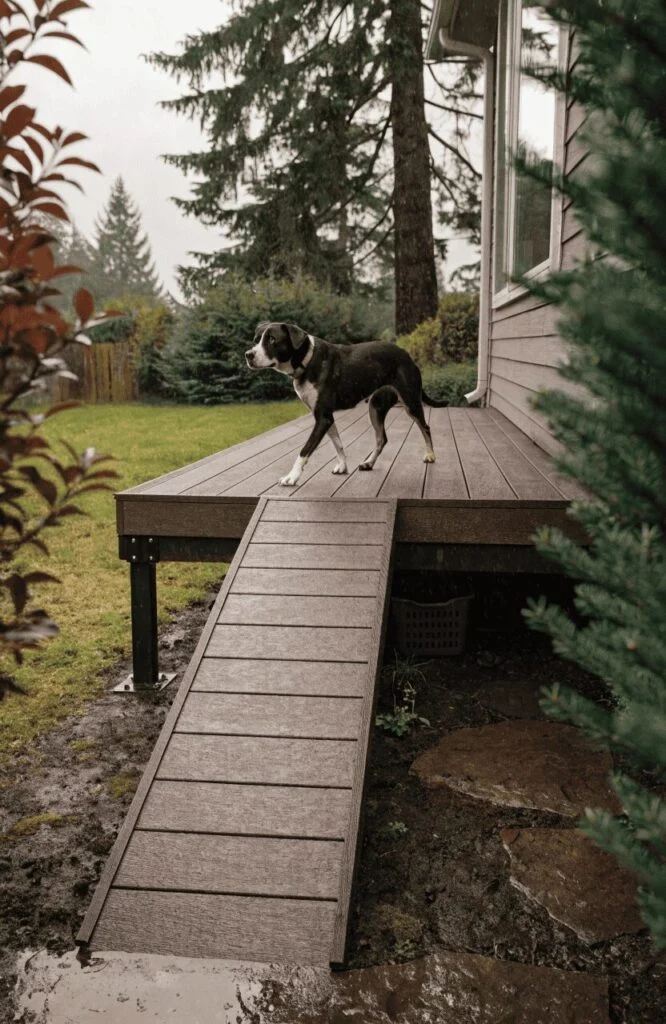
If your side yard stays wet for months at a time, ground-level surfaces are always going to be a losing battle. The answer is to go elevated.
A raised deck platform (12–18 inches off the ground) keeps your dog completely out of mud and standing water. The space beneath the deck provides natural drainage and airflow, which also reduces odor and moisture buildup.
Use composite decking or pressure-treated lumber for longevity. Add a ramp alongside any steps to make it accessible for older dogs or puppies. Built-in storage underneath is a bonus — it’s a great place to keep toys, leashes, and cleaning supplies.
For more ideas on enclosed outdoor dog spaces that combine comfort and durability, explore these outdoor kennel layouts.
Idea 9 — The Full-Integration Run with Dog Door and Mudroom Access (~$2,000–$4,000)
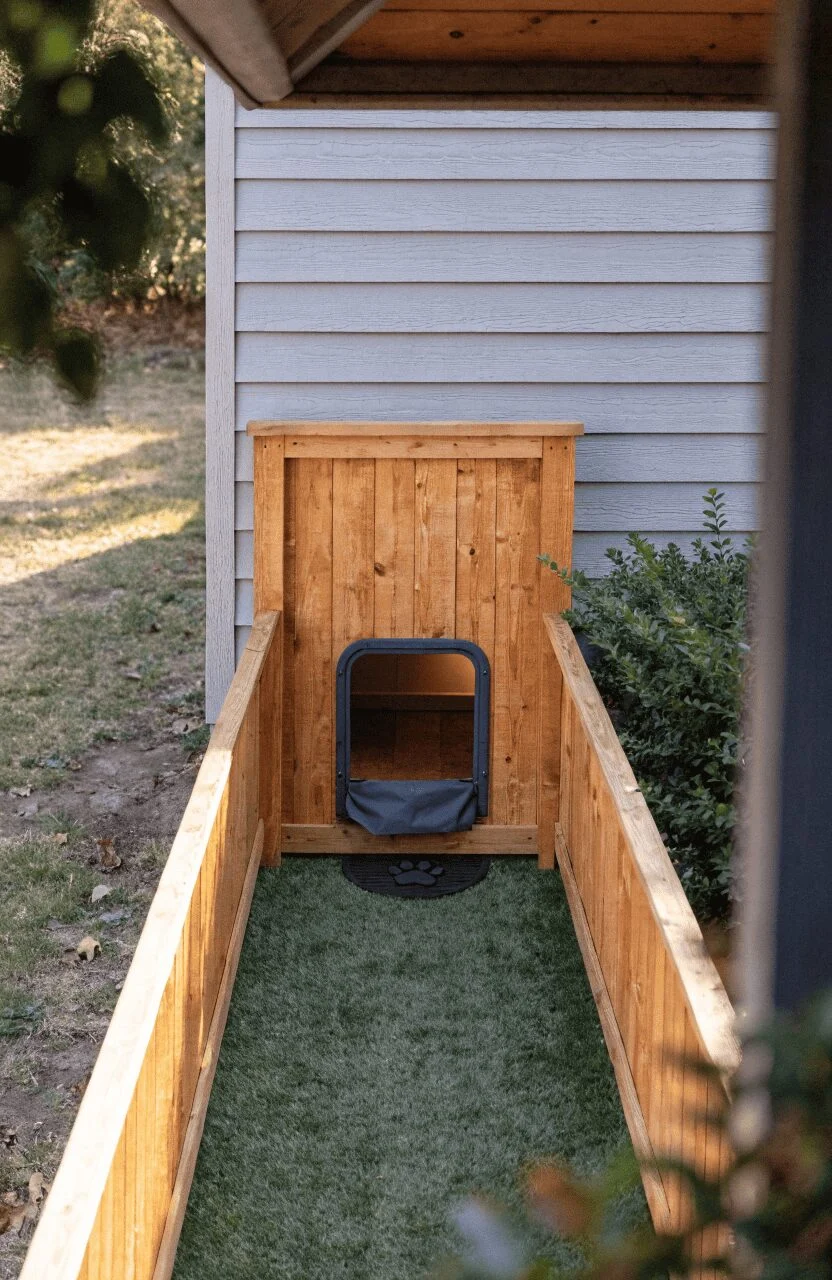
This is the run that works with your house, not just alongside it. Instead of making your dog go through the main yard to reach the run, you install a dog door directly through a side-wall gate or mudroom access point.
The flow looks like this: dog door from the house → small mudroom area with a paw-wipe mat → gate into the run. It sounds simple, but it changes how you and your dog use the space daily.
No more trudging through the living room with muddy paws. No more running to let the dog out. The run becomes a self-service system your dog can use throughout the day.
This is the most functional upgrade you can make if you work from home or have a high-energy dog with frequent outdoor needs.
Idea 10 — The Smart Run with Automatic Water, Camera, and Motion Lighting (~$1,200–$2,500)
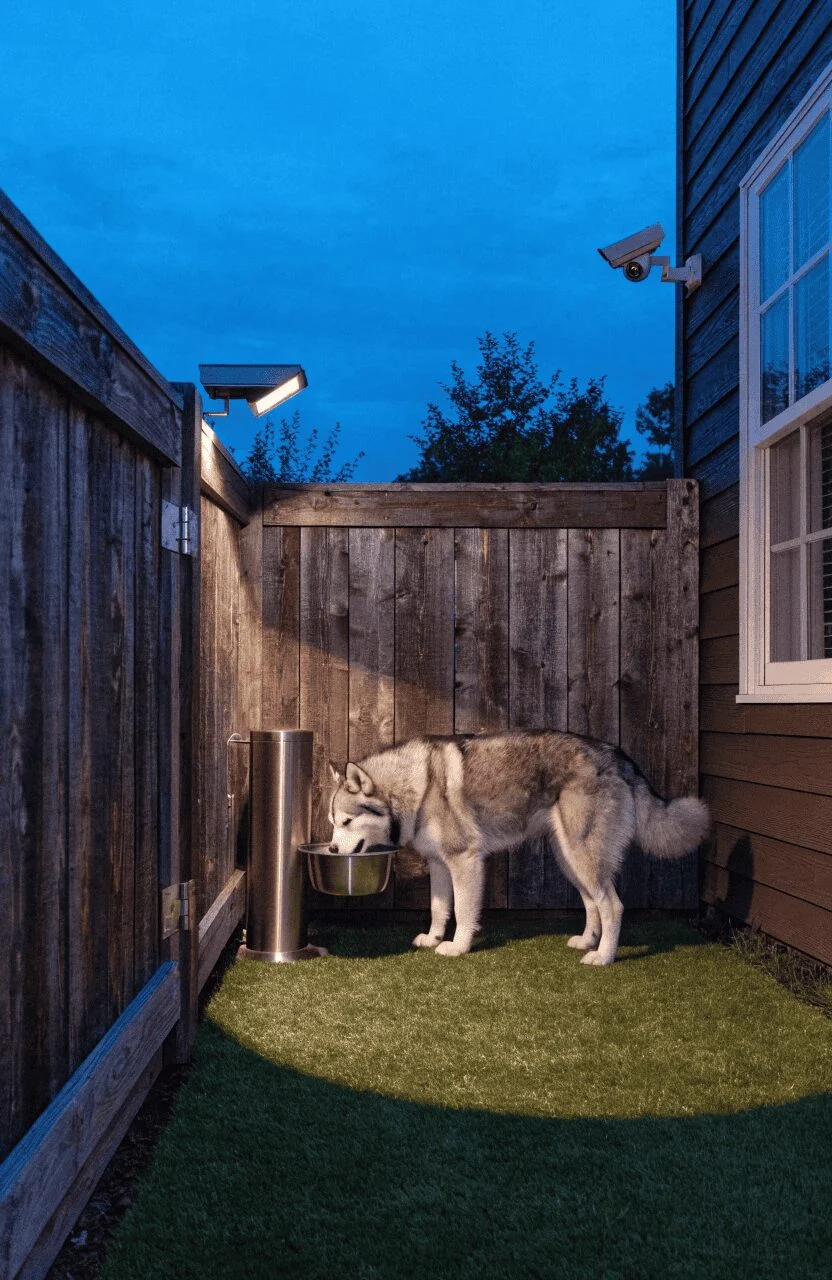
Technology has made the dog run significantly easier to manage. An automatic refill water station keeps fresh water available all day without manual effort. A simple weatherproof camera lets you check on your dog from your phone. Motion-sensor LED lights turn on automatically at dusk so your dog is always visible and safe.
Add a smart lock on the gate, and you can let a dog walker or neighbor in remotely without handing over a physical key.
None of these additions require professional installation. Most are plug-in or solar-powered and can be added to any existing run design.
For more inspiration on modern, tech-integrated spaces for dogs, this guide on smart dog space design is worth a read.
Narrow Yard Specific Ideas
Idea 11 — The Vertical Enrichment Run for Ultra-Narrow Spaces (Under 4 feet wide)
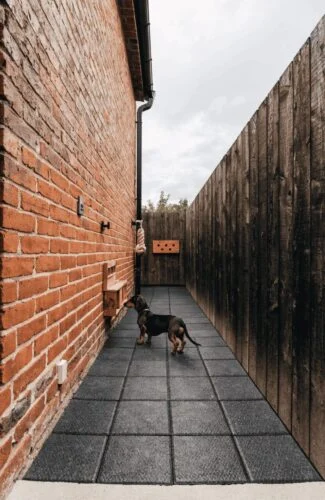
When your side yard is too narrow for traditional running, shift the focus from movement to mental stimulation. Dogs that are mentally engaged are just as satisfied as dogs that run laps.
Install wall-mounted sniff boards, puzzle feeders attached to the fence, and hanging rope toys at different heights. Add a small raised platform (just a wooden step or low deck section) where your dog can sit and observe the yard — dogs love elevated vantage points.
You’re essentially building a stimulation corridor rather than a movement corridor. It works especially well for smaller breeds and senior dogs who don’t need as much physical exercise.
Idea 12 — The Aerial or Tether Run for Yards Under 3 Feet Wide (~$50–$200)
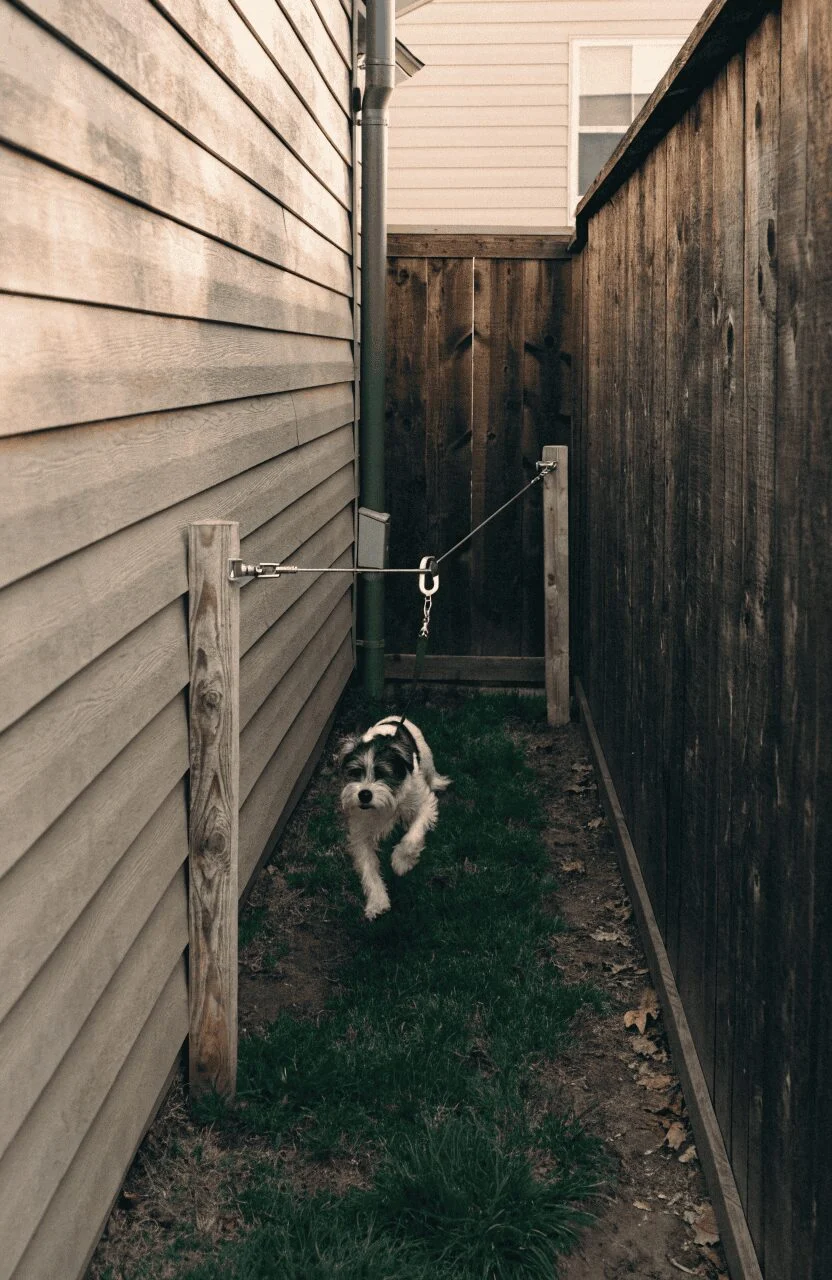
If your side yard is genuinely too narrow for any fencing solution, an aerial run (also called a trolley run or zip-line run) is your best option.
You attach a cable between two fixed anchor points — usually posts or existing structures — and clip your dog’s leash to a pulley on the cable. Your dog can run the full length of the cable freely without getting tangled.
This setup costs under $200, requires no digging or construction, and can be removed easily. It won’t win any design awards, but it works well for temporary setups, rentals, or extremely narrow corridors.
Side-Yard Dog Run Layout Ideas That Work in Any Yard
No matter which idea you choose, the layout determines how useful the space actually is day-to-day.
The Linear Layout is the most common — one long lane from one end of the house to the other. Entry gate at the house end, closed off at the far end. Simple and effective.
The L-Shaped Layout works if your side yard wraps around a corner. One arm of the L becomes the run, the other becomes an entry/transition zone. Good for giving dogs more total square footage.
Zone Your Space: Even in a simple linear layout, divide the run into three sections mentally: entry/transition near the gate, play/exercise in the middle (longest section), and potty/cleanup at the far end with a different ground cover material. This separation makes cleanup faster and keeps the rest of the run cleaner.
Gate Placement: Put your main entry gate at the house end — it’s easier to walk out directly from a door rather than going around to the far end. If the run is long, consider a second gate at the far end for maintenance access.
For more inspiration on how to structure enclosed outdoor dog spaces, browse these DIY kennel finishing ideas that pair well with any of the layouts above.
The Ground Cover Comparison Nobody Shows You
| Material | Approx. Cost | Drainage | Odor Control | Paw Safety | Maintenance |
|---|---|---|---|---|---|
| Artificial Turf (pet-grade) | $3–$7/sq ft | Excellent | Excellent | Excellent | Low |
| Pea Gravel | $0.50–$1.50/sq ft | Excellent | Fair | Good | Low |
| Concrete | $4–$8/sq ft | Poor (needs slope) | Excellent | Fair (gets hot) | Very Low |
| Cedar Mulch | $0.30–$0.80/sq ft | Good | Good | Excellent | Medium (replace 1-2x/yr) |
| Pavers | $3–$10/sq ft | Good (if gapped) | Excellent | Good | Very Low |
| Natural Grass | Near free | Poor | Poor | Excellent | High (dies quickly) |
Best combos:
- Artificial turf for running + pea gravel potty corner = best overall
- Concrete center path + turf panels on sides = easiest to clean
- Pavers at the gate + mulch throughout = most natural-looking on a budget
Keeping It Looking Good from the Outside
Your side yard is visible. Neighbors see it, guests see it, and if it faces the street, anyone walking by sees it.
A few simple upgrades make the difference between a dog pen and a designed outdoor feature:
- Stain or paint your fence in a color that matches your home’s trim. Dark tones (charcoal, navy, forest green) make fencing look sharp and intentional.
- Add a planted border along the outside of the fence with low-maintenance shrubs or ornamental grasses. This softens hard fence lines and creates a landscaped look.
- Use matching gate hardware. A mismatched latch is a small detail that makes the whole thing look rushed. Black hardware on a black fence always looks clean.
- Keep the entry tidy. A small boot scraper and a potted plant at the gate opening signals care and attention, even if the space inside is purely functional.
Simple Maintenance Schedule to Keep the Run Fresh
A dog run only stays clean if you follow a routine. Here’s what that looks like in practice:
Daily:
- Remove solid waste
- Refill water station
- Do a quick visual check for any digging along fence lines
Weekly:
- Rinse turf or gravel with a garden hose
- Check gate latches and fence integrity
- Shake out or replace any worn toys
Monthly:
- Deodorize turf or gravel with a pet-safe enzyme cleaner
- Clear any debris from drainage areas
- Check for signs of rust, rot, or wear on fencing and wood elements
Seasonally:
- In winter: ensure drainage isn’t blocked by fallen leaves or debris; check that the run doesn’t flood with snowmelt
- In summer: inspect turf or dark-surface areas for heat buildup on extremely hot days; provide extra shade or move water station to a shaded spot
A clean, well-maintained dog run lasts years longer than one that’s ignored — and it stays odor-free, which matters as much for your neighbors as it does for you.
Final Thoughts
Your side yard doesn’t have to be a forgotten stretch of dirt that gets muddy in winter and dry in summer. With the right design, it becomes one of the most functional spaces on your entire property — for your dog and for your household.
Start with your yard’s width, your dog’s personality, and your budget. Pick one idea from this list that fits all three. You don’t have to build the perfect run on the first try — many homeowners start with a gravel and timber setup and upgrade over time.
The main thing is giving your dog a dedicated space to be a dog, safely and happily, right outside your door.

Izzy is an experienced ranch worker who has a passion for exploring nature and getting up close to wildlife. With her connections to various animal organizations, Izzy is well-versed in animal care and rehabilitation.