How to Make No-Sew Dog Sweaters: 12 Cozy DIY Ideas
Winter walks don’t have to mean an expensive trip to the pet store. If you’ve got an old fleece blanket, a spare sweater, or even a worn-out hoodie sitting in your closet, you already have everything you need to make a cozy outfit for your pup. No-sew dog sweaters are exactly what they sound like — warm, stylish coats you can build without touching a sewing machine or threading a single needle.
All you need is fabric that doesn’t fray (like fleece), a pair of sharp scissors, some fabric glue or fusible tape, and a little patience. In this guide, we’re walking through 12 real, inspiration-worthy no-sew dog sweater ideas, from simple pullovers to full costume-style onesies. Each one comes with a breakdown of what it looks like, how you can recreate it, and which dogs it works best for.
Grab your fabric and let’s get started.
What You’ll Need Before You Start
Before jumping into the ideas, it helps to have your supplies ready so you’re not stopping halfway through a project.
Basic No-Sew Tools
- Fleece fabric (anti-pill fleece works best since it doesn’t fray at the edges)
- Fabric glue or a hot glue gun
- Fusible hem tape and an iron (for a cleaner finish than glue)
- Sharp fabric scissors
- Fabric marker or chalk
- Elastic or ribbon (for ties and cuffs)
Measuring Your Dog Correctly
A no-sew sweater only looks good if it fits well. Before cutting any fabric, take three measurements:
- Neck circumference — around the base of the neck, where a collar sits
- Chest girth — the widest part of the ribcage, right behind the front legs
- Back length — from the base of the neck to the base of the tail
Write these numbers down and add half an inch of wiggle room for comfort. If you’re outfitting a small breed, check out this guide on best small dog breeds to understand typical sizing differences between toy and small breeds before you start cutting fabric.
Now, let’s get into the ideas.
1. Colorblock Fleece Four-Leg Onesie
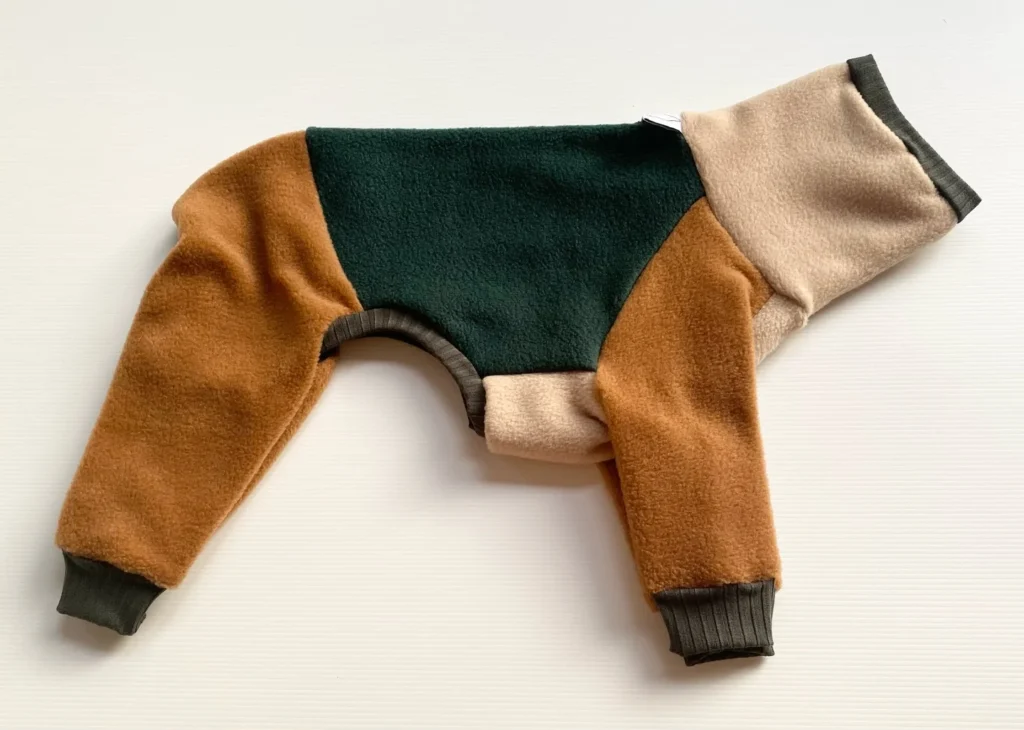
This is one of the most functional no-sew designs out there, and it’s a favorite for dogs who need full-body coverage rather than just a back-and-belly cover. Picture a rust-orange, forest-green, and tan patchwork fleece suit with all four legs covered and ribbed cuffs at the wrists and ankles. The color-blocking makes it look intentional and polished, even though it’s built from fleece scraps joined together without a single stitch.
Start with a basic fleece “onesie” pattern (search for a free printable four-leg pattern sized to your dog, or trace an old dog sweater that already fits). Cut two body panels and four leg tubes from different colored fleece scraps. Instead of stitching the seams, use fusible hem tape and iron the edges together, or run a thin line of fabric glue along each seam and clamp with binder clips while it dries. Finish the cuffs with pre-made ribbed knit cuffs, glued on for that snug, professional finish.
This style works especially well for dogs with short or medium coats who get cold quickly, like Greyhounds, Whippets, or French Bulldogs that need leg coverage in winter.
📸 Photo credit: Instagram @gipphound
2. Checkerboard Print Pullover Style
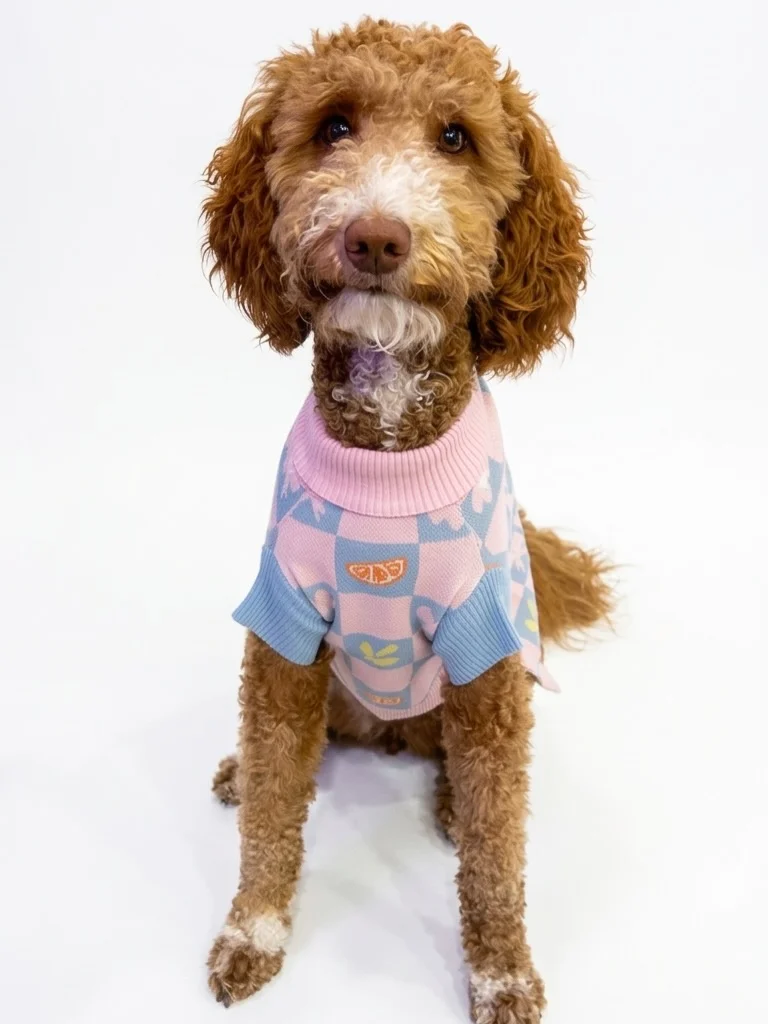
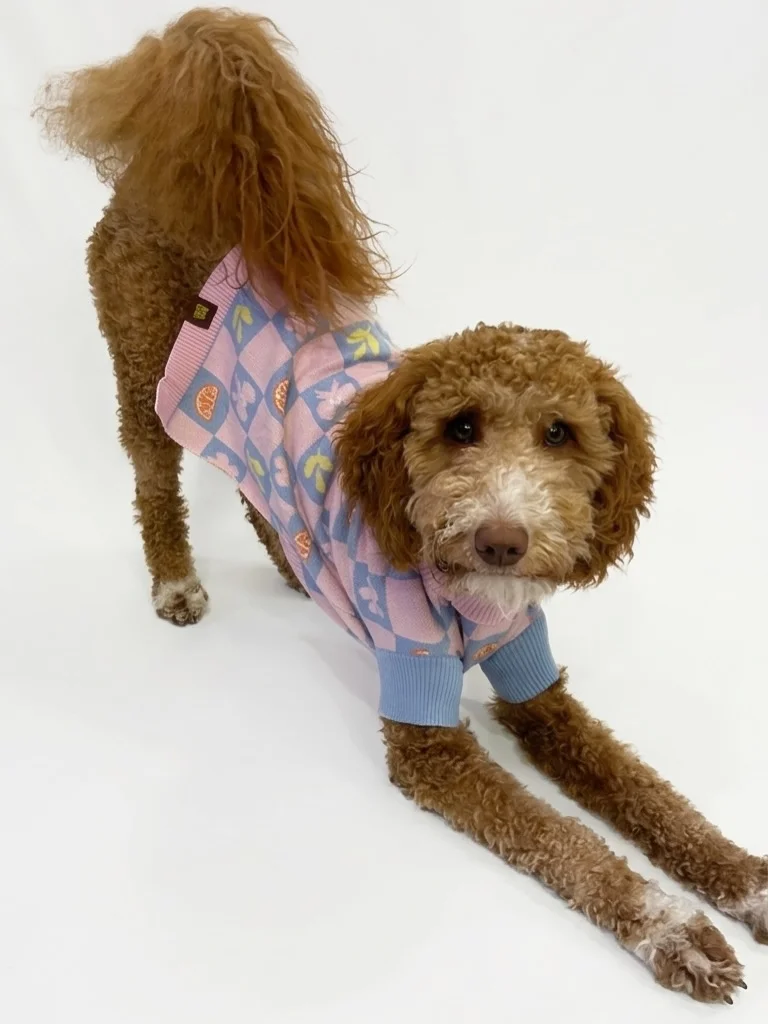
If you want something that looks like it came from a boutique but costs a fraction of the price, this checkerboard print pullover is a great template. It features a soft pink-and-blue checkerboard pattern with small fruit and leaf motifs, finished off with contrasting blue ribbed cuffs and a pink ribbed collar. It’s a pullover style, meaning it slips over the head and covers the back and belly.
Look for printed fleece or soft knit-look fleece in a fun pattern like checkerboard, gingham, or florals. Cut a simple T-shaped pattern — one rectangle for the body, with a slit for the head and two smaller openings for the front legs. Instead of hemming the edges with a needle, use fusible tape along the raw edges to prevent curling, then glue on pre-made ribbed cuffs at the neckline and leg openings for that finished, boutique look.
This design shines on medium-sized, fluffy-coated dogs like Cavapoos, Cockapoos, or Goldendoodles, since the pullover shape flatters a longer torso.
📸 Photo credit: Instagram @lolas.sox
3. Buffalo Plaid No-Sew Vest with Faux Fur Collar
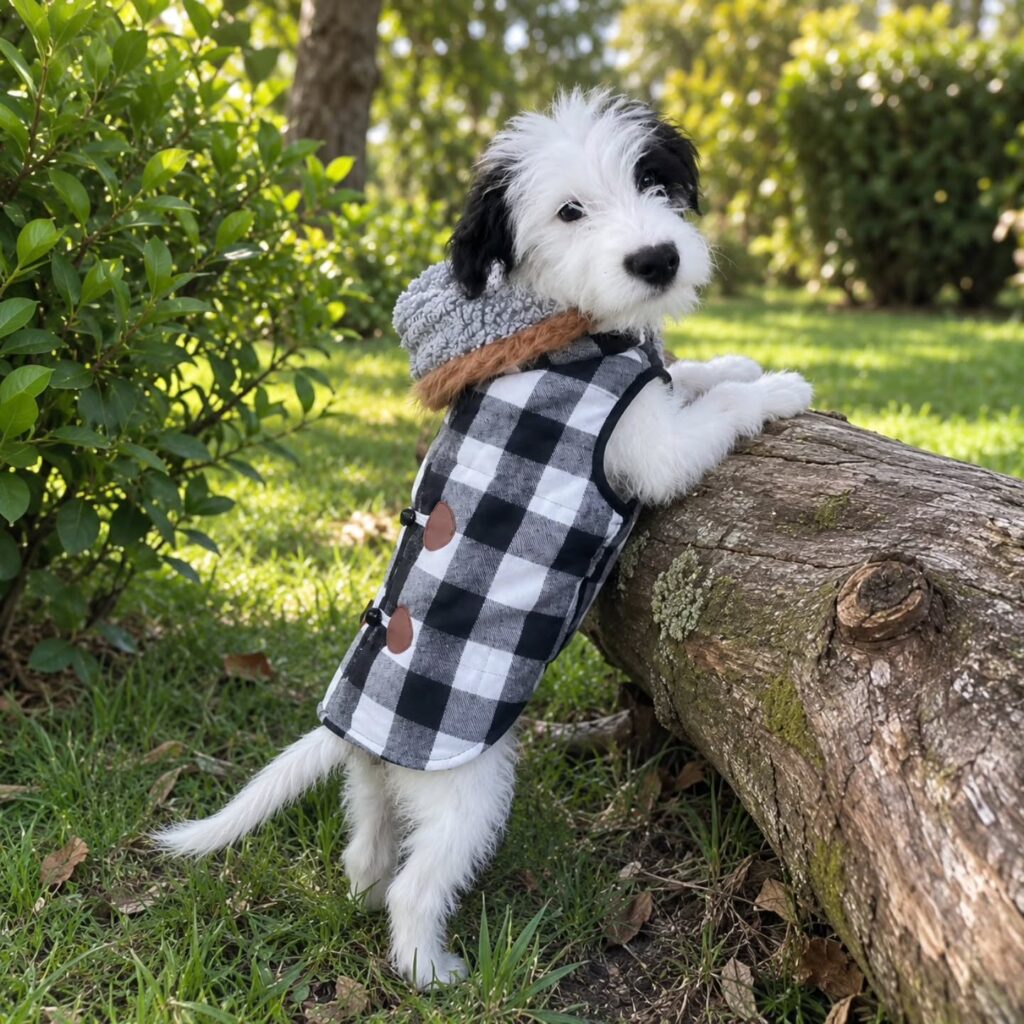
For a rustic, farmhouse-style look, this buffalo plaid vest is one of the easiest no-sew projects on this list because vests require far less fabric shaping than a full sweater. It’s a black-and-white buffalo plaid fleece vest with a soft grey faux fur collar and leather-look button closures down the side, sitting like a little open jacket instead of a pullover.
Cut a single rectangle of buffalo plaid fleece long enough to wrap around your dog’s torso, with a curved neckline cut at one end. Fold and glue the raw edges using fusible tape. Attach a strip of faux fur fabric around the neckline using fabric glue for that cozy collar look, then use no-sew snap fasteners — the kind that clamp on with a pair of pliers — down one side to close the vest instead of sewing button holes.
This one is ideal for puppies and small dogs who need a light layer rather than a full sweater, especially for early fall or mild winter days, or for dogs who dislike fabric on their legs.
📸 Photo credit: Instagram @manitos.pets
4. Striped Fleece Hoodie Look
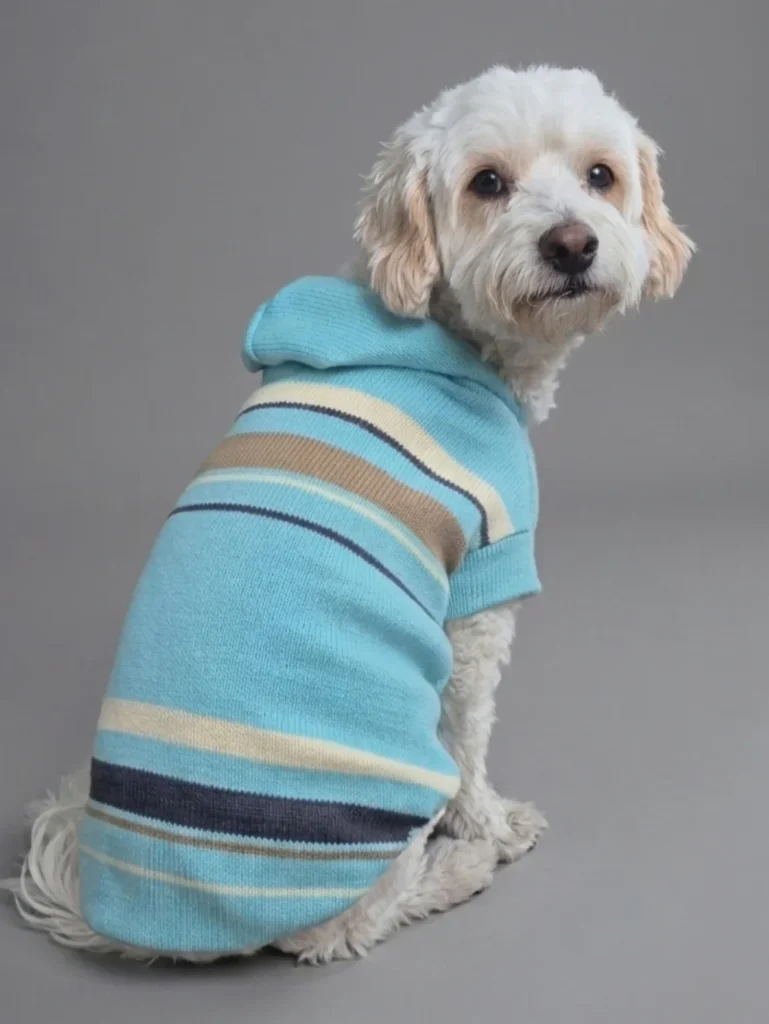
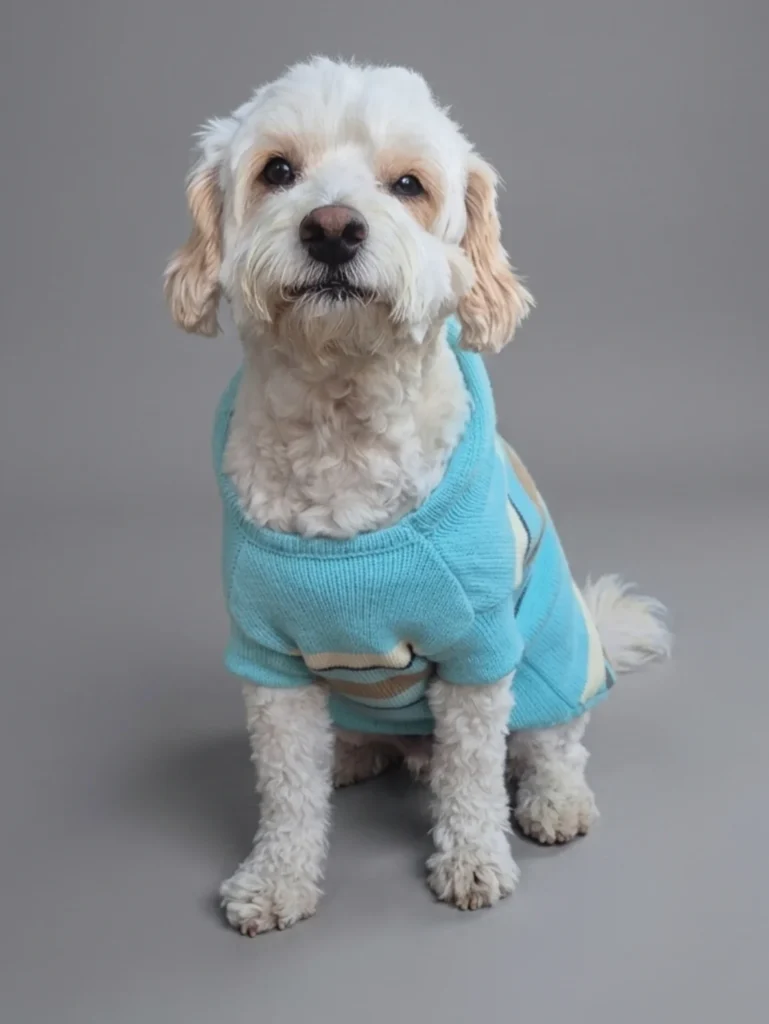
A hooded sweater adds an extra layer of warmth around the ears and neck, and this striped version proves you don’t need to sew a complicated hood to get the look. It’s a light blue, cream, and tan striped sweater with a soft hood that lays flat against the back when not in use, plus ribbed cuffs that match the body color for a clean, coordinated finish.
The trickiest part of a hoodie is the hood itself, but you can simplify this by cutting a half-circle of fleece and gluing (or fusible-taping) the curved edge together to form a cone shape, then attaching the flat edge to the neckline of your sweater body. Use striped fleece, or sew two coordinating solid fleece colors edge-to-edge with fusible tape to mimic a striped pattern. Add ribbed cuffs at the sleeve openings for a store-bought finish.
It’s a great pick for dogs with short or fine fur who feel cold around their ears, like Chihuahuas, Miniature Pinschers, or senior dogs who run cold.
📸 Photo credit: Instagram @locky_el_simba
5. Fair Isle Paw-Print Pocket Sweater Style
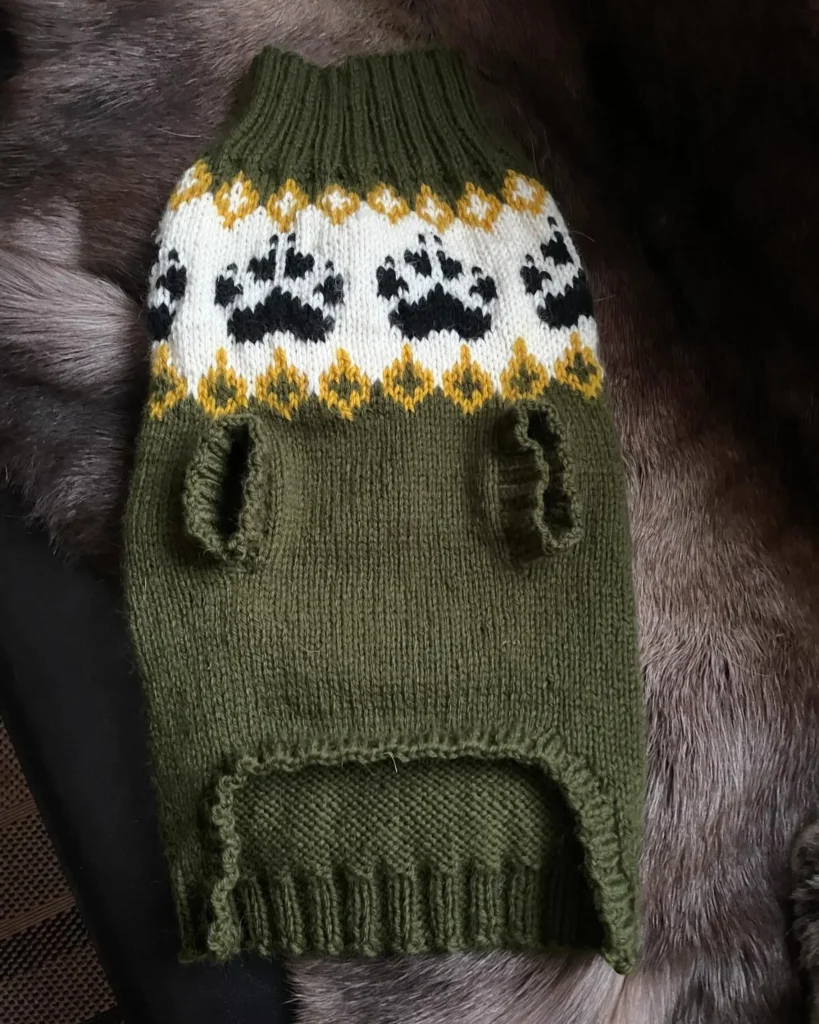
This design brings a festive, cabin-inspired look with a fun paw print motif, and the pouch-style front pocket is a detail that’s easier to recreate without sewing than you’d think. It’s an olive green sweater with a cream and gold Fair Isle-style paw print pattern around the neckline, plus a small front pocket detail near the chest, finishing in a simple ribbed hem band.
While the original Fair Isle pattern is knitted, you can recreate the look using printed fleece with a paw-print or Nordic pattern, paired with a solid olive fleece body. For the pocket detail, cut two small fleece rectangles, fold the top edge over, and glue three sides onto the body panel before assembling the rest of the sweater, leaving the top open like a real pocket. Fusible tape works well for all the main seams.
Small to medium dogs who love a bit of personality in their wardrobe will suit this style best, especially for holiday photos and winter outings.
📸 Photo credit: Instagram @toneberitengebretsen
6. Cherry Print Sherpa Fleece Onesie
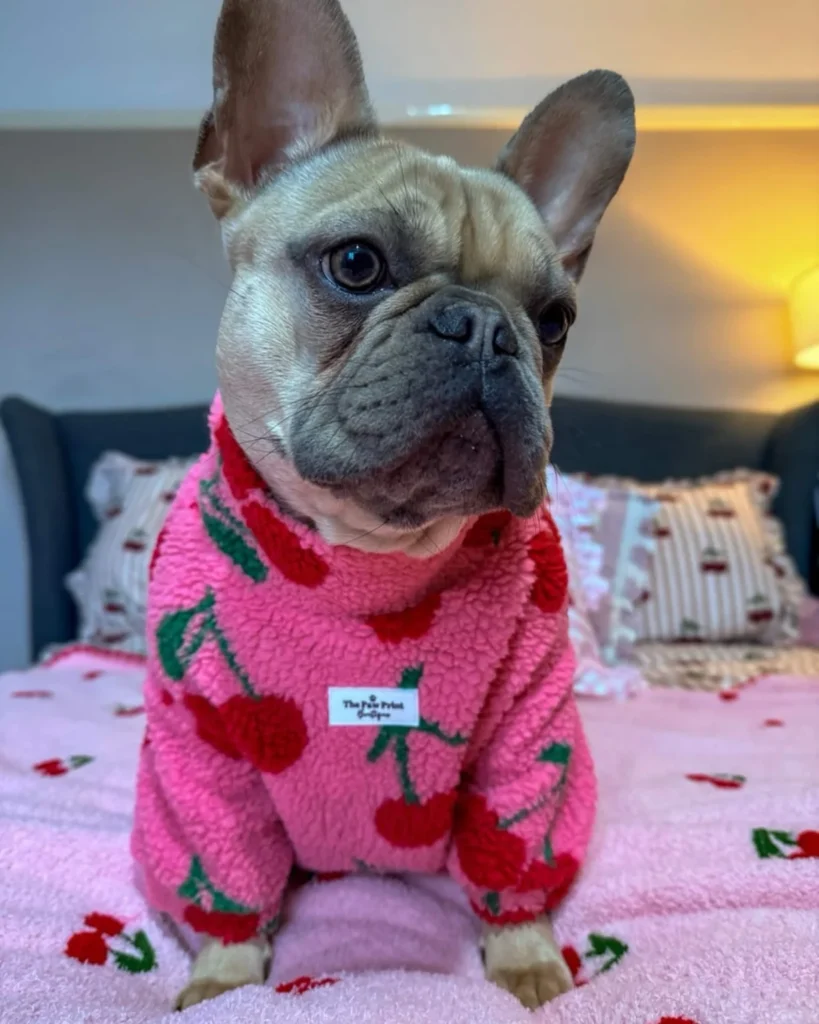
Sherpa fleece takes any no-sew project up a notch in terms of coziness, and this cherry print onesie is proof that a playful pattern can still look put-together. It’s a bright pink sherpa fleece onesie covered in a bold red cherry print, with full sleeve coverage down each front leg and a soft, plush texture throughout, finished with a small fabric label glued near the chest for a branded touch.
Sherpa fleece is thicker than standard fleece, so it holds its shape well even without stitched seams. Use a strong fabric glue (or a hot glue gun on a low setting, tested first on a scrap) along all seam lines, and reinforce with fusible hem tape on high-stress areas like the underarms. Add a printed or embroidered patch near the chest using fabric glue for that boutique-label look.
This is one of the warmest styles on the list, making it a great match for small breeds with thin coats, like French Bulldogs or Chihuahuas, who need extra insulation during cold snaps.
📸 Photo credit: Instagram @frankieb_thefrenchb
7. No-Sew Dino Costume Sweater
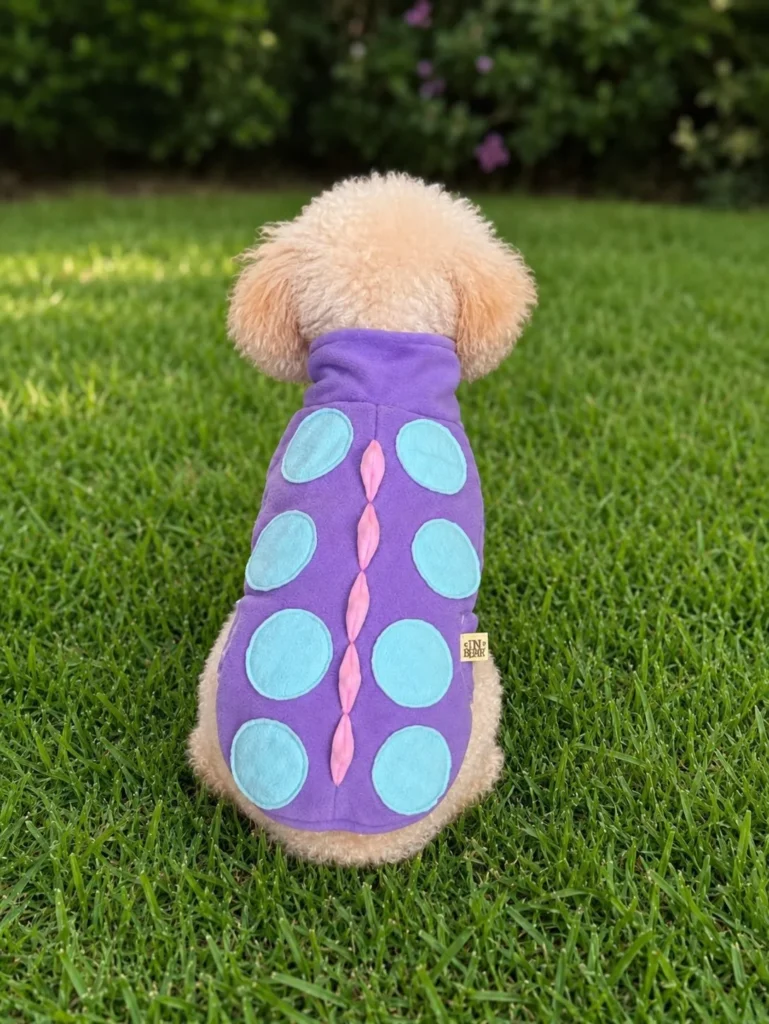
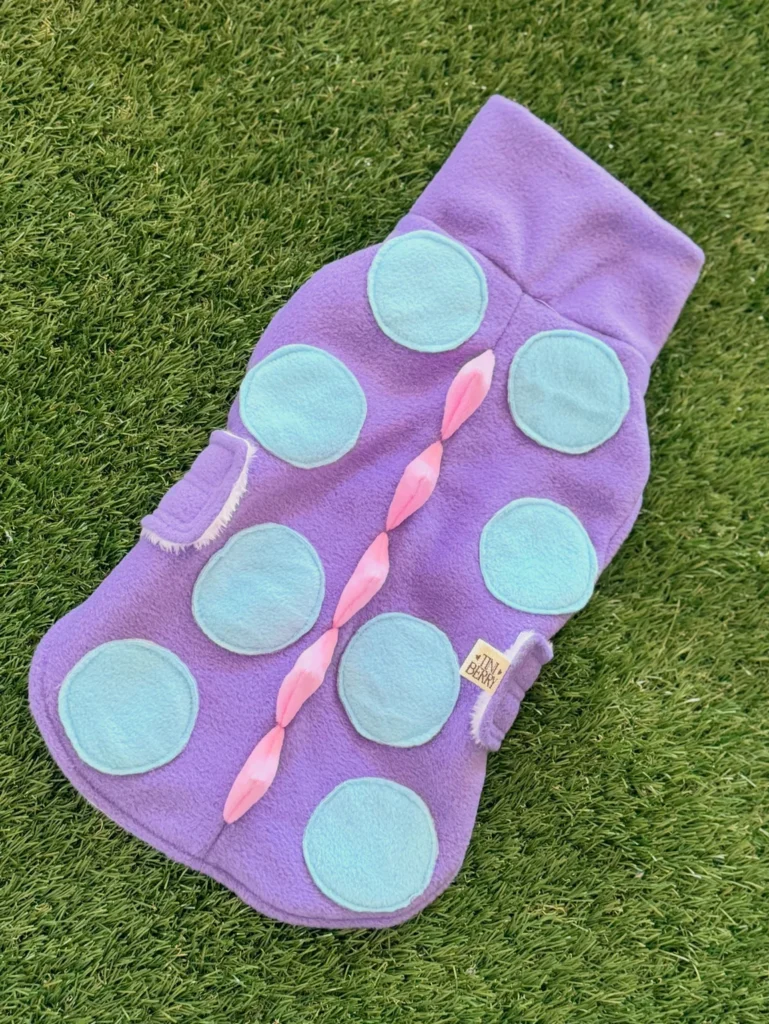
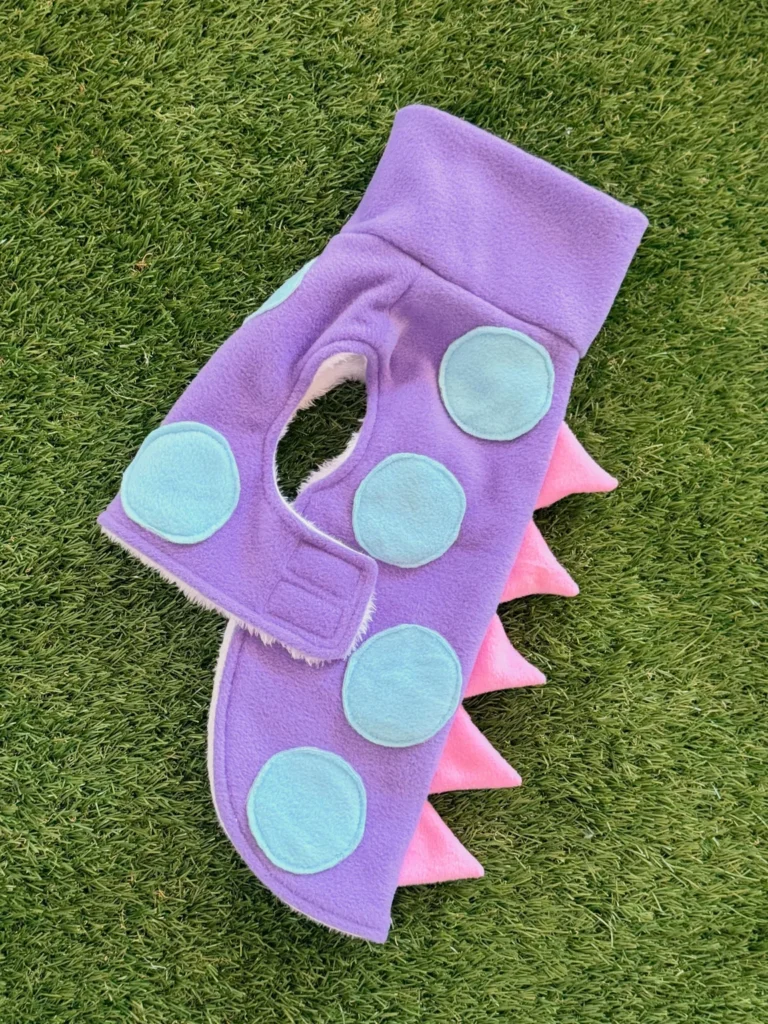
Want to have some fun with your dog’s wardrobe? This dinosaur-inspired sweater is a great example of how no-sew methods make novelty costumes way more approachable. It’s a purple fleece sweater covered in light blue polka-dot “scales” and a row of pink fleece spikes running down the spine, finished with a soft faux fur trim along the belly and legs — part sweater, part costume, and entirely adorable.
Start with a basic sweater body cut from purple fleece. Cut small circles from teal fleece for the “scale” spots and glue them evenly across the back and sides using fabric glue. For the spikes, cut small triangle shapes from pink fleece, fold them in half, and glue the folded edge into the center back seam before it’s fully assembled, so they stick up like a dinosaur’s ridge. Fusible tape works well for attaching faux fur trim around the edges.
It’s best suited for dogs who tolerate costumes well, and it looks especially natural on rounder, compact breeds like Poodles or Cavoodles, where the “ridge” sits nicely along the spine.
📸 Photo credit: Instagram @tiniberry.mascotas
8. Chunky Knit-Look Fleece Sweater
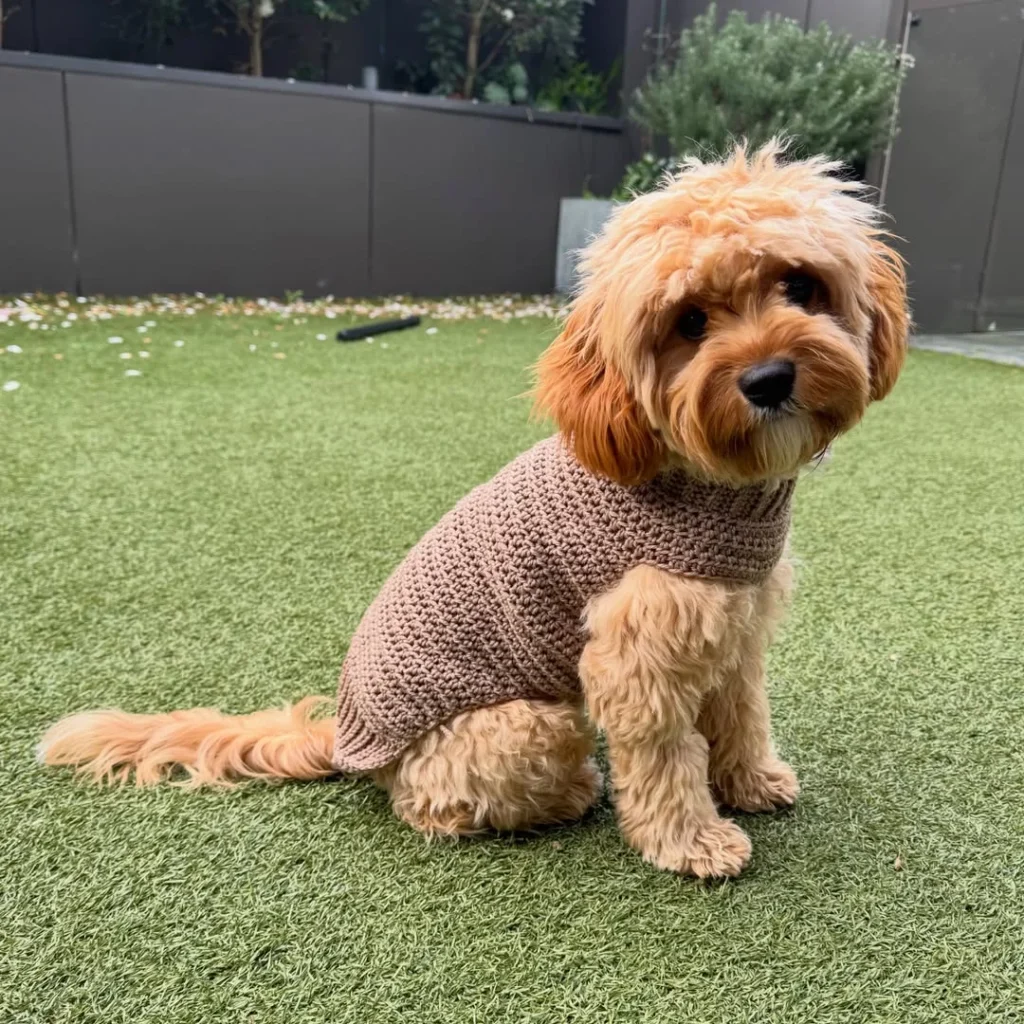
Not everyone wants to knit an entire sweater by hand, but you can absolutely fake the chunky knit look using no-sew fleece techniques. This one is a warm taupe-brown sweater with a thick, chunky-knit texture and a ribbed neckline that mimics a hand-knitted crochet piece, but without any visible stitching.
Look for a “sweater fleece” or textured fleece fabric that already has a knit-like surface — these are widely available and give you the chunky knit appearance without needing actual knitting needles. Cut your sweater body pattern, then use fusible hem tape along every raw edge to prevent the thicker fabric from fraying or curling. A ribbed knit collar, bought pre-made, can be glued on at the neckline to complete the look.
This earthy, neutral tone pairs beautifully with lighter or golden coats, making it a natural fit for medium-sized, curly-coated dogs like Cavapoos and Cockapoos.
📸 Photo credit: Instagram @remy.potatogem
9. Pom-Pom Trim Sweater and Hat Set
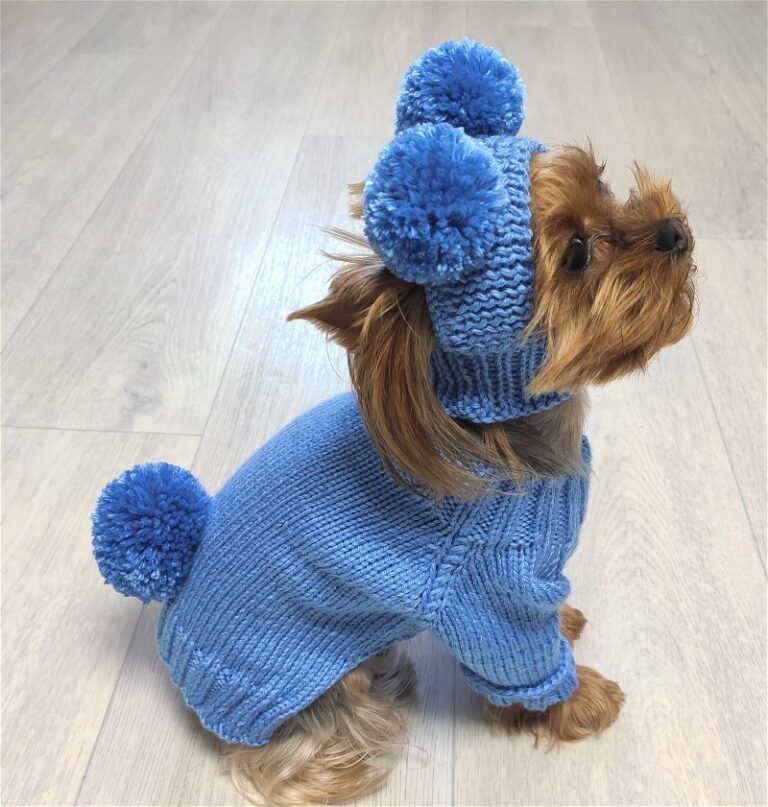
If you want a design that photographs beautifully, this pom-pom trimmed sweater-and-hat combo is worth the extra effort. It’s a dusty blue sweater paired with a matching hat, both decorated with oversized yarn pom-poms — two on the hat, one on the sweater’s back, and one at the tail. It’s a coordinated, whimsical set that looks straight out of a winter catalog.
Build your basic sweater body from blue fleece using fusible tape for the seams. For the pom-poms, you don’t need to knit them into the fabric — simply make yarn pom-poms using a fork or pom-pom maker, then hot glue them directly onto the finished sweater and hat wherever you like. This is one of the simplest embellishments to add without any sewing at all.
Small breeds with longer fur, like Yorkies or Shih Tzus, tend to show off the pom-pom detailing best against a fuller coat.
📸 Photo credit: Instagram @dog.moda
10. Upcycled Human Sweater Sleeve Method
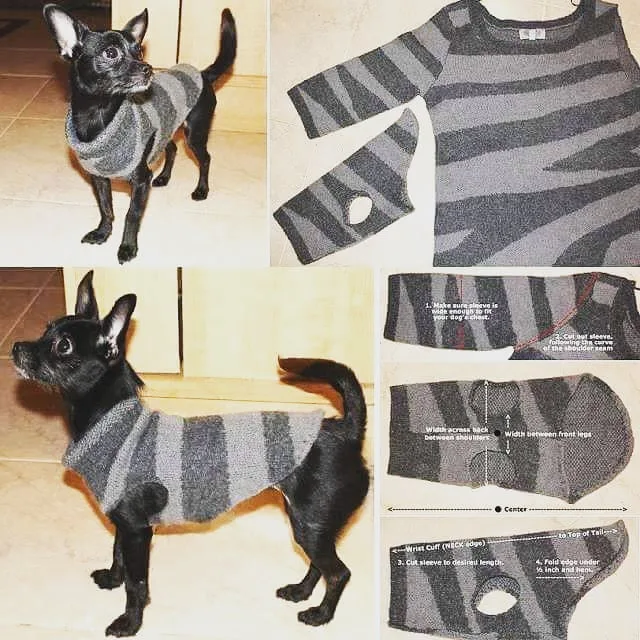
This is the ultimate budget-friendly no-sew hack, and it deserves its own spot on the list because it requires zero new fabric — just an old sweater you already own. It’s a grey-and-charcoal striped sweater made entirely from a repurposed human sweater sleeve, complete with a built-in leg hole cut near the cuff and the original ribbed hem reused as the sweater’s finished edge.
Take an old sweater and cut off one sleeve at the shoulder seam, keeping the original cuff intact — this becomes the neckline or waistband of your dog’s sweater. Cut a small hole near the wider end of the sleeve for one front leg. Fold the raw cut edge inward and secure it with fusible hem tape, or glue the fold with fabric glue and let it dry flat. Since the fabric already came from a finished garment, most of the edges, like the original cuff and hem, don’t need any additional finishing at all.
This method takes less than 20 minutes and works on almost any small to medium dog, making it perfect for anyone on a budget or short on time, and a great way to reuse a sentimental sweater instead of throwing it away.
📸 Photo credit: Instagram @jenchampken
11. Ribbed Turtleneck Style Fleece Sweater
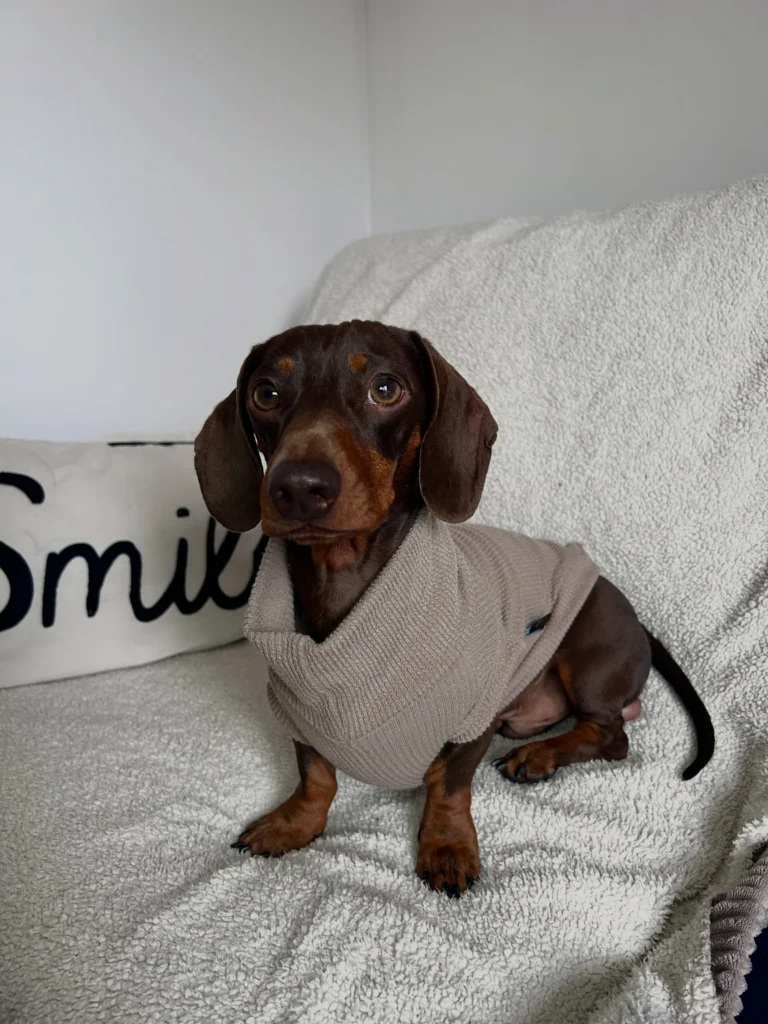
For a timeless, classic look, a ribbed turtleneck sweater never goes out of style — and this version proves it can be made without any stitching. It’s a soft beige sweater with a ribbed knit-look turtleneck collar that folds gently at the neck, covering the chest and back in a simple, elegant silhouette with no extra patterns or embellishments.
Use a textured or ribbed-look fleece for the body, and purchase a pre-made ribbed knit tube (often sold for DIY collar and cuff projects) to use as the turtleneck. Cut your sweater body pattern, then glue or fusible-tape the ribbed tube directly onto the neckline opening, folding it over once it’s attached to create that classic turtleneck fold. Finish the bottom hem and leg openings with fusible tape to prevent curling.
The turtleneck style keeps the chest extra warm, which matters for Dachshunds, Beagles, and other short-legged breeds with a lower body closer to cold ground.
📸 Photo credit: Instagram @sir_reggiethesausage
12. Matching No-Sew Sweaters for Two Dogs
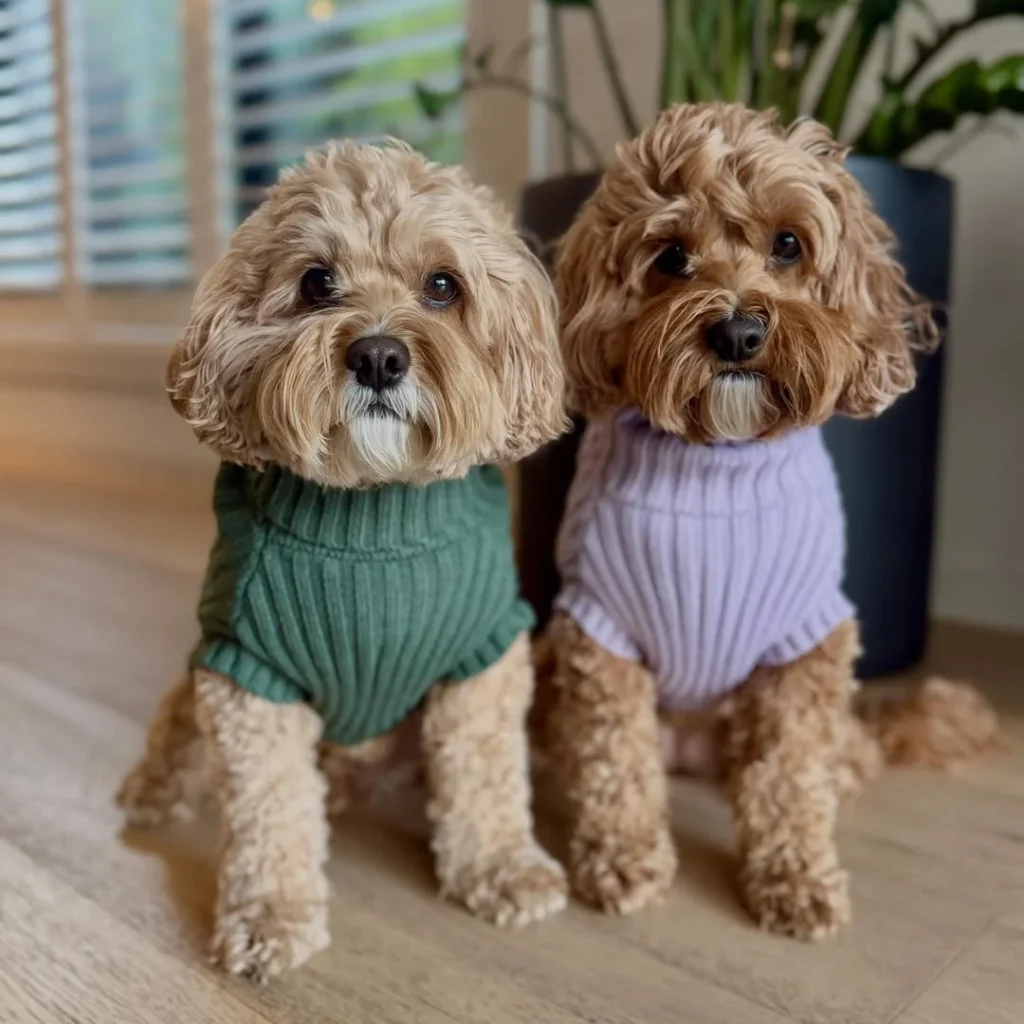
If you have more than one dog, coordinating outfits are always a hit — and the no-sew method makes it easy to batch-produce two (or more) sweaters at once. Picture two ribbed sweaters in complementary colors, one sage green and one soft lilac, both cut from the same simple pattern, just in different fleece colors, giving each dog their own look while still matching as a set.
Once you’ve made one sweater and confirmed the fit, the process becomes a repeatable template. Trace your finished pattern piece onto different colored fleece for each dog, adjusting the size slightly if your dogs aren’t the same breed or weight. Use the same fusible tape or glue method for every seam so the finish stays consistent across both sweaters. Buying fleece in bulk or from remnant bins is an easy way to keep this project affordable when making multiples.
This idea works great for multi-dog households, especially with dogs of similar or slightly different sizes, like a Cavapoo and a Cockapoo, where a coordinating color palette makes for great photos without looking overly matchy.
📸 Photo credit: Instagram @rubenandlucia
Sizing Tips for No-Sew Dog Sweaters
Getting the fit right matters more than the design itself. A sweater that’s too tight will restrict shoulder movement, while one that’s too loose can slip or bunch up during walks.
- Always measure your dog standing up, not sitting, for the most accurate chest and back measurements.
- Leave slightly more room around the neck than you think you need — dogs dislike anything that feels too snug near the throat.
- If your dog is between sizes, size up and use ribbed cuffs to snug the fit at the wrists and ankles instead of cutting the body too tight.
- Breeds with deep chests, like Greyhounds, need extra length in the belly panel compared to their back measurement.
If you’re not sure what coat type or size category your dog falls into, this breakdown of small dog breeds that don’t shed can help you understand coat thickness differences that affect how warm a sweater needs to be.
Common Mistakes to Avoid
Even simple no-sew projects can go wrong if you skip a few key steps. Here’s what to watch out for:
Skipping the fray-test. Not all fleece is created equal — always cut a small scrap and pull at the edges before starting your full project. If it frays even slightly, use fusible tape on every edge instead of relying on glue alone.
Using too much glue. A thick, gloppy seam feels stiff and can irritate your dog’s skin. Apply glue in thin, even lines and let each seam dry fully before moving to the next one.
Forgetting leg hole placement. Measure twice before cutting leg holes — a hole that’s placed too far forward or too small will make the sweater uncomfortable and hard to put on.
Ignoring the coat type. A thick-coated dog like a Husky doesn’t need a heavy sherpa onesie, while a short-haired breed like a French Bulldog might need one. Match your fabric weight to your dog’s natural insulation.
If you’re building a whole wardrobe collection, it’s worth reading up on general dog accessory tips to round out your dog’s cold-weather gear beyond just sweaters.
Caring for Your Dog’s No-Sew Sweater
No-sew sweaters are surprisingly durable if you finish the seams properly, but a little care goes a long way.
- Hand wash when possible. Machine washing can loosen glued seams over time, especially in a hot wash cycle.
- Air dry, don’t tumble dry. Heat from a dryer can weaken fusible tape bonds and cause pilling on sherpa or textured fleece.
- Check seams monthly. If you notice a seam starting to peel, reinforce it with a small amount of fresh fabric glue before it fully separates.
- Store flat, not folded tightly. This helps ribbed cuffs and collars keep their shape between wears.
Fleece is naturally low-maintenance, which is part of why it’s the go-to fabric for no-sew projects in the first place — it dries fast and resists odor better than most knit materials.
Final Thoughts
No-sew dog sweaters are one of the easiest ways to keep your dog warm and stylish without needing any sewing experience. From full-body onesies to simple pullovers, vests, and even costume-inspired designs, there’s a style on this list for almost every dog breed, coat type, and skill level.
The best part? Once you’ve made your first one, every project after that gets faster. You’ll start recognizing which fabrics work best, how much fusible tape you actually need, and which cuff styles give you that polished, boutique look. Pick your favorite idea from this list, grab your fleece, and get started — your dog’s next favorite outfit is just a glue gun away.
Izzy is an experienced ranch worker who has a passion for exploring nature and getting up close to wildlife. With her connections to various animal organizations, Izzy is well-versed in animal care and rehabilitation.