Homemade Banana Carrot Dog Treats That Turn Ripe Bananas Into Training Gold
Every dog owner eventually faces the same kitchen dilemma: a bunch of bananas going from speckled to overripe on the counter, and a carrot or two softening in the crisper drawer. Most people toss them both and head to the store, but here is the truth — those two ingredients are about to become the most versatile, nutritionally packed treats your dog has ever tasted. Banana carrot dog treats solve the overripe banana problem while delivering potassium, fiber, and natural sweetness that no commercial biscuit can match. These four recipes cover every texture your dog might prefer, from a hard cracker-style crunch that satisfies determined chewers to a soft, pillowy disc for puppies and seniors. Whether you have a grain-sensitive dog, a hot summer day, or a pocket full of training treats you would rather fill with something real, one of these four banana carrot dog treats recipes has your back.
Why Banana and Carrot Are the Perfect Pair for Dogs
The combination of banana and carrot in dog treats is not accidental — it is nutritional good sense that happens to taste exactly like something your dog will beg for. Ripe bananas bring potassium, which supports healthy heart and muscle function, plus vitamin B6 that aids metabolism and brain health. Carrots bring a completely different set of benefits to the table. Beta-carotene for eye and immune health, insoluble fiber that keeps digestion moving, and a satisfying crunch that actually scrapes the teeth a little as your dog chews. Grate the carrots finely rather than handing your dog whole baby carrots, which can be a choking risk for small dogs. Together, banana and carrot need no added sugar, no fancy preservatives, and no ingredient list you need a chemistry degree to read. If your dog falls into the carrot-skeptic camp, this pairing is exactly the bridge you need, and you might find yourself reaching for carrot and apple waffles for dogs to expand the variety even further.
Four Textures From Two Ingredients: Pick Your Dog's
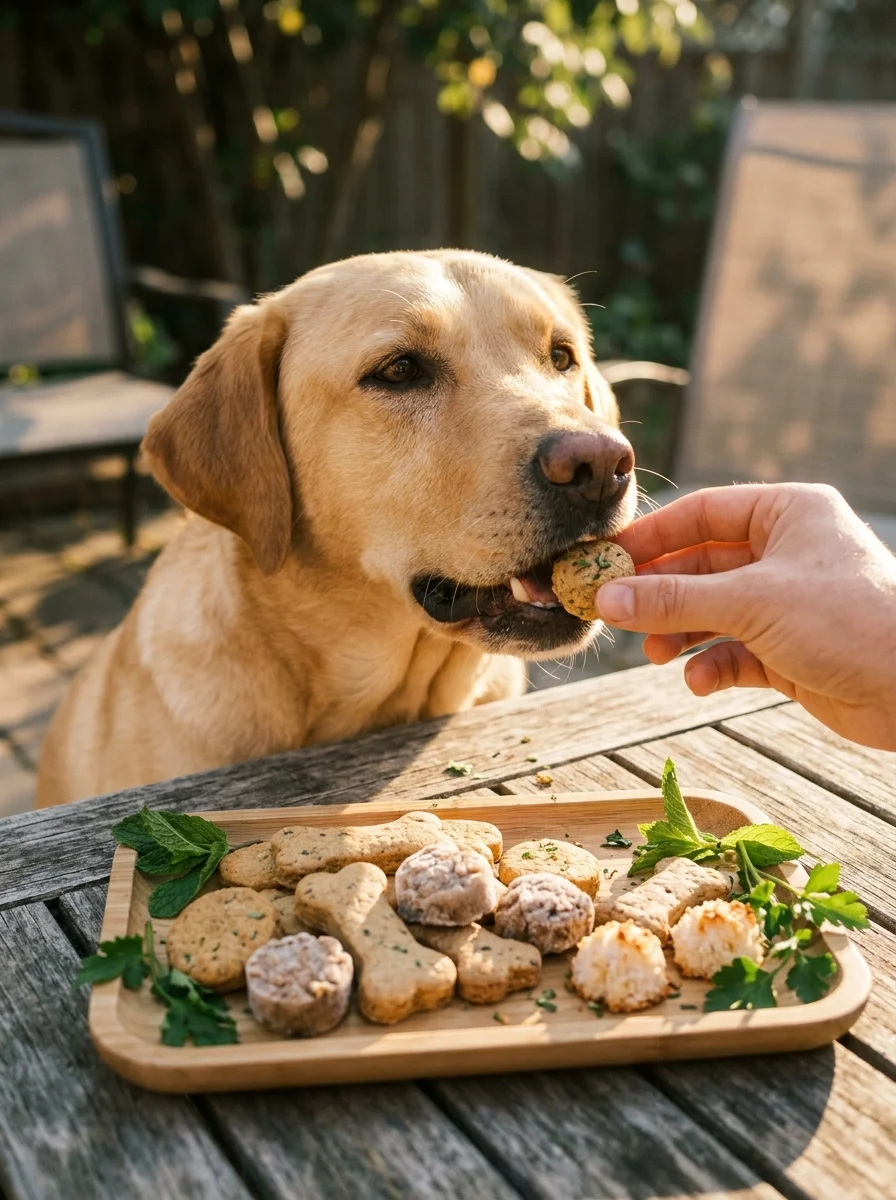
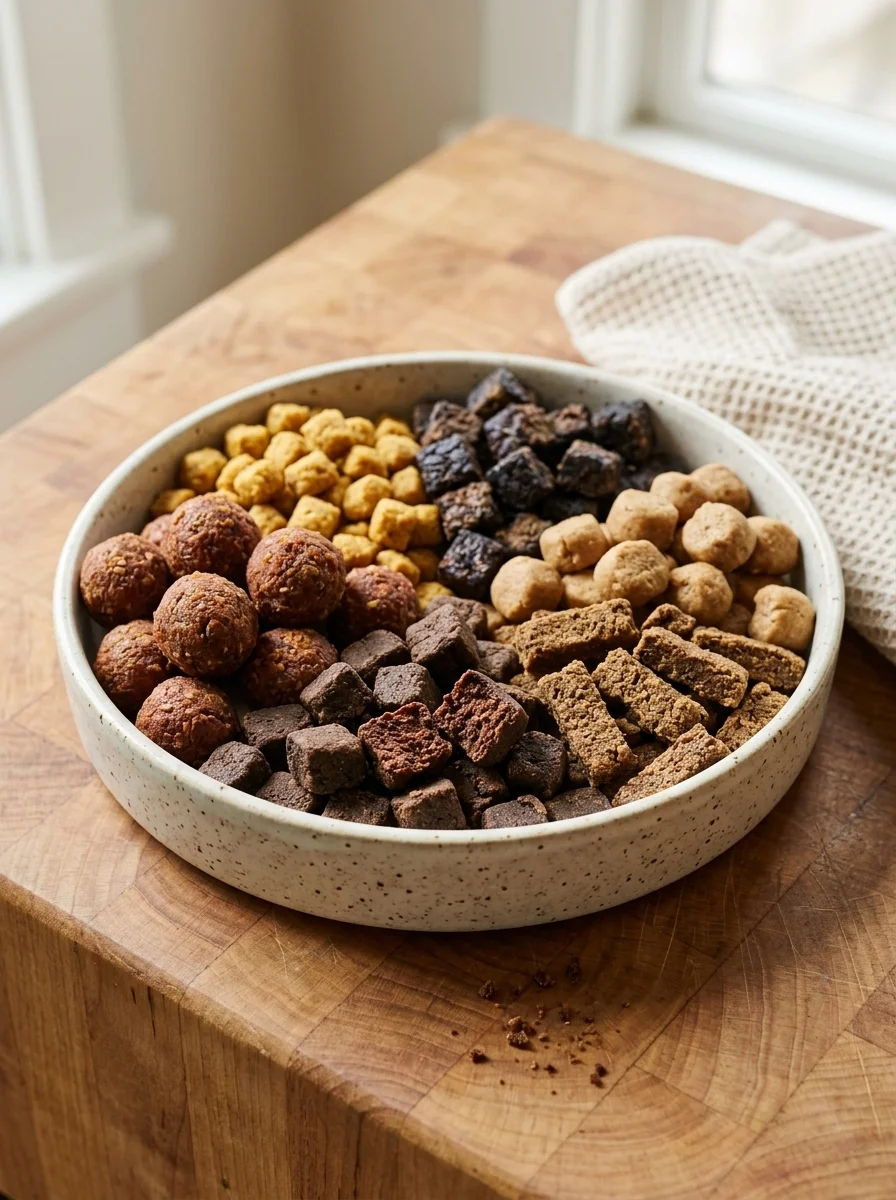
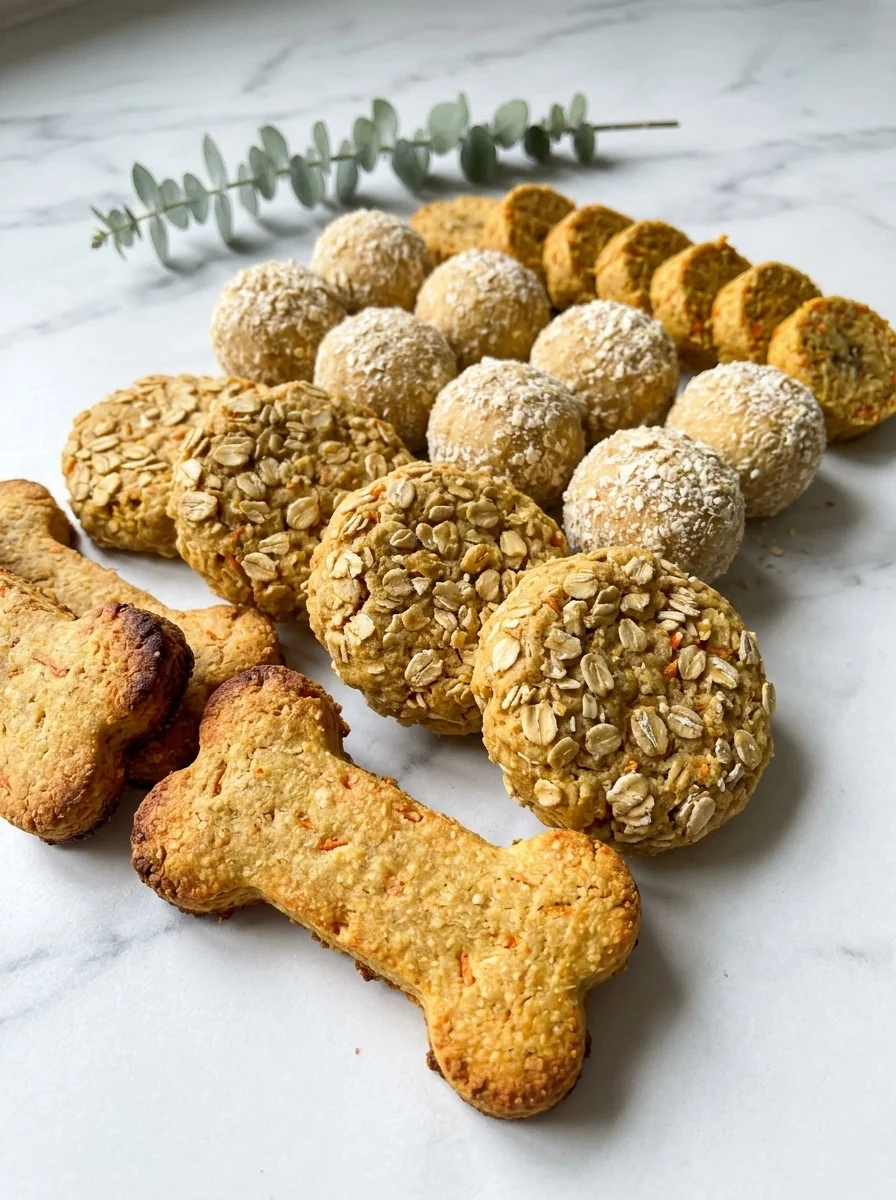
Not every dog eats the same way, and not every situation calls for the same treat texture. These four banana carrot dog treats recipes cover every one of those needs using the same two core ingredients, and picking the right one for your dog is simpler than it sounds.
Crunchy banana carrot dog treats are the answer for dogs who love to work for their food. A firm, baked biscuit with a crisp edge gives your dog something to gnaw, crack, and savor, and that extended chewing time actually slows down how quickly they consume the calories.
Soft and chewy banana carrot dog treats discs move in the opposite direction. They yield easily under pressure, which makes them perfect for puppies under six months whose teeth are still sharp but whose jaws lack the strength to handle a dense biscuit. Senior dogs with worn teeth or missing molars also benefit from a softer treat that does not require aggressive chewing.
No-bake banana carrot dog treats balls are the summer solution. When the kitchen feels like a sauna and turning on the oven seems counterproductive, these chilled balls come together in minutes and set in the refrigerator with zero baking involved.
Grain-free banana carrot dog treats logs cater to dogs with allergies or sensitivities. The ground ginger in this recipe adds a gentle warming note that most dogs enjoy and that can soothe mild stomach discomfort. If you are exploring grain-free options more broadly, this guide walks through additional grain-free base ingredients you can rotate into your treat rotation.
Recipe 1: Classic Crunchy Banana Carrot Biscuits
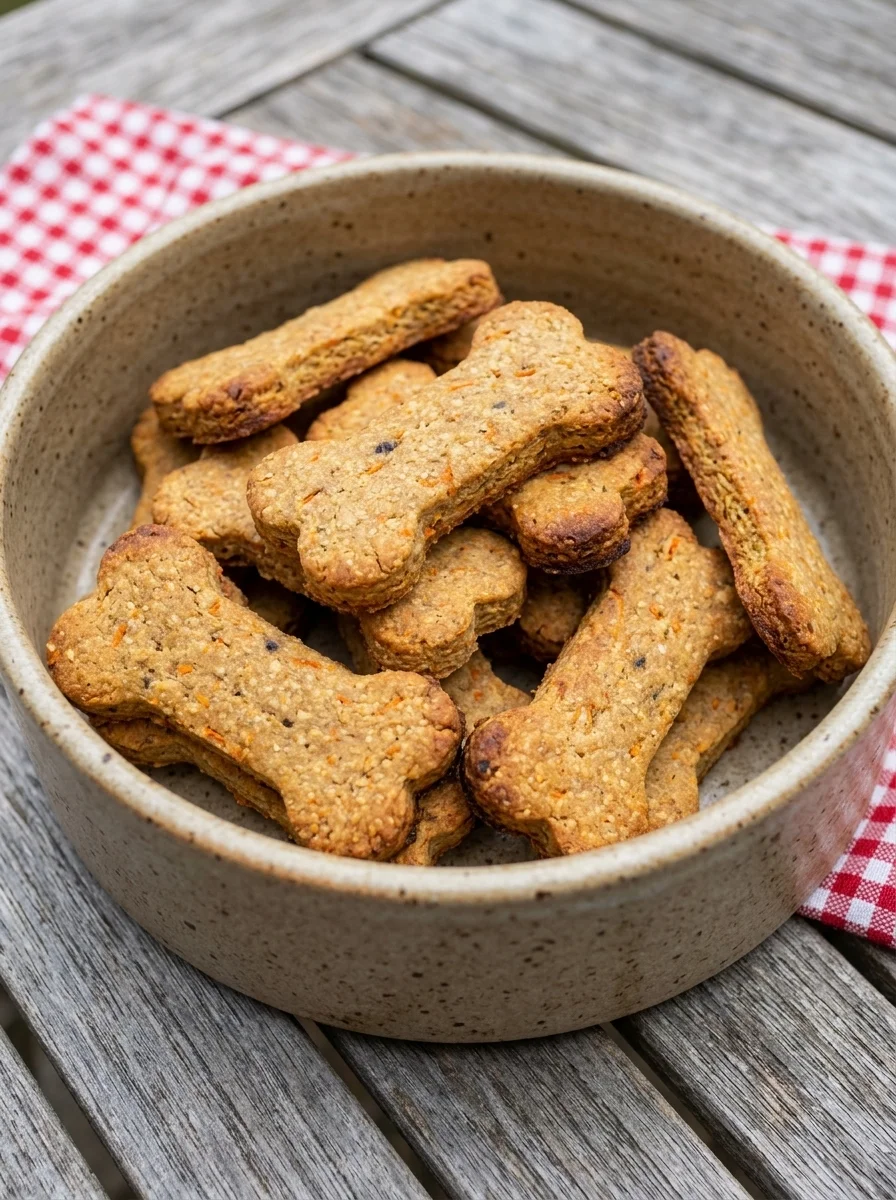
The classic crunchy banana carrot dog treats recipe is the one to reach for when you want a biscuit that holds up to a determined chewer, travels well in a pocket or treat jar, and satisfies that primal urge to crack something open. That extra drying time in the residual warmth turns a merely firm biscuit into something with genuine snap.
Ingredients
- 2 ripe bananas, mashed (about 1 cup)
- 1 cup finely grated carrots
- 2 cups oat flour
- 1 large egg
- 2 tablespoons coconut oil, melted
Step-by-Step Instructions
- Mash the ripe bananas in a large bowl until smooth with just a few small lumps left.
- Stir in the finely grated carrots, the egg, and the melted coconut oil.
- Add the oat flour a cup at a time, stirring until a firm, rollable dough forms.
- Turn the dough onto a lightly floured surface and roll it to 1/4 inch thick.
- Cut into bone shapes with a cookie cutter and place on a parchment-lined baking sheet.
- Bake at 350°F for 20 to 25 minutes until firm and lightly golden at the edges.
- For extra crunch, turn off the oven and leave the biscuits inside for 10 more minutes.
- Cool completely on a wire rack before serving or storing.
These biscuits are ideal for dogs who need something to occupy them during a crate rest or a rainy afternoon. Break one in half for a small dog, or hand over the full biscuit to a large breed who can handle the size. If you are looking for another apple-forward treat to rotate alongside these, homemade apple pie for dogs brings a similar cozy baked texture with a different flavor profile.
Recipe 2: Soft Chewy Banana Carrot Oat Discs
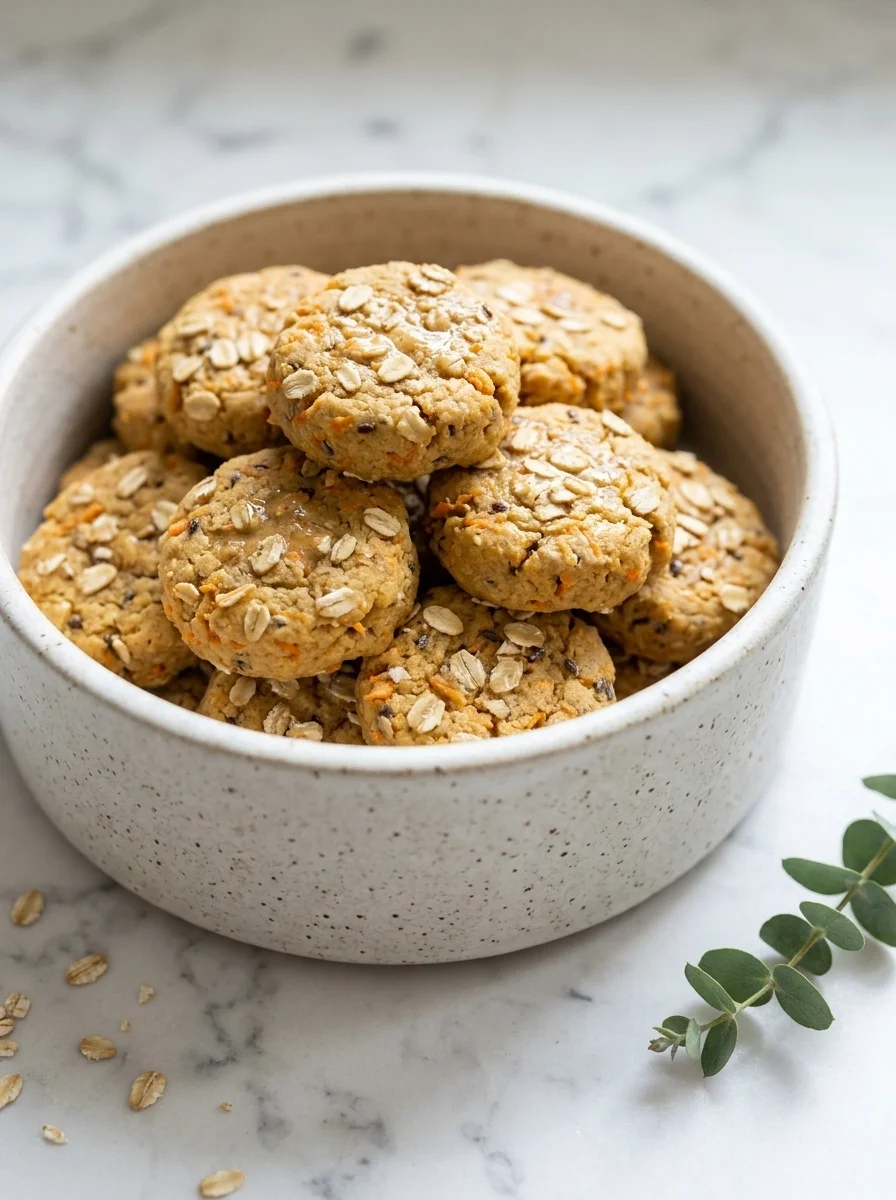
Soft chewy banana carrot dog treats discs are the gentlest entry in this collection, designed for dogs who need a treat they can compress with minimal jaw effort. Peanut butter is the binding agent here, and it does double duty as a flavor magnet — most dogs will do almost anything for the smell of peanut butter, and that makes these discs exceptionally useful as high-value training rewards. The applesauce adds moisture and a subtle sweetness that rounds out the banana flavor without making the dough sticky in the wrong way.
Ingredients
- 1 ripe banana, mashed (about 1/2 cup)
- 1/2 cup finely grated carrots
- 1 1/2 cups rolled oats
- 1 large egg
- 2 tablespoons xylitol-free peanut butter
- 2 tablespoons unsweetened applesauce
- 1 tablespoon ground flaxseed
Step-by-Step Instructions
- Mash the ripe banana in a large bowl, then stir in the grated carrots, the egg, the xylitol-free peanut butter, the applesauce, and the ground flaxseed.
- Fold in the rolled oats until the mixture holds together when squeezed — it should be soft and sticky, not dry.
- Scoop tablespoon-sized portions onto a parchment-lined baking sheet and flatten each one into a disc about 1/2 inch thick.
- Bake at 350°F for 20 to 25 minutes until the discs are set on the outside but still soft when pressed.
- Cool on the sheet for 10 minutes, then move to a wire rack to cool fully.
These discs are the treat to pack for a training class, a nose work session, or any situation where you need your dog to stay engaged and happy without working hard to chew. If you want something richer and more dessert-like alongside these, homemade cheesecake for dogs offers a creamy, no-bake alternative that uses similar base ingredients.
Recipe 3: No-Bake Banana Carrot Balls
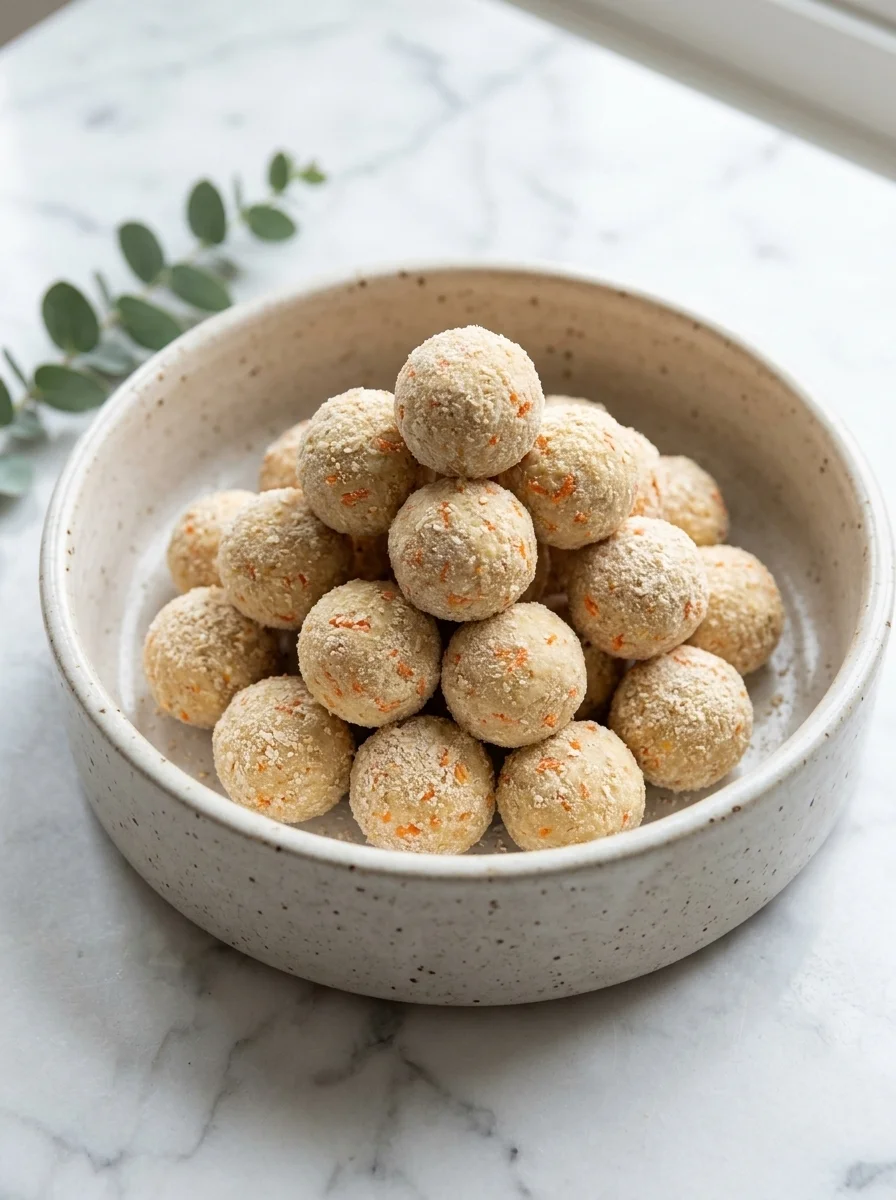
No-bake banana carrot dog treats balls are the recipe that saves a summer day. When the kitchen is already warm and the last thing you want is the oven raising the temperature another twenty degrees, these chilled balls come together in a single bowl and set in the refrigerator with zero baking involved. The critical thing to understand about these is that they are a refrigerator-only treat. At room temperature, the kefir or yogurt softens the dough and they lose their shape. Pull them straight from the fridge and place them in a bowl or on a mat when it is time to serve.
Ingredients
- 1 ripe banana, mashed (about 1/2 cup)
- 1/2 cup finely grated carrots
- 1 cup oat flour
- 1/2 cup plain kefir or Greek yogurt
Step-by-Step Instructions
- Mash the ripe banana in a medium bowl until smooth.
- Stir in the finely grated carrots and the kefir or Greek yogurt.
- Add the oat flour a little at a time, stirring until the mixture is thick enough to roll — it should hold its shape without sticking to your hands.
- Roll into balls about the size of a marble for small dogs or a walnut for large dogs.
- Place on a parchment-lined tray and chill in the fridge for 1 to 2 hours until firm.
Because these contain perishable kefir or yogurt, treat them like you would a fresh food. Keep them in a sealed container in the refrigerator and serve them cold.
Recipe 4: Grain-Free Banana Carrot Logs
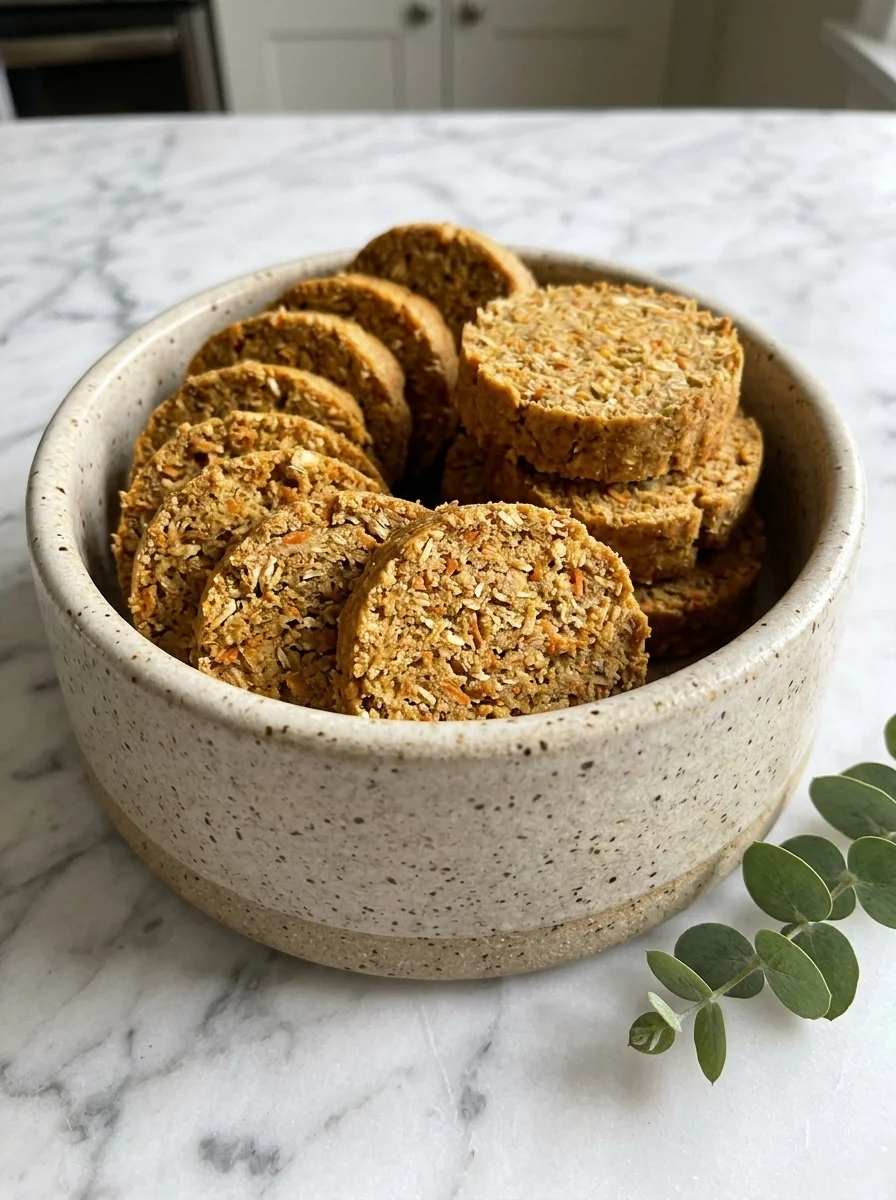
Grain-free banana carrot dog treats logs are built around a base of rice flour and rolled oats, which keeps common grain triggers like wheat, barley, and rye completely out of the picture. The ground ginger is a thoughtful addition — it has natural anti-inflammatory properties that can soothe mild stomach discomfort, and most dogs find its warm, earthy aroma appealing. The one rule that matters most here is cooling time. A warm log crumbles under the knife. A fully cooled log slices cleanly and holds its round shape.
Ingredients
- 2 ripe bananas, mashed (about 1 cup)
- 1 cup finely grated carrots
- 1 1/2 cups rice flour
- 1/2 cup rolled oats
- 1 large egg
- 1 tablespoon ground flaxseed
- 1/2 teaspoon ground ginger
Step-by-Step Instructions
- Mash the ripe bananas in a large bowl, then stir in the grated carrots, the egg, and the ground ginger.
- Add the rice flour, the rolled oats, and the ground flaxseed, stirring until a stiff dough forms.
- Divide the dough and roll each piece into a log about 1 inch thick on a lightly floured surface.
- Place the logs on a parchment-lined baking sheet and bake at 350°F for 25 to 30 minutes until firm and lightly golden.
- Cool the logs COMPLETELY before slicing — warm logs crumble.
- Slice into rounds about 1/2 inch thick with a serrated knife.
These grain-free banana carrot dog treats rounds freeze particularly well, so you can bake a batch, slice them all at once, and pull out individual rounds as needed.
Serving by Dog Size
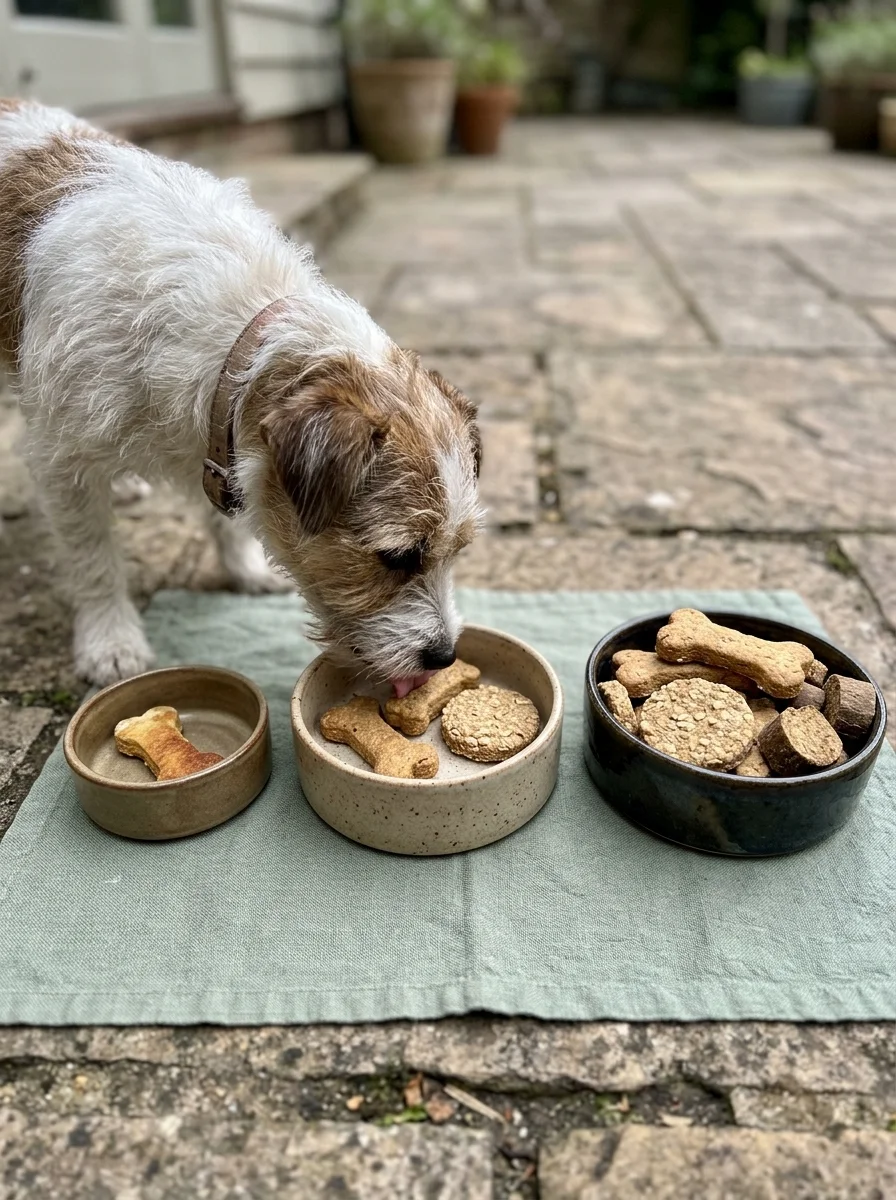
Serving size is the part of treat feeding that most owners underestimate, and getting it right matters more than most people think. The rule that every veterinarian and nutritionist agrees on is simple: treats should stay under ten percent of a dog’s total daily calories. That ten percent includes everything — the biscuits, the training rewards, the cheese you handed over during a walk, the piece of banana you shared from your own snack.
Small dogs under twenty pounds benefit from having every biscuit broken in half. A whole crunchy biscuit can be physically large relative to a small dog’s mouth, and breaking it in half creates two manageable pieces that are easier to chew and swallow safely. For medium dogs between twenty and fifty pounds, the standard recipe yields are spot-on, and one or two treats per session is a reasonable serving. Large dogs over fifty pounds can handle two or three crunchy biscuits at once, and they appreciate having something substantial to chew rather than tiny rewards that disappear in a single bite. No matter what size your dog is, serve treats in a dog bowl or on a designated mat, or crumble a biscuit over their kibble as a topper. If you are looking for another versatile treat to add to your rotation, apple cinnamon dog treats offer a warm-spiced alternative that many dogs love alongside these banana carrot options.
Storage and Freezing
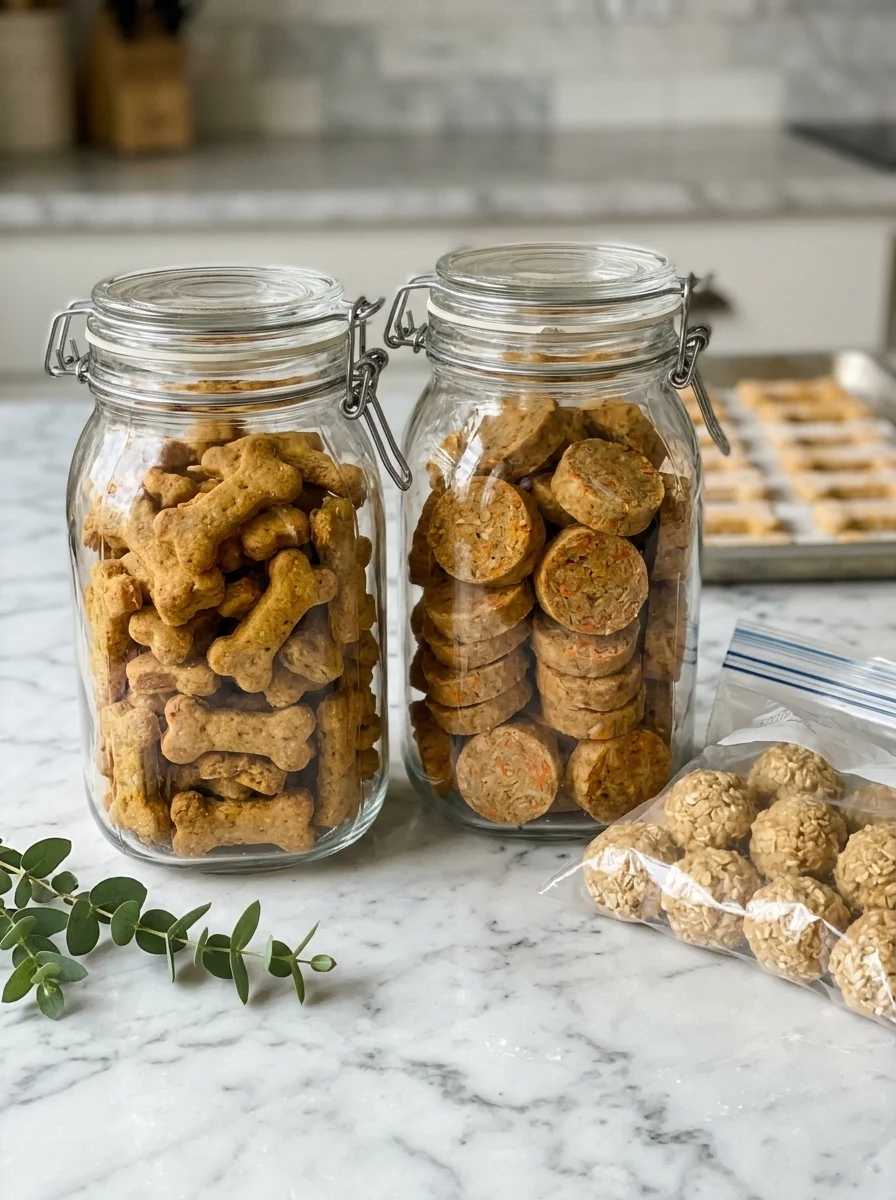
The classic crunchy banana carrot dog treats and the grain-free logs are the most forgiving. Once they are fully cooled, store them in an airtight container at room temperature for three to four days, or in the refrigerator for up to one week. For longer storage, these two recipes freeze beautifully. Place the biscuits or sliced log rounds in a single layer on a tray to freeze solid, then transfer to a freezer bag. They keep for up to three months, and you can thaw a handful at a time as needed.
The soft chewy discs have a shorter shelf life because their moisture content is higher. Store them in an airtight container in the refrigerator for up to five days.
The no-bake banana carrot dog treats balls are strictly refrigerator treats. Because they contain kefir or Greek yogurt, they soften and can begin to separate if left at room temperature, so they belong in a sealed container in the fridge and should stay there until it is time to serve. Their fridge life is four to five days, which means they are best made in small batches for immediate enjoyment.
Troubleshooting
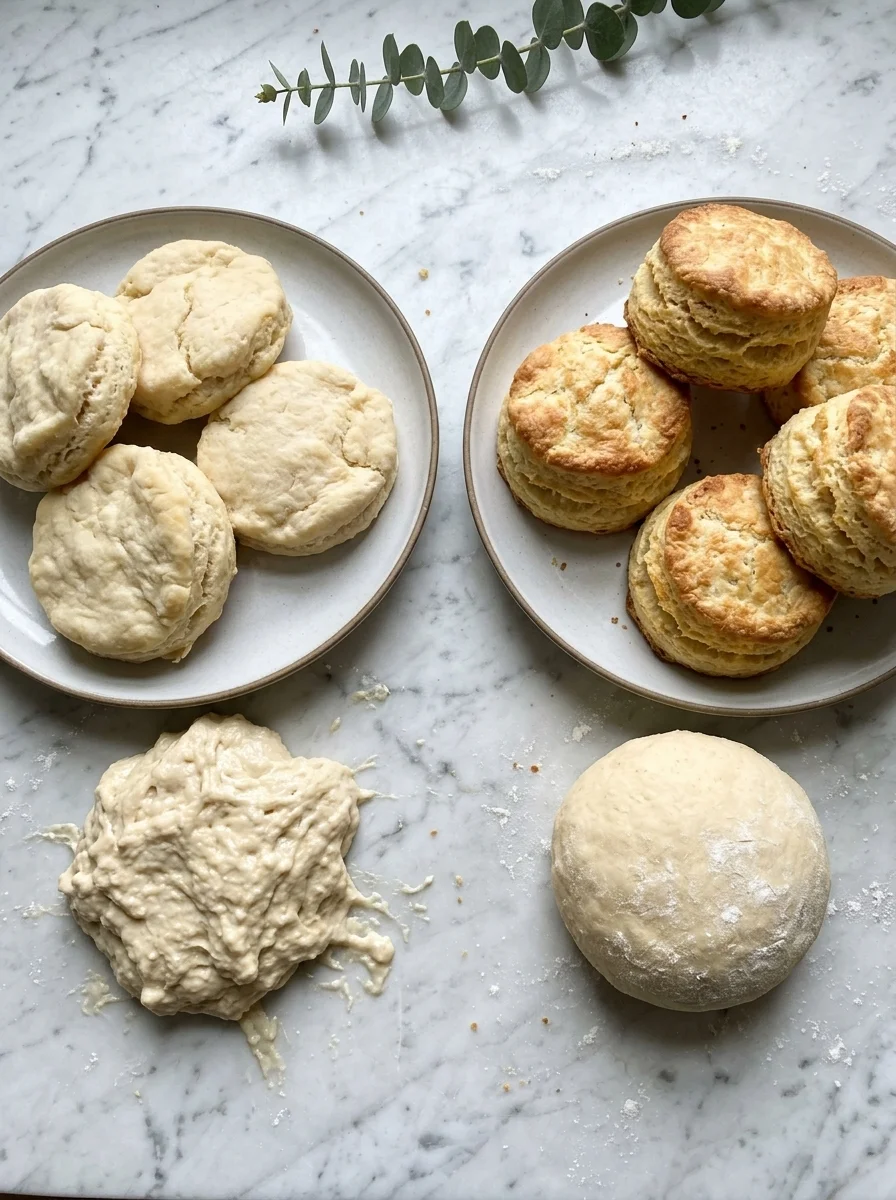
The most common issue is dough that is too wet. Bananas vary enormously in size and moisture depending on ripeness, so a large banana or one that is extra juicy can throw off the hydration balance. If your dough sticks to your hands and refuses to roll, add oat flour or rice flour one tablespoon at a time, mixing thoroughly after each addition, until the dough reaches a firm, workable consistency.
Biscuits that come out of the oven too soft are usually the result of underbaking or pulling them early out of impatience. The doneness cue is firmness at the edges and a light golden color — not deep brown, just a hint of gold.
No-bake balls that refuse to set are almost always a chilling issue. The refrigerator might not be cold enough, or the balls may not have had enough time to firm up. Extend the chilling time to the full two-hour mark, and if they are still soft, add a tablespoon more of oat flour to the remaining mixture before rolling the next batch.
Grain-free logs that crack when slicing are a cooling problem, plain and simple. Let the logs cool on the baking sheet for ten minutes, then move them to a wire rack and let them reach full room temperature before you even think about picking up a knife. A fully cooled log slices cleanly into even rounds.
Frequently Asked Questions
Final Thoughts
Making homemade banana carrot dog treats is one of those kitchen projects that pays back in ways far beyond the ten minutes it takes to mix the dough. The four recipes in this collection are not interchangeable by accident — they are four different answers to four different moments in dog ownership. A rainy Tuesday calls for the crunchy biscuits. A training session on a warm afternoon calls for the soft discs. A summer weekend calls for the chilled no-bake balls. A vet visit that confirms a grain sensitivity calls for the grain-free logs. Keep the ripeness rule in mind — spotty, sweet, soft bananas only — and keep the grating fine so the carrot distributes evenly through the dough. Your dog does not need a perfect biscuit. They need a biscuit made by you, with real ingredients, served with consistency, and shared with the kind of attention that only a home-cooked treat carries.

Izzy is an experienced ranch worker who has a passion for exploring nature and getting up close to wildlife. With her connections to various animal organizations, Izzy is well-versed in animal care and rehabilitation.