Easy DIY Dog Puzzle Toys: 10 Homemade Ideas to Try Today
Does your dog chew the couch, dig at the carpet, or bark at nothing when they’re bored? That restless energy usually isn’t a behavior problem. It’s a bored brain looking for a job.
Dogs were bred to work, whether that meant herding, hunting, guarding, or sniffing things out all day. Most modern dogs get none of that. They get a walk around the block and then hours of nothing, which is exactly when the couch cushions start looking interesting. Easy DIY dog puzzle toys are one of the simplest ways to fix that gap. You don’t need to buy anything fancy from a pet store. Most of these puzzles use items already sitting in your kitchen or recycling bin, and you can build most of them in under ten minutes.
Below are 10 homemade DIY dog puzzle toys that are cheap, safe, and easy enough for a beginner to build today. Each one comes with clear steps, a safety tip, and an idea of how long it will keep your dog busy. By the end, you’ll also know how to keep these puzzles working for months instead of just a few days, which is the part most guides skip.
10 Easy DIY Dog Puzzle Toys You Can Make Today
These are simple, low-cost projects. Most take five to ten minutes to set up, and none require special tools. Start with one or two, see how your dog reacts, and build out from there.
1. Muffin Tin Treat Hunt
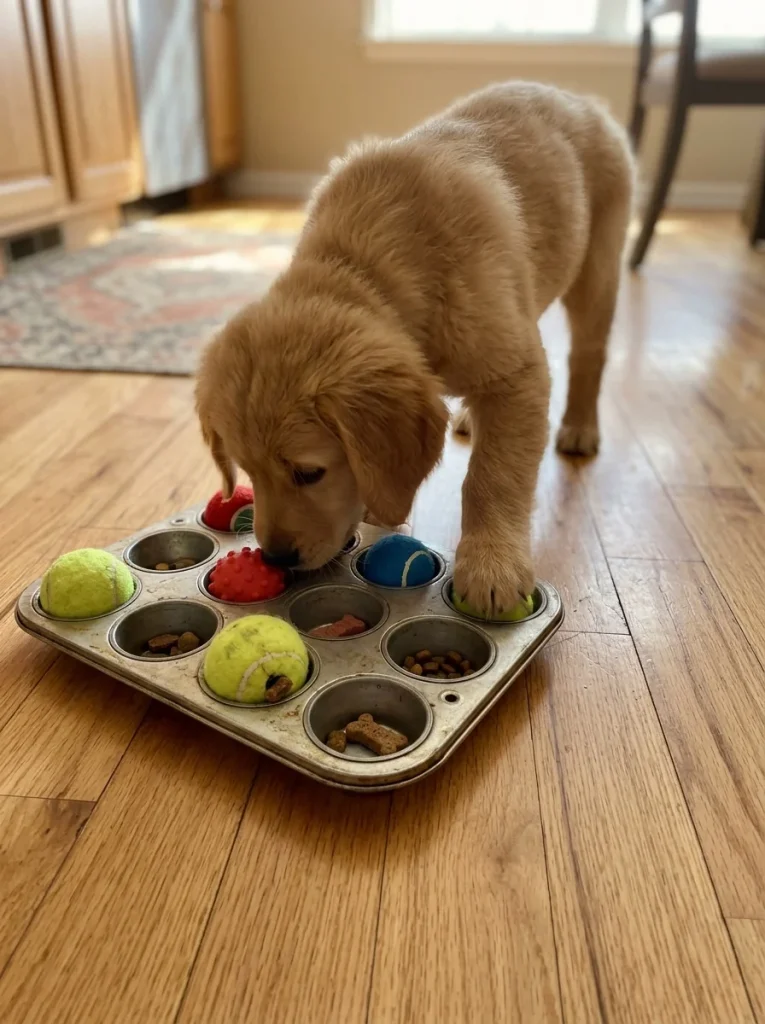
This is the easiest puzzle on this list, and a great starting point if your dog has never used a puzzle toy before. It’s also a good way to test how your dog handles a “hidden reward” style puzzle before you try anything more complicated.
What you need:
- A 12-cup muffin tin
- Small balls that fit snugly in each cup (tennis balls, rubber balls, or squeaky toys)
- Small treats or kibble
How to build it:
- Drop a treat into a few of the cups. Don’t fill every single one, since the mystery is what keeps your dog interested.
- Cover each filled cup with a ball.
- Set the tin on the floor and let your dog nose and paw the balls out of the way.
Mix up which cups you fill each time so your dog can’t just memorize the pattern and skip straight to the loaded cups. This keeps the sniffing part of the puzzle active instead of turning it into a routine.
Safety tip: Use balls that are too big for your dog to swallow. For small dogs, use golf balls or crumpled paper instead of tennis balls.
Time: 5 minutes to build, 10–20 minutes of play.
2. Toilet Paper Roll Treat Puzzle
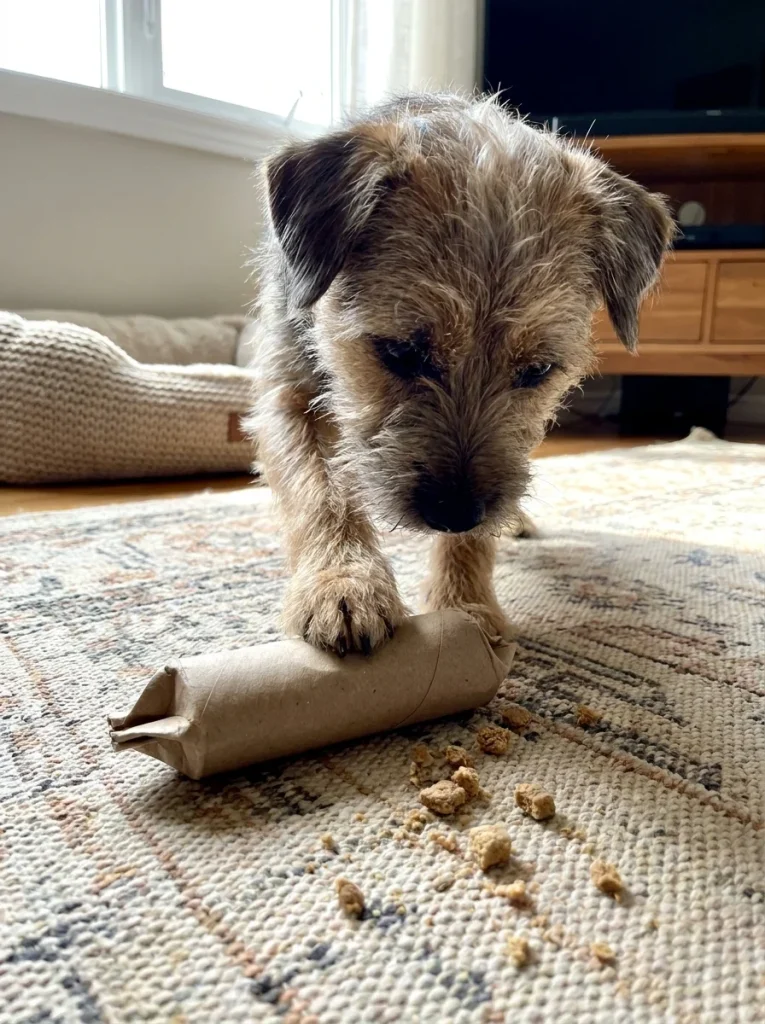
This is a zero-cost option since it uses something you’re probably about to throw away anyway. It’s also one of the fastest puzzles to reset, which makes it a good choice for busy mornings.
What you need:
- 1–3 empty toilet paper rolls
- Small treats
How to build it:
- Pinch one end of the roll flat and fold it over itself so it closes, similar to folding the end of a wrapping paper tube.
- Drop 5–8 small treats inside.
- Fold and pinch the other end shut the same way.
Hand it to your dog and let them figure out how to tear it open. If your dog solves this one too quickly, try nesting a second, smaller roll inside the first one before folding the ends. That adds an extra layer they have to work through.
Safety tip: If your dog swallows cardboard instead of just tearing it, supervise closely or size up to a paper towel roll, which is thicker and harder to swallow in one bite.
Time: 2 minutes to build, 5–10 minutes of play.
3. Towel Roll-Up Game
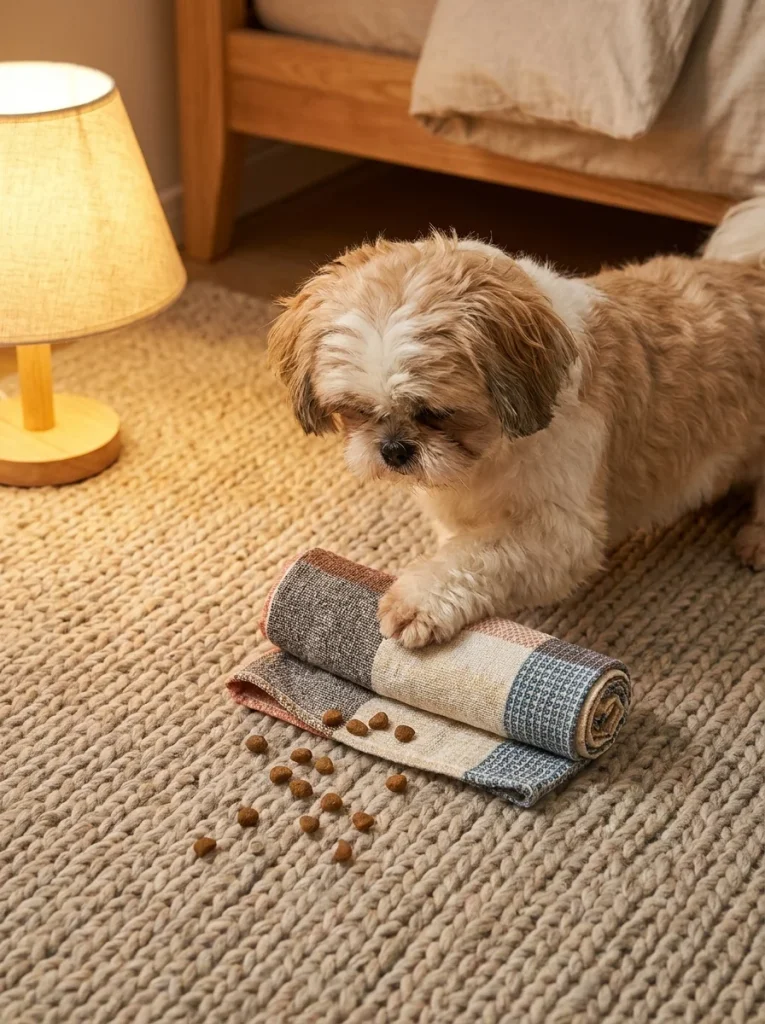
This one is great for sniffing and unrolling, and it’s completely reusable. Unlike the cardboard options, a towel can be washed and reused hundreds of times, which makes it one of the most cost-effective puzzles on this list.
What you need:
- An old kitchen towel or small blanket
- Kibble or small treats
How to build it:
- Lay the towel flat.
- Sprinkle treats along the middle in a line.
- Roll the towel up snugly, then tie a loose knot in the center so it doesn’t unroll on its own.
Your dog will need to sniff, paw, and unroll the towel to find each treat. For a harder version, fold the towel into thirds lengthwise before rolling it, which buries the treats deeper and forces your dog to work through more layers of fabric.
Safety tip: Watch your dog the first couple of times. Some dogs try to chew and swallow fabric instead of just unrolling it.
Time: 3 minutes to build, 10–15 minutes of play.
4. Egg Carton Sniff Box
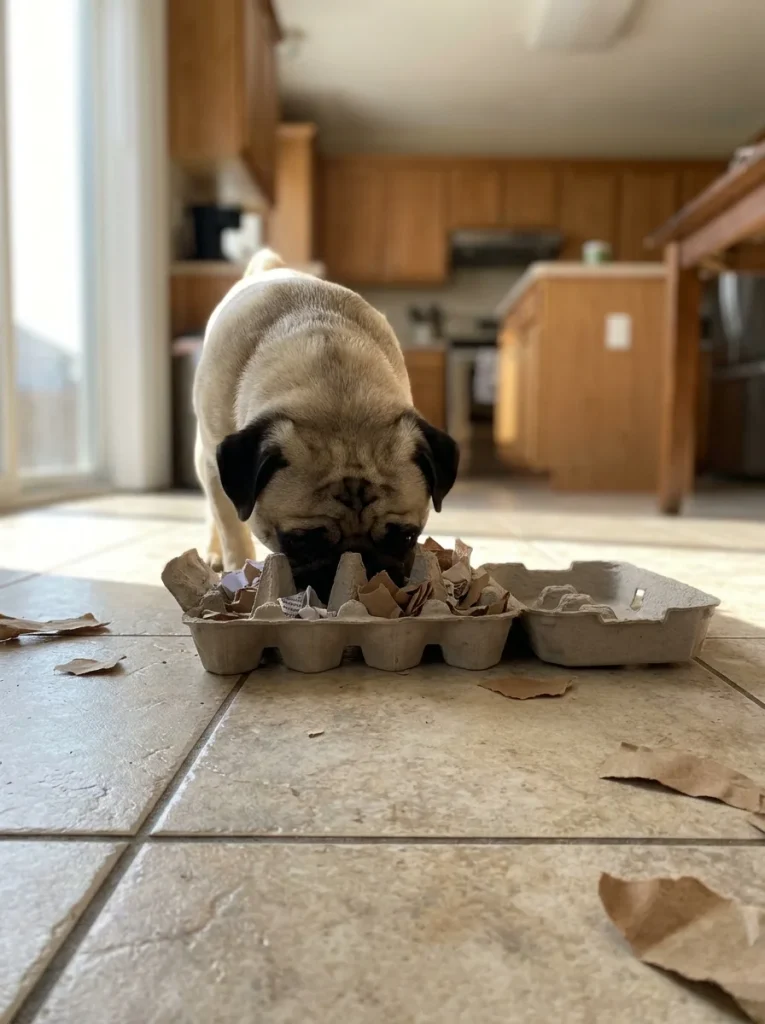
Another free option that turns household trash into a legitimate scent-work puzzle. This one is particularly good for dogs who enjoy using their nose more than their paws, since most of the work happens through sniffing rather than physical force.
What you need:
- A cardboard egg carton (10 or 12 count)
- Small treats
- Scrap paper
How to build it:
- Open the carton flat.
- Drop a treat into a few of the cups, not all of them.
- Crumple small pieces of paper and stuff one into each cup so the treat is hidden underneath.
- Close the lid loosely.
Your dog has to nose and paw at the lid, then dig through the paper to find the treats. Once your dog gets good at this one, try skipping the paper stuffing and simply flipping the carton upside down over the treats instead, which forces them to lift and search rather than just dig straight down.
Safety tip: Take the carton away once it gets soggy or starts to shred into large pieces that could be swallowed.
Time: 3 minutes to build, 5–10 minutes per session.
5. Frozen Treat Puzzle
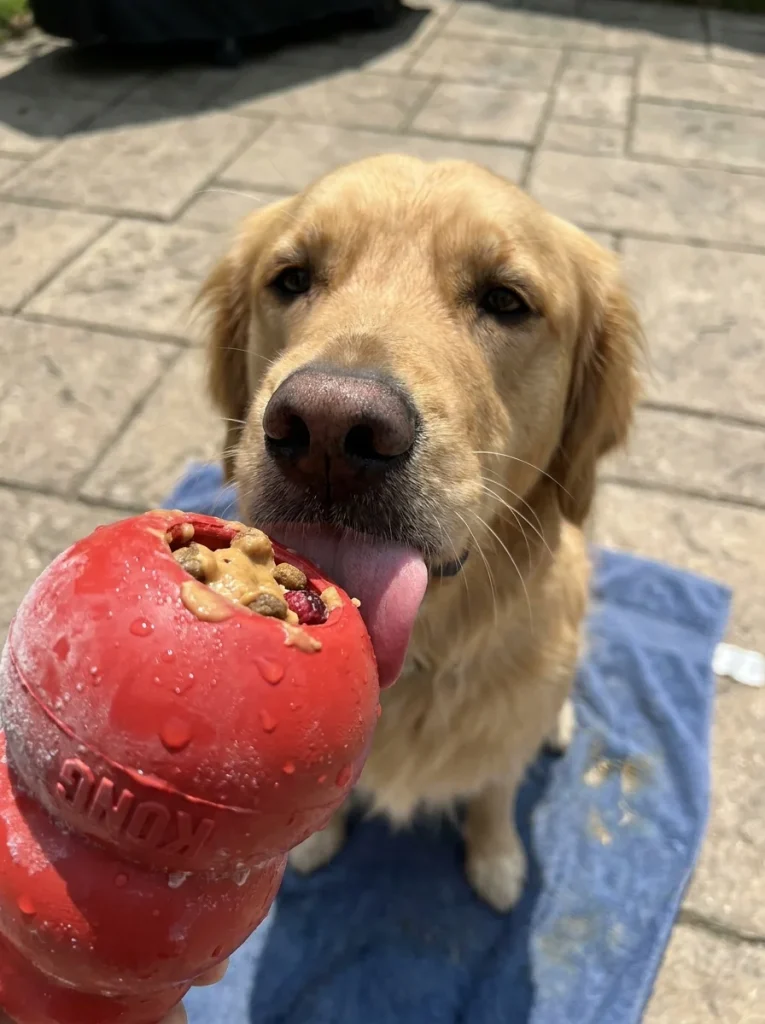
This is the best option for hot days or teething puppies, and it slows down fast eaters. It’s also one of the longer-lasting puzzles on this list, since your dog can’t just tear through it in a few seconds.
What you need:
- An ice cube tray or a rubber Kong toy
- Water
- Small treats like kibble, blueberries, or bits of cheese
How to build it:
- Drop a treat into each compartment of the tray (or pack them into the Kong).
- Fill with water.
- Freeze for at least two hours.
Give your dog the frozen result on a towel or in a shallow bowl so it doesn’t slide around. For an extra challenge, layer the Kong with different textures, like a bit of peanut butter, then a few pieces of kibble, then more peanut butter, before freezing. The mixed textures keep your dog working longer than a single layer of frozen water.
Safety tip: Watch portion sizes for small dogs, since ice can be harder on smaller teeth and stomachs.
Time: 5 minutes to build, 2+ hours to freeze, 15–20 minutes of play.
6. DIY Snuffle Mat
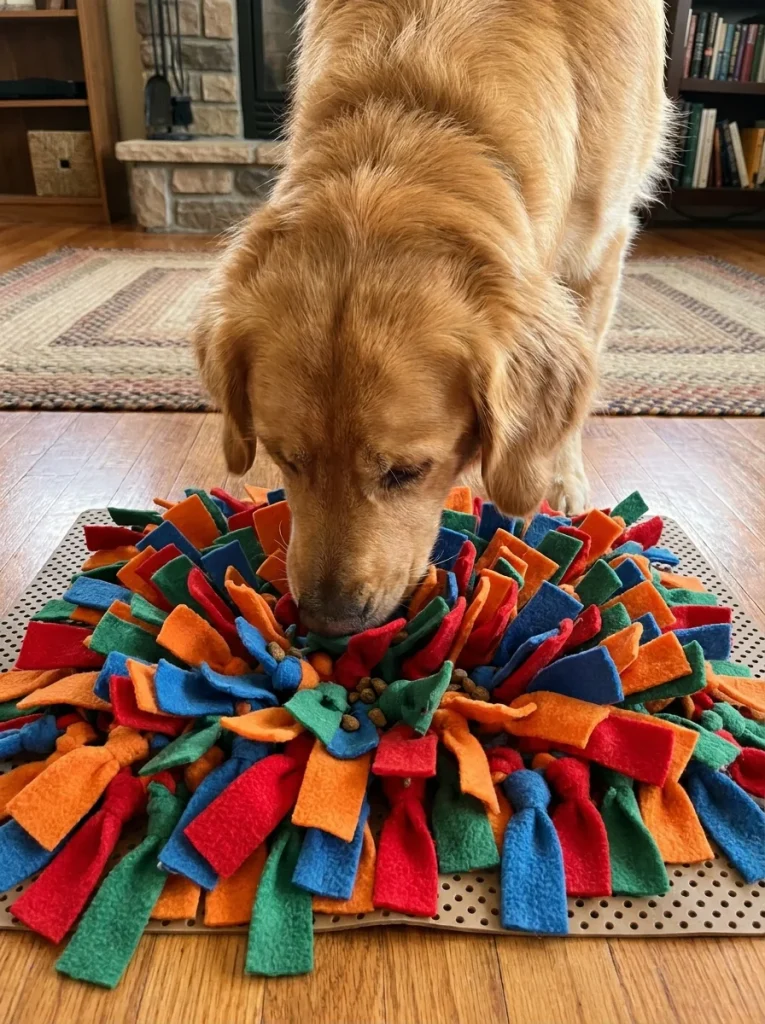
A snuffle mat mimics grass and dirt, letting your dog use their nose the way nature intended. This is one of the best options for dogs who get anxious easily, since the repetitive sniffing motion has a naturally calming effect.
What you need:
- A rubber sink mat or drainer mat with holes
- Fleece fabric strips (cut from an old blanket)
- Kibble or small treats
How to build it:
- Cut fleece into strips, roughly 1 inch by 8 inches.
- Tie each strip through a hole in the mat, knotting it so it stays in place.
- Repeat until the mat is fully covered in fabric strips.
- Sprinkle kibble deep into the fabric.
This is a one-time build that keeps paying off. Once the mat is finished, all you have to do each time is sprinkle in fresh treats, which makes it one of the lowest-effort puzzles to maintain long-term.
Safety tip: This puzzle is great for anxious dogs because sniffing naturally lowers stress. It’s also machine washable when it gets dirty.
Time: 20–30 minutes to build (one-time project), reusable for months.
7. Water Bottle Crunch Box
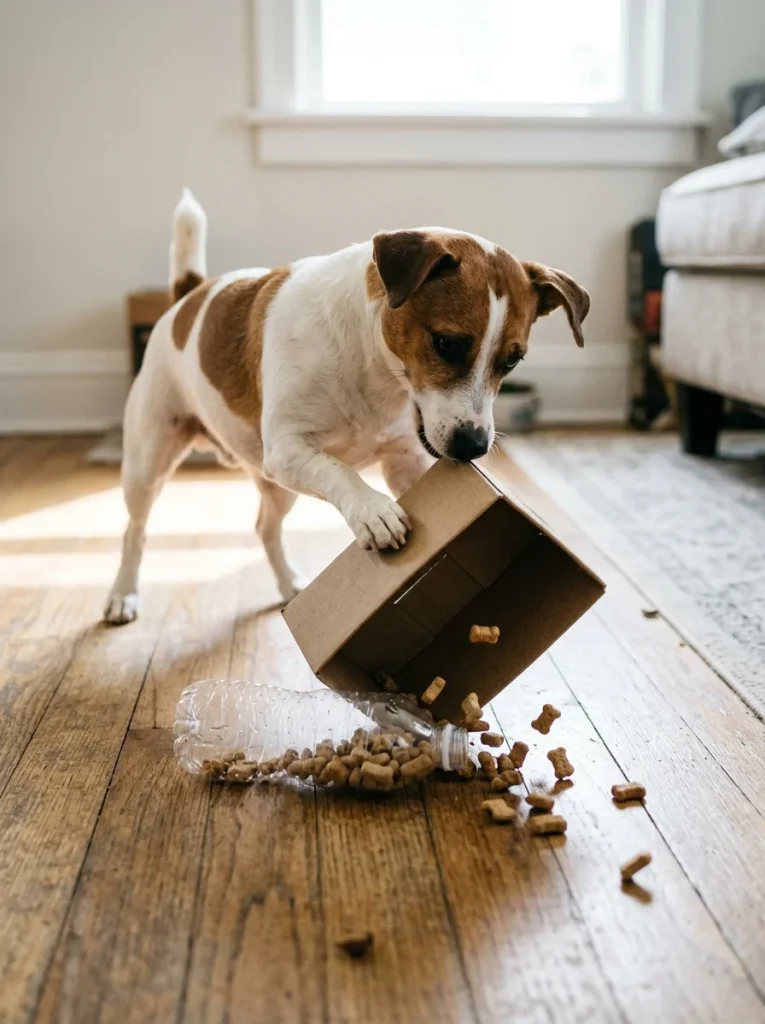
This is a favorite for dogs who love noise and chasing things around the floor. It works especially well for dogs who like to use their whole body, not just their nose or paws, to solve a problem.
What you need:
- An empty plastic water bottle (label and cap removed)
- A cardboard box
- Treats
How to build it:
- Drop a few treats inside the empty bottle.
- Place the bottle inside the box.
- Close the box loosely and let your dog knock it around.
The crunching sound of the bottle is usually what hooks a dog’s attention first. Once they’ve cracked this version a few times, try using two bottles in a larger box so there’s more searching involved before they find where the sound and treats are actually coming from.
Safety tip: Always remove the bottle cap and the plastic ring around the neck before giving it to your dog. Both are choking hazards.
Time: 2 minutes to build, 10–15 minutes of play.
8. Nesting Box Challenge
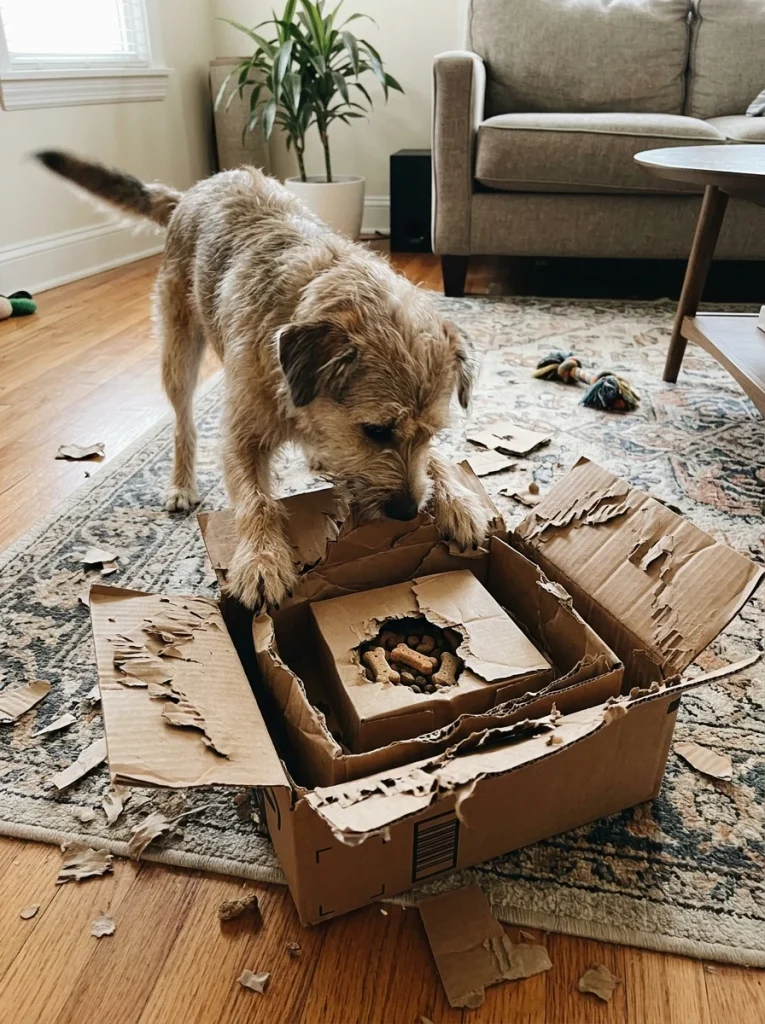
This one scales easily, so you can make it harder as your dog gets better at solving puzzles. It’s also a great way to reuse shipping boxes instead of tossing them straight into the recycling bin.
What you need:
- 2–3 cardboard boxes of different sizes that fit inside each other
- Treats
How to build it:
- Put treats in the smallest box.
- Place that box inside the next size up.
- Repeat until all boxes are nested, closing each one loosely.
Your dog tears through each layer to reach the treats at the center. As your dog gets faster at this, add a fourth box, or loosely wrap the smallest box in a towel before nesting it, so there’s one more layer between them and the treats.
Safety tip: Remove any tape, staples, or plastic packing material from the boxes before you start.
Time: 5 minutes to build, 15–20 minutes of play.
9. Paper Bag Treasure Hunt
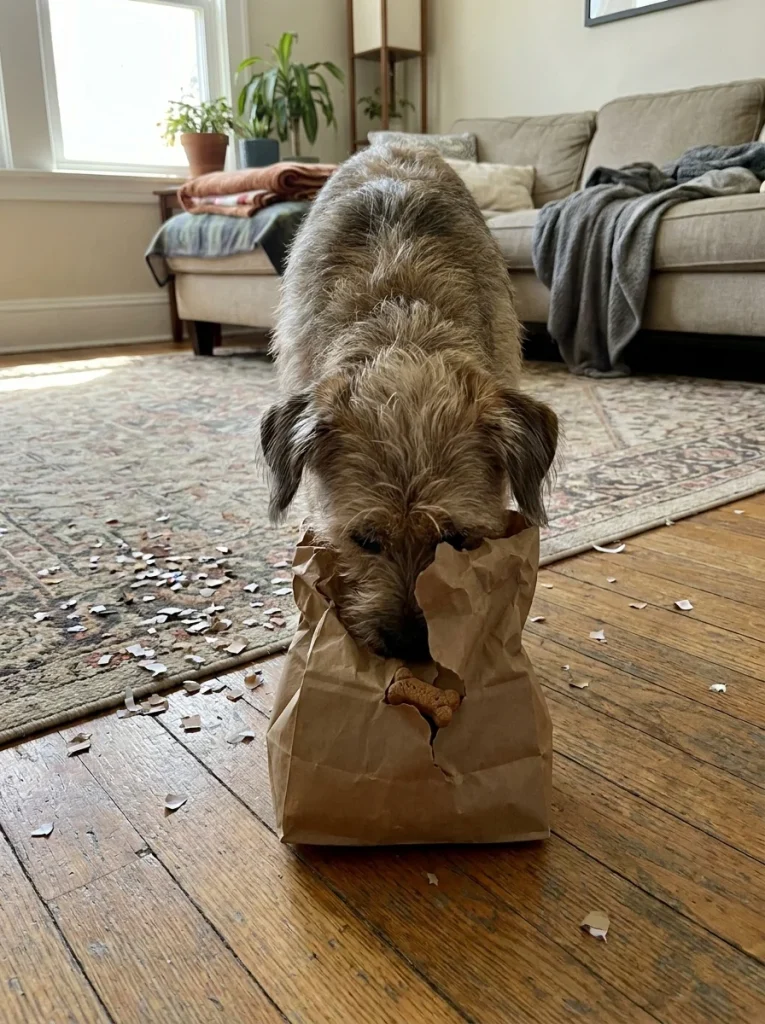
This is loud, messy, and one of the most satisfying puzzles for dogs who like to tear things apart. It also doubles as a great rainy-day activity since the mess is easy to sweep up afterward.
What you need:
- A plain brown paper lunch bag
- Treats
How to build it:
- Crumple the bag slightly to loosen it up.
- Drop a treat inside.
- Twist the top closed.
- For an extra challenge, place that bag inside a second paper bag.
You can also line up three or four stuffed bags in a row and let your dog work through them one at a time, which stretches out the play session without any extra prep work.
Safety tip: Only use plain paper bags without plastic handles, string, or glossy printed ink.
Time: 1 minute to build, 5–10 minutes of play.
10. PVC Pipe Treat Roller
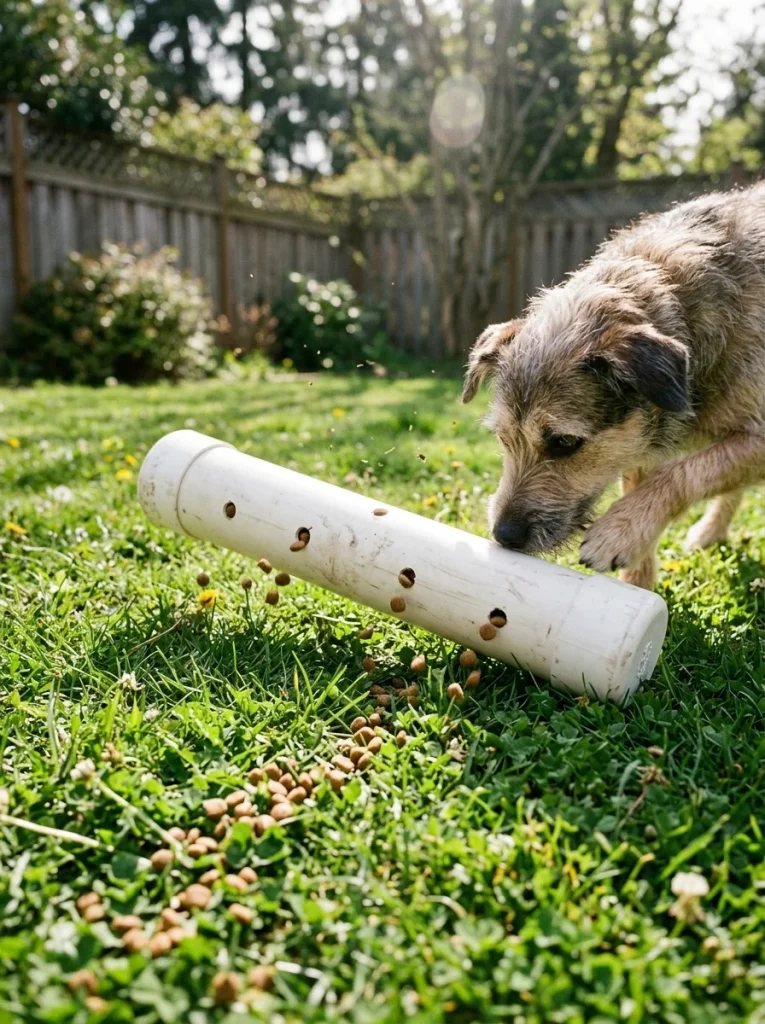
This is the only puzzle on the list that takes a little more effort to build, but it lasts for years instead of one use, which makes the extra setup time worth it.
What you need:
- A short piece of PVC pipe (4–6 inches long)
- A drill
- Two removable end caps
- Treats or kibble
How to build it:
- Drill several small holes along one side of the pipe, spaced a few inches apart.
- Cap one end permanently with glue, and leave the other end cap removable.
- Fill the pipe with treats through the open end, then cap it.
Your dog rolls the pipe around, and treats fall out through the holes as it moves. If you want a version with more control over difficulty, drill the holes at slightly different sizes. Larger holes release treats faster, so you can adjust how quickly the puzzle empties based on your dog’s patience level.
Safety tip: Sand down any rough plastic edges around the drilled holes so your dog’s gums don’t get scratched. If you don’t have tools, use a clean toilet paper roll as a one-time disposable version instead.
Time: 15–20 minutes to build (one-time project), reusable indefinitely.
Dog Puzzle DIY Enrichment Activities Beyond Toys
Puzzle toys are great, but enrichment doesn’t have to involve treats stuffed into cardboard every single day. Dogs are naturally curious animals, and understanding why dogs do what they do can help you come up with even more ways to keep their brain busy without buying or building anything new.
Here are a few extra enrichment activities that work alongside the puzzle toys above:
Hide and seek with treats. Instead of building a toy, just hide small treats around a room and let your dog sniff them out. Start with easy, visible spots, then gradually hide them higher up or behind furniture as your dog gets better at the game. This is basically the muffin tin puzzle without the muffin tin, and it costs nothing to set up.
Training as enrichment. Teaching a new trick for ten minutes can tire out a dog’s brain just as much as a puzzle toy. Mental effort burns energy the same way physical effort does, which is why a short training session can leave a dog just as relaxed afterward as a puzzle toy would. If you’re new to training methods, comparing positive reinforcement vs traditional dog training is a good place to start before you begin.
Rotating treat types. The type of treat matters more than people think. Using homemade dog treats instead of store-bought kibble in your puzzles adds a new scent your dog hasn’t gotten bored of yet, which keeps the “hunt” part of the puzzle interesting for longer. Even swapping treats between two or three puzzles you already own can make an old toy feel new again.
Chew-based enrichment. Not every enrichment activity needs to involve searching. Giving your dog a safe chew treat on its own also satisfies a natural need to gnaw, which is a different kind of mental work than sniffing or pawing. Chewing releases calming hormones in dogs, so pairing a chew session with a puzzle toy can round out a full enrichment routine in a single afternoon.
Mixing puzzle toys with these other activities keeps your dog from getting bored of any single method, and it gives you a full toolkit instead of relying on one trick. A dog who gets variety across sniffing, chewing, training, and problem-solving tends to settle down faster than a dog who only gets one type of stimulation over and over.
Best DIY Dog Puzzle Toys: How to Keep Them Working Long-Term
Here’s something most people get wrong: they build one puzzle, watch their dog solve it in under a minute, and assume the dog just isn’t interested in puzzles. Usually, the real problem is that the puzzle got too easy too fast.
The best DIY dog puzzle toys aren’t the ones with the most steps. They’re the ones you rotate and adjust so your dog never fully “solves” the system. A puzzle that stays interesting for months is far more valuable than one that impresses your dog once and then gets ignored.
Here’s how to keep your homemade puzzles working for months instead of days:
Change the treat, not just the toy. If your dog stops caring about a puzzle, try switching from regular kibble to something with a stronger smell, like small pieces of cheese or freeze-dried liver. A new smell resets a dog’s interest even in an old toy, since dogs rely on scent far more than sight when it comes to finding food.
Increase difficulty slowly. Once your dog masters the muffin tin puzzle in under a minute, don’t jump straight to the hardest option on this list. Add one more layer at a time, like using smaller balls or hiding treats deeper in a snuffle mat. Jumping too far ahead too quickly can frustrate a dog instead of challenging them, which sometimes leads to them giving up on puzzles altogether.
Rotate two or three puzzles at a time. Don’t put every puzzle toy out at once. Pick two or three, use them for a week, then swap them out. This keeps each one feeling new when it comes back into rotation, and it also saves you from having to build something new every single day.
Match the puzzle to your dog’s energy that day. A tired dog might only want the easy toilet paper roll puzzle, while a dog with pent-up energy might need the nesting box challenge to really burn through it. Reading your dog’s mood before choosing a puzzle helps you get more mileage out of each one.
Watch for frustration versus boredom. If your dog gives up quickly and walks away, the puzzle might be too hard. If they solve it in seconds and lose interest, it’s too easy. The goal is a puzzle that takes a bit of real effort but is still solvable. Pay attention to body language too. A relaxed, focused dog is engaged, while a dog pacing or whining at the puzzle may need an easier version.
If you’re setting up a permanent spot for feeding and puzzle time, a few dog feeding station ideas can help keep the mess contained to one area of the house instead of spreading treats and torn cardboard across your floors. Having a dedicated spot also signals to your dog that this is their designated “work area,” which can help them settle into puzzle time faster.
Final Thoughts
Easy DIY dog puzzle toys are one of the cheapest, fastest ways to solve boredom-driven behavior at home. You don’t need a big budget or special skills. A muffin tin, an old towel, or a leftover cardboard box is often all it takes to turn ten minutes into a genuinely tiring mental workout for your dog.
Start with one or two ideas from this list. Once your dog gets the hang of solving them, rotate in a new one, switch up the treats, and slowly increase the challenge. That’s really the whole secret to keeping a dog engaged long-term: variety, not complexity.
Building a few of these puzzles ahead of time also means you’re never caught without a solution on a rainy day or a busy work-from-home afternoon. Keep a small stash of empty toilet paper rolls, an extra muffin tin, and a bag of high-value treats on hand, and you’ll always be ready to put together a puzzle in a matter of minutes.
Pick one puzzle, build it today, and see how your dog reacts. Chances are, it’ll buy you more quiet time than a walk ever could.

Izzy is an experienced ranch worker who has a passion for exploring nature and getting up close to wildlife. With her connections to various animal organizations, Izzy is well-versed in animal care and rehabilitation.