10 Dog Kennel Flooring Ideas for Indoor, Outdoor, and DIY Setups
Most dog owners spend a lot of time thinking about the kennel itself — the size, the location, whether it has a roof. But the floor? That usually gets an afterthought. That’s a mistake, because your dog’s kennel floor affects everything: how comfortable your dog is, how easy the kennel is to clean, how long it holds up to weather and use, and whether your dog risks slipping or developing joint problems over time.
The good news is there are excellent dog kennel flooring ideas for every type of setup and every budget. Whether you’re building an outdoor run from scratch, upgrading a kennel in your garage, or simply laying something down over bare dirt, this guide covers 10 real options — with honest guidance on cost, comfort, installation, and which dogs each option works best for.
Contents
- How to Choose the Right Dog Kennel Flooring
- 10 Dog Kennel Flooring Ideas for Every Situation
- 1. Rubber Mats — The Most Popular Dog Kennel Floor
- 2. Epoxy Coating — Best for Existing Concrete Kennel Floors
- 3. Kennel Deck / Raised Plastic Tiles — Best for Drainage and Wet Climates
- 4. Gravel or Pea Gravel — The Budget-Friendly Outdoor Option
- 5. Artificial Turf — Best Outdoor Look with Easy Maintenance
- 6. Vinyl Roll Flooring — Sleek and Easy to Clean Indoors
- 7. Concrete (Improved) — Making the Most of What You Already Have
- 8. Polyurea Coating — The Heavy-Duty Professional Upgrade
- 9. Interlocking Foam Tiles — Best for Puppies and Senior Dogs
- 10. Combination (Hybrid) Flooring — The Smartest Long-Term Setup
- Quick Comparison: Dog Kennel Flooring at a Glance
- 3 Things That Make Any Dog Kennel Floor Work Better
- Conclusion
How to Choose the Right Dog Kennel Flooring

Before jumping into the options, answering three quick questions will save you a lot of time and money. These questions cut through the noise and point you toward the right dog kennel floors almost immediately.
Is Your Kennel Indoor or Outdoor?
This is the single biggest deciding factor. Flooring for an indoor dog kennel needs to prioritize comfort, warmth, and easy cleaning. Outdoor kennel flooring has to handle weather, drainage, UV exposure, and sometimes mud. Some materials work brilliantly indoors but fail quickly outside (foam tiles, for example), while others are built specifically for outdoor punishment (gravel, raised plastic decking, polyurea coatings).
What’s Your Dog’s Size, Age, and Behavior?
A large, energetic breed like a German Shepherd needs something completely different from a small senior dog with arthritis. Puppies and older dogs need soft, joint-friendly surfaces. Destructive chewers can destroy rubber mats and foam tiles in a matter of days, so harder, fixed surfaces work better for them. A calm, medium-sized dog? Almost any option on this list will work.
Is Your Setup Permanent or Temporary — and What’s Your Budget?
Epoxy coatings and polyurea are permanent investments that pay off over years. Interlocking rubber mats are portable and affordable. Gravel is cheap to install but needs occasional top-ups. Knowing whether you own the space or rent it, and how much you can spend upfront versus over time, will guide your final decision more than almost anything else.
10 Dog Kennel Flooring Ideas for Every Situation
1. Rubber Mats — The Most Popular Dog Kennel Floor

If there’s one material that comes up in nearly every conversation about dog kennel flooring, it’s rubber. Rubber mats are durable, cushioned, non-slip, and easy to clean — which is why they’re the go-to choice for everything from home kennels to professional doggy daycares.
Interlocking rubber tiles typically run $1.50 to $4 per square foot, making them affordable for most setups. They’re available in rolls or interlocking tiles, both of which you can cut to fit any kennel shape. The cushioning is genuinely good for joint health, especially for medium and large dogs.
There are two things to watch out for, though. First, rubber retains heat, so in a sunny outdoor kennel during summer, the surface can get uncomfortably hot. Shade and ventilation help. Second, if you have a chewer, they can pick up the corner of a mat and tear it apart — and ingesting rubber is dangerous. Securing the edges under kennel walls or frames solves this.
For most dog owners, rubber mats are the safest all-around starting point for dog kennel floors.
2. Epoxy Coating — Best for Existing Concrete Kennel Floors

If your kennel already sits on a concrete slab, epoxy coating is one of the smartest upgrades you can make. Instead of laying something on top of the concrete, you apply a protective resin coating directly to the surface. The result is a seamless, waterproof, non-porous floor that resists stains, bacteria, and odors — and it can be scrubbed down with almost any disinfectant.
Epoxy is especially popular for indoor kennels and commercial boarding facilities because it creates a hospital-grade surface that’s incredibly hygienic. It can also be tinted in colors and finished with anti-slip grit additives, which you should always use — plain epoxy is slippery when wet.
The main downside is UV sensitivity. Some epoxy formulations yellow and crack under direct sunlight, so for outdoor kennel flooring, you need a UV-resistant topcoat. Installation also requires surface prep (cleaning, grinding, priming) and is best done professionally the first time. Expect to spend $3 to $7 per square foot installed.
3. Kennel Deck / Raised Plastic Tiles — Best for Drainage and Wet Climates

Kennel decking refers to interlocking plastic tiles with an elevated, slatted or perforated design. The tiles sit slightly above the ground, which means urine and water drain through and away from your dog. This is a huge deal for outdoor dog kennels or any run that tends to collect moisture.
The raised design also means your dog isn’t lying on cold, wet ground — which matters a lot for dogs who spend extended time in the kennel. Most kennel deck tiles are made from high-density polyethylene (HDPE), which is durable, UV-resistant, and easy to spray clean.
These tiles pair beautifully with a dog kennel floor drain — you can slope the base underneath toward the drain and let the perforated tiles do the rest. They’re among the best outside dog kennel flooring ideas for rainy climates or kennels in shaded, damp areas.
The trade-off is that the hard plastic surface provides less cushioning than rubber. For dogs with joint issues, adding a rubber mat on top of a section of kennel decking gives you the best of both worlds.
4. Gravel or Pea Gravel — The Budget-Friendly Outdoor Option

For large outdoor runs, gravel is one of the most affordable and practical dog kennel flooring options. It drains excellently, doesn’t hold mud like dirt does, and discourages digging in many dogs. It also stays cool in summer, which is a real advantage in hot climates.
Pea gravel (small, smooth, rounded stones) is the preferred type because the smooth edges are gentler on paws. Sharp crushed gravel can cut paw pads, so avoid it. Size matters too — stones large enough that a dog can’t accidentally swallow them, but small enough to be comfortable underfoot. A ¾ inch diameter is a common sweet spot.
For a budget outdoor dog kennel flooring DIY project, lay landscaping fabric first, then pour 3 to 4 inches of pea gravel on top. This prevents weeds from growing through and gives you a clean, draining base. Gravel typically costs $0.50 to $1.50 per square foot for the material alone.
The downside is that gravel can shift, get tracked into the house on paws, and needs occasional raking and topping-up. If your dog is a digger, they’ll move it around over time.
5. Artificial Turf — Best Outdoor Look with Easy Maintenance

Artificial turf has become one of the most popular outdoor dog kennel flooring ideas for homeowners who want their kennel to blend nicely into a backyard. It looks like real grass, feels soft underfoot, and creates a natural, comfortable play surface.
The best pet turf is made from polyethylene, which is non-toxic, UV-stable, and durable enough to resist digging and running. It’s also frost-resistant and handles weather year-round. For dog kennel flooring outdoor DIY projects, you can order rolls of pet turf, cut them to size, and lay them over a drainage base.
There are two practical issues to manage. The first is heat — artificial turf can get surprisingly hot under direct sun, so if your kennel is in a sunny spot, choose a turf with a cooling infill or add shade. The second is odor. Urine doesn’t drain away on its own; it soaks through the turf backing and can build up. A zeolite infill mixed into the turf fibers absorbs ammonia and dramatically reduces this problem.
Artificial turf typically costs $2 to $5 per square foot for quality pet-grade material, making it a mid-range outdoor investment with strong aesthetic results.
6. Vinyl Roll Flooring — Sleek and Easy to Clean Indoors

Vinyl flooring is a solid choice for indoor dog kennel flooring because it’s completely non-porous, which means spills, urine, and bacteria stay on the surface rather than soaking in. It wipes or mops clean in minutes and holds up well against scratching from most dog breeds.
Vinyl rolls are typically wider than rubber rolls, which means fewer seams — and fewer seams mean fewer spots for bacteria to hide. You can also find vinyl in wood-look and stone-look finishes, which makes it ideal if the kennel is inside your home or garage and you want it to look presentable.
The main limitation is traction. Vinyl can become slippery when wet, so always choose a textured or embossed finish (not a polished, smooth one), and consider placing a rubber-backed rug or mat in the area where your dog rests. Vinyl is also not ideal for heavy chewers, as the surface can tear.
For renters or anyone who needs a temporary, portable setup, vinyl is one of the easiest flooring ideas for dog kennel use — you can roll it up and take it with you.
7. Concrete (Improved) — Making the Most of What You Already Have

Bare concrete is the most common existing base material for kennels, and it often gets a bad reputation. Untreated concrete is hard, cold, absorbs odors, and can be rough on paw pads over time. But concrete itself isn’t the problem — the lack of treatment is.
If you already have a concrete kennel floor, there are three things you can do to dramatically improve it without replacing it. First, seal the surface with a concrete sealant or an epoxy topcoat to prevent urine and moisture from soaking in. Second, slope the floor slightly (about 1 inch per 4 feet) toward a dog kennel floor drain so water runs off cleanly rather than pooling. Third, lay rubber mats or kennel deck tiles on top to add comfort and traction.
This layered approach — sealed concrete + drainage slope + surface mat — is one of the smartest outside dog kennel flooring ideas because it uses what you already have while solving all the major problems concrete creates on its own.
8. Polyurea Coating — The Heavy-Duty Professional Upgrade

Polyurea is similar to epoxy but better in almost every way for demanding kennel environments. It’s more flexible, cures faster, and — crucially — it’s UV-resistant right out of the bottle, so it works for both indoor and outdoor surfaces without needing a special topcoat.
A polyurea-coated floor is completely seamless, which means zero joints for bacteria or odors to hide in. It resists dog waste acids, harsh disinfectants, and the kind of heavy daily use that commercial boarding kennels experience. It’s the choice of professional multi-dog facilities for a reason.
The downside is cost. Polyurea professionally installed typically runs $6 to $12 per square foot, making it the most expensive option on this list. For a home kennel with one or two dogs, the investment is hard to justify. For a serious breeding setup, boarding operation, or anyone building a luxury dog kennel, it’s worth every dollar.
9. Interlocking Foam Tiles — Best for Puppies and Senior Dogs

If your priority is joint comfort above everything else — especially for an older dog with arthritis or a young puppy still developing — interlocking foam tiles are the warmest, softest surface on this list. They provide excellent cushioning, insulate against cold floors, and can be assembled into any shape in minutes without tools.
Foam tiles are best suited for indoor kennels or temperature-controlled spaces. They’re not durable enough for outdoor use — they degrade in UV light and can waterlog in rain. They’re also the most vulnerable to chewing damage, so they’re genuinely only a good fit for calm, non-destructive dogs.
One big advantage is that individual tiles can be replaced if damaged, so you don’t have to redo the whole floor over a chewed corner. Foam tiles are also the least expensive option at around $0.50 to $1.50 per square foot.
For a puppy kennel setup inside your home, foam tiles paired with some thoughtful dog bedroom ideas create a really comfortable, safe first environment.
10. Combination (Hybrid) Flooring — The Smartest Long-Term Setup
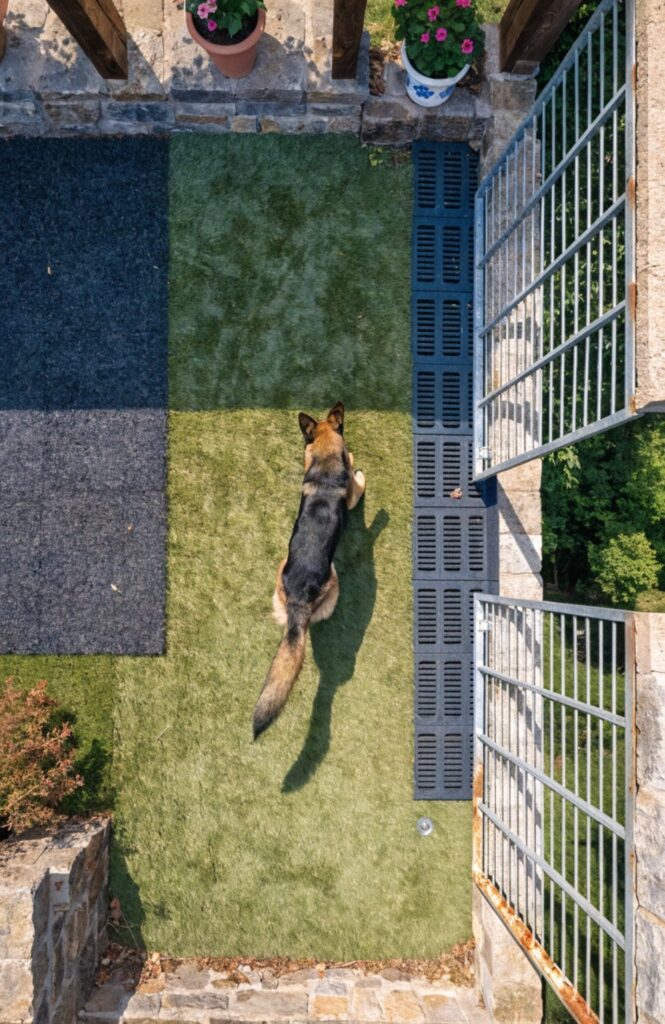
Here’s the dog kennel floor idea that almost no one talks about, even though it’s what most experienced dog owners actually end up doing: combining two materials to get the best of both worlds.
Some of the most effective hybrid setups include gravel as a drainage base with rubber mats placed on top in the sleeping or resting area; kennel deck tiles over a concrete slab with a rubber mat zone for lying down; and artificial turf laid over a perforated drainage tile base for both comfort and sanitation. Another great combo is sealed concrete with a rubber mat covering and a raised cot bed in one corner — the hard surface is easy to disinfect, the mat adds traction and warmth, and the cot keeps the dog off the cold floor entirely.
Thinking about your dog’s outdoor kennel as a combination of zones — an active area, a resting area, and a drainage zone — rather than one single material covering everything, gives you a much more practical and dog-friendly result.
Quick Comparison: Dog Kennel Flooring at a Glance
| Material | Best Use | Approx. Cost/sq ft | Comfort | Cleaning | Dog Type |
|---|---|---|---|---|---|
| Rubber Mats | Indoor & outdoor | $1.50–$4 | High | Easy | Most dogs |
| Epoxy Coating | Indoor/concrete base | $3–$7 installed | Medium | Very Easy | All dogs |
| Kennel Deck Tiles | Outdoor/wet climates | $2–$5 | Medium | Very Easy | All dogs |
| Gravel | Large outdoor runs | $0.50–$1.50 | Low-Medium | Moderate | Non-diggers |
| Artificial Turf | Outdoor/backyard | $2–$5 | High | Moderate | Calm/active |
| Vinyl Roll | Indoor/temporary | $1–$3 | Medium | Very Easy | Non-chewers |
| Concrete (improved) | Existing base | Low (add-ons only) | Low alone | Easy sealed | All dogs |
| Polyurea Coating | Commercial/heavy use | $6–$12 installed | Medium | Easiest | Multi-dog |
| Foam Tiles | Indoor/puppies/seniors | $0.50–$1.50 | Very High | Moderate | Calm dogs only |
| Hybrid/Combo | Any | Varies | Very High | Easy | All dogs |
3 Things That Make Any Dog Kennel Floor Work Better
No matter which material you choose, these three fundamentals apply to every dog kennel flooring setup — and skipping any one of them will undermine even the best surface.
Slope toward a drain. Any solid kennel floor should slope gently (about ¼ inch per foot) toward a corner or center dog kennel floor drain. Without drainage, water and urine pool on the surface, creating odor, bacteria, and slip hazards. If you’re laying a new concrete base or sealing an existing one, build in this slope from the start. Pairing this with a well-designed dog washing station nearby makes cleanup even faster.
Always prioritize a non-slip surface. Dogs, especially older or excited ones, can seriously injure themselves on smooth flooring. Textured rubber, anti-slip epoxy grit, perforated kennel decking, and brushed concrete all provide traction. If your chosen surface becomes slippery when wet — vinyl and smooth epoxy especially — add a textured mat in the main activity zone.
Match your cleaner to your floor. Not all disinfectants are compatible with all materials. Bleach solutions break down rubber over time and can damage certain coatings. Enzymatic cleaners work well for odor control on rubber and turf. Quaternary ammonia disinfectants are safe on epoxy and polyurea. Always check the manufacturer’s guidance and rinse the surface well after disinfecting, as residue can irritate paws.
When you think about your kennel holistically — floor material, drainage, traction, and sanitation together — you create a space that’s genuinely healthy and comfortable for your dog, and genuinely easy for you to maintain.
Conclusion
The right dog kennel flooring idea isn’t the same for every dog or every situation. A senior Labrador in a garage kennel has completely different needs than an energetic Husky in an outdoor run in a rainy climate. What this guide gives you is a real framework: start with indoor vs. outdoor, consider your dog’s size and behavior, factor in your budget and permanence, and then use the comparisons here to make a confident decision.
If you’re still unsure, rubber mats are the safest starting point for most home setups — they’re affordable, comfortable, and easy to try. From there, you can add epoxy coating to an underlying concrete floor, layer in kennel deck tiles for better drainage outdoors, or build a hybrid zone-based setup as you learn what works best for your specific dog.
For more inspiration on building out your dog’s space beyond just the floor, take a look at these outdoor kennel ideas, kennel furniture setups, or ideas for a full dog room in the garage. Your dog spends a significant amount of time in their kennel — it’s worth getting the foundation right.

Izzy is an experienced ranch worker who has a passion for exploring nature and getting up close to wildlife. With her connections to various animal organizations, Izzy is well-versed in animal care and rehabilitation.