How to Breed a Dog Safely and Responsibly: A Vet-Approved Beginner’s Breeding Guide
Breeding a dog is one of the most rewarding things a dog lover can do. But it is also one of the most serious responsibilities you can take on. If you are wondering how to breed a dog the right way, you are in the right place.
This guide walks you through every step — from deciding if breeding is right for you, all the way to finding loving homes for the puppies. Whether you are completely new to dog breeding or just want to make sure you are doing things correctly, this article has you covered.
Let us get started.
1. Should You Breed Your Dog? Ask These Questions First
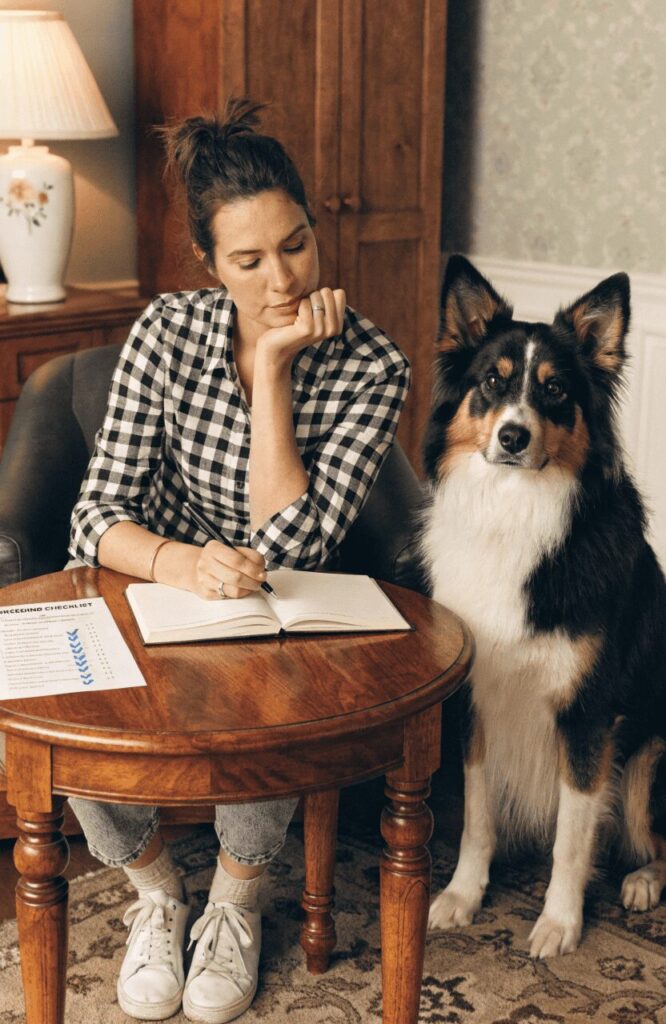
Before you do anything else, stop and ask yourself some honest questions. Many first-time breeders skip this step, and it leads to problems later.
Is your dog healthy and high quality? Not every dog should be bred. Your dog should be in excellent health, have a good temperament, and ideally meet the breed standard. A dog with serious health issues, genetic problems, or poor temperament can pass those traits on to puppies.
Do you have the time? Raising a litter of puppies is almost a full-time job for 8 weeks. You will need to check on newborns every few hours, handle emergencies at night, and socialize the puppies daily.
Do you have the money? This is where many people are surprised. Breeding dogs is not cheap. Here is a rough idea of what to expect:
- Health testing for the mother: $200–$500+
- Stud fee: $500–$2,000+
- Vet checkups during pregnancy: $200–$400
- Whelping supplies: $100–$300
- Emergency C-section (if needed): $1,500–$5,000
- Puppy vaccinations and microchipping: $50–$100 per puppy
If something goes wrong during whelping, costs can rise fast. Make sure you have savings set aside.
Are you ready for the emotional side? Sometimes puppies are stillborn. Sometimes the mother has complications. You need to be prepared for difficult moments, not just the cute ones.
2. Health Testing Before You Start Dog Breeding
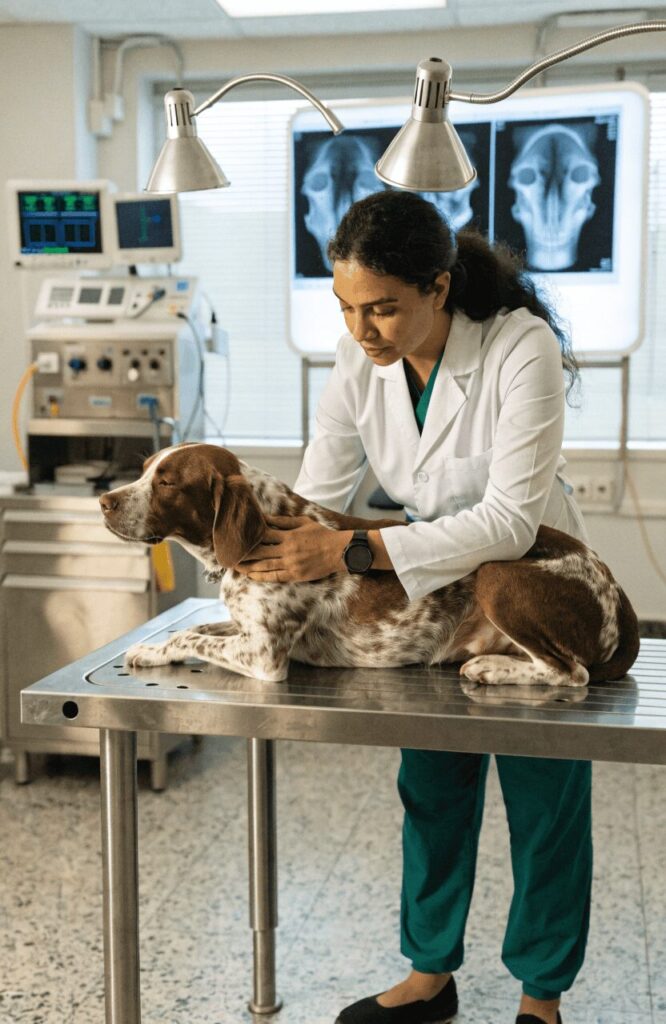
One of the most important parts of responsible dog breeding is health testing. This means getting your dog checked for genetic and hereditary conditions before breeding.
Different breeds are prone to different problems. For example:
- Labradors are prone to hip dysplasia and eye disease
- Bulldogs and French Bulldogs are prone to breathing problems (called brachycephalic issues)
- German Shepherds are prone to hip and elbow dysplasia
- Cavalier King Charles Spaniels are prone to heart disease
Common health tests include:
- Hip and elbow scoring — X-rays graded by a specialist
- Eye testing — Checks for inherited eye conditions
- DNA tests — Blood or swab tests for specific genetic diseases
- Heart testing — Especially important in certain breeds
You should also test your stud dog. Both parents need to be health-tested, not just the mother.
Talk to your vet before breeding. They can tell you exactly which tests are recommended for your dog’s breed. Getting this right protects your puppies and gives buyers confidence. You can also check out puppy veterinary needs to understand what health care puppies will need after birth.
3. How to Choose the Right Stud Dog
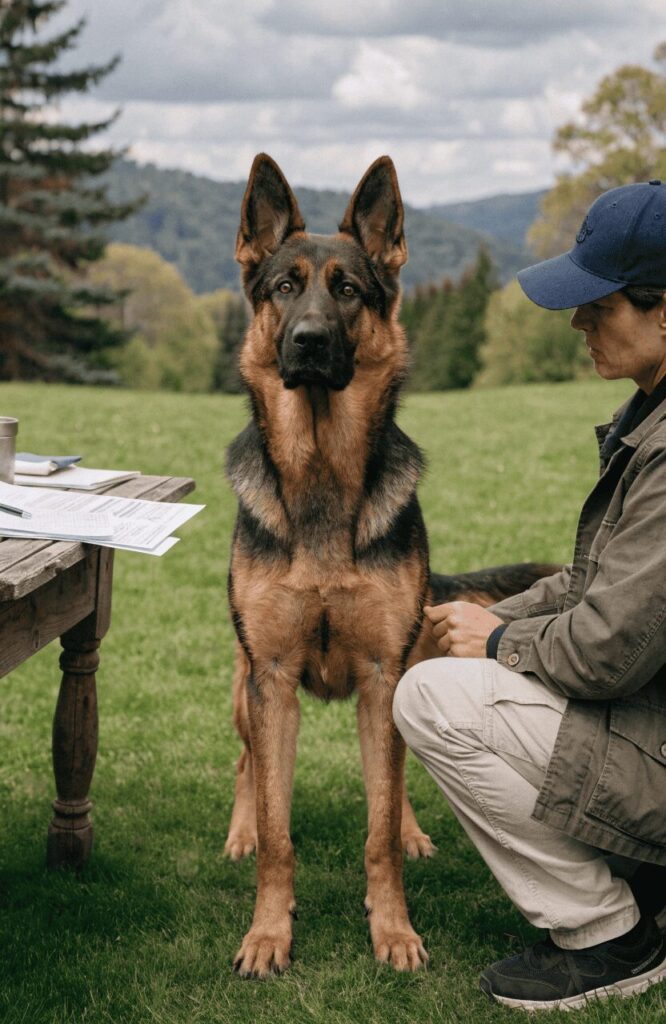
Finding the right male dog to breed with is one of the biggest decisions in how to breed dogs responsibly. Do not just pick the most convenient option or the cheapest stud fee.
Here is what to look for:
Health clearances The stud dog should have all the same health tests done as your female. Ask to see the results in writing. Do not take the owner’s word for it.
Complementary traits Think about what your female dog is lacking and what you want to improve. If your female is a little nervous around strangers, look for a male with a calm and confident temperament.
Pedigree and lineage Check the family tree of both dogs. Breeding closely related dogs (inbreeding) raises the risk of genetic diseases in puppies. Aim for low inbreeding coefficients where possible.
Stud fee and contract Most stud owners charge a fee — either a flat payment or “pick of the litter” (one puppy from the litter). Always have a written contract that covers what happens if the mating does not result in puppies.
If you are interested in how selective breeding shapes a breed over time, this piece on how responsible breeders shape quality Boxer puppies is a great read.
4. Understanding Your Female Dog’s Heat Cycle
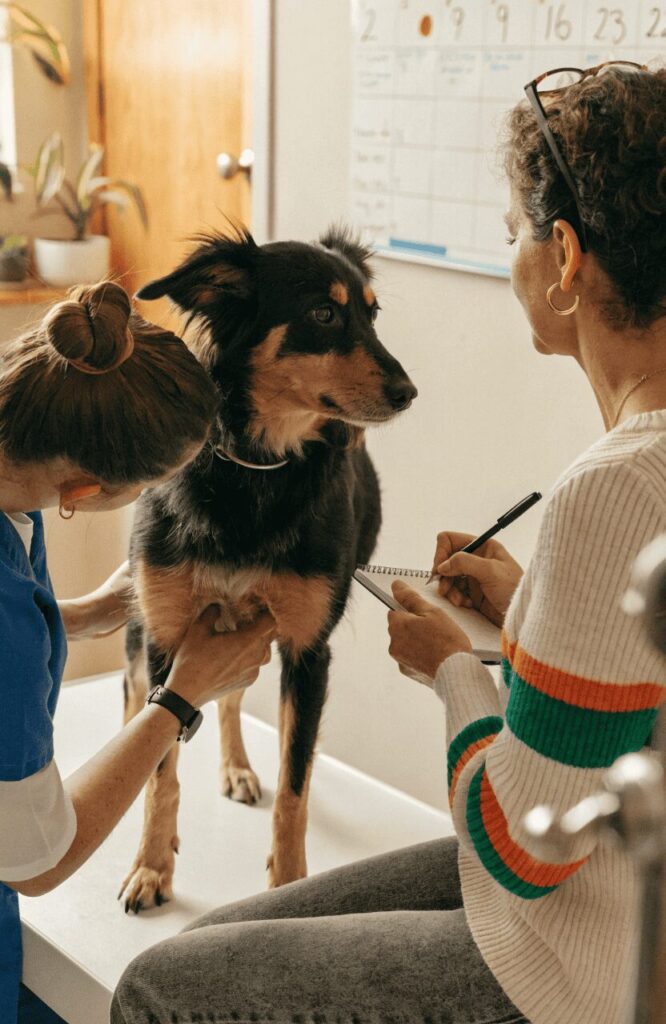
To successfully breed your dog, you need to understand her heat cycle. Missing the fertile window is one of the most common dog breeding mistakes.
4.1 Signs of Heat
Female dogs usually come into heat every 6 months, starting from around 6–12 months of age. Signs include:
- Swelling of the vulva
- Bloody discharge
- Increased urination
- Males showing strong interest in her
4.2 The Best Time to Mate
This is critical. Most people assume any day during heat is fine — it is not. The female is most fertile between days 10 and 14 of her heat cycle. However, this can vary. Some females are fertile as early as day 3 or as late as day 18.
Missing this window is the number one reason matings fail. Keep a diary and count from the first day you notice signs of heat.
4.3 Progesterone Testing for Accuracy
The most accurate way to find the fertile window is through a progesterone blood test. Your vet draws a small blood sample and measures hormone levels. As progesterone rises, ovulation is near.
This test removes the guesswork. It is especially useful for dogs with irregular cycles or if you are shipping chilled or frozen semen.
5. The Mating Process Explained

Once you have confirmed the right timing, it is time for mating. Here is what to expect.
Natural mating Bring the female to the male’s home — not the other way around. Males are more confident and perform better on their own territory. Keep things calm and supervised. Do not rush or stress the dogs.
The “tie” During mating, the male and female may become physically locked together for 10–30 minutes. This is completely normal and is called a “tie.” Do not try to separate them — it can cause injury to both dogs. Just stay calm and supervise.
Artificial insemination (AI) If natural mating is not possible (due to distance, size difference, or behaviour), artificial insemination is an option. Your vet collects semen from the male and inserts it into the female. This is more common than most people realise and can be very effective when timed correctly.
Did the mating work? You will not know immediately. Wait about 3–4 weeks, then visit your vet for a scan to confirm pregnancy.
6. Dog Pregnancy: What to Expect Week by Week
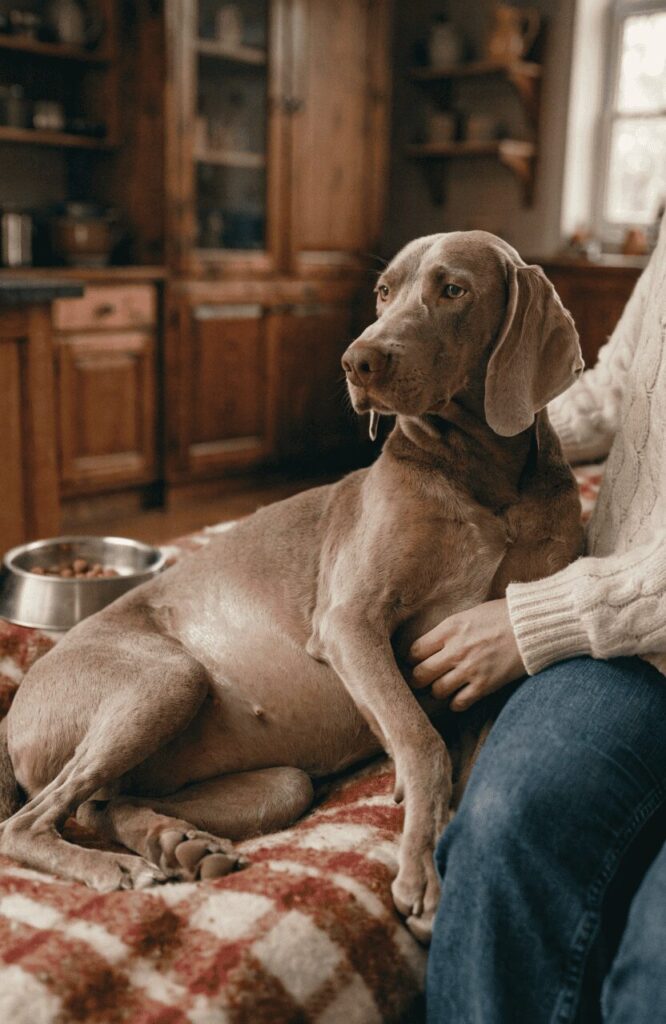
Dog pregnancy lasts approximately 63 days — just over 9 weeks. Here is what happens during that time.
6.1 Confirming Pregnancy
At around 3–4 weeks, your vet can detect puppies via ultrasound. At 6 weeks, an X-ray can give you a puppy count. Knowing how many puppies to expect helps you prepare and spot problems during whelping.
6.2 Feeding and Nutrition During Pregnancy
For the first 6 weeks, feed your dog her normal diet. After week 6, gradually increase her food intake. By the final 3 weeks, she may need up to 1.5 times her normal amount. During peak lactation (about 3 weeks after birth), she may need 2.5 to 3.5 times her normal intake.
Use a high-quality, high-energy food during the late stages. Avoid supplements unless your vet recommends them — too much calcium can actually cause problems.
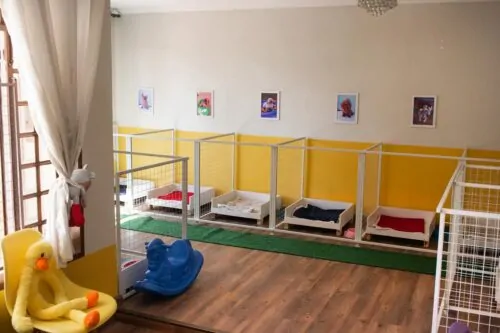
6.3 Preparing the Whelping Box
Start preparing the whelping box about 2 weeks before the due date. This gives your dog time to get used to it.
The box should be:
- Large enough for the mother to stretch out fully
- Warm and draught-free
- In a quiet, private area
- Lined with newspaper first, then soft bedding
Add “pig rails” around the inside edges — these prevent the mother from accidentally crushing puppies against the sides.
7. Whelping Day: Helping Your Dog Give Birth
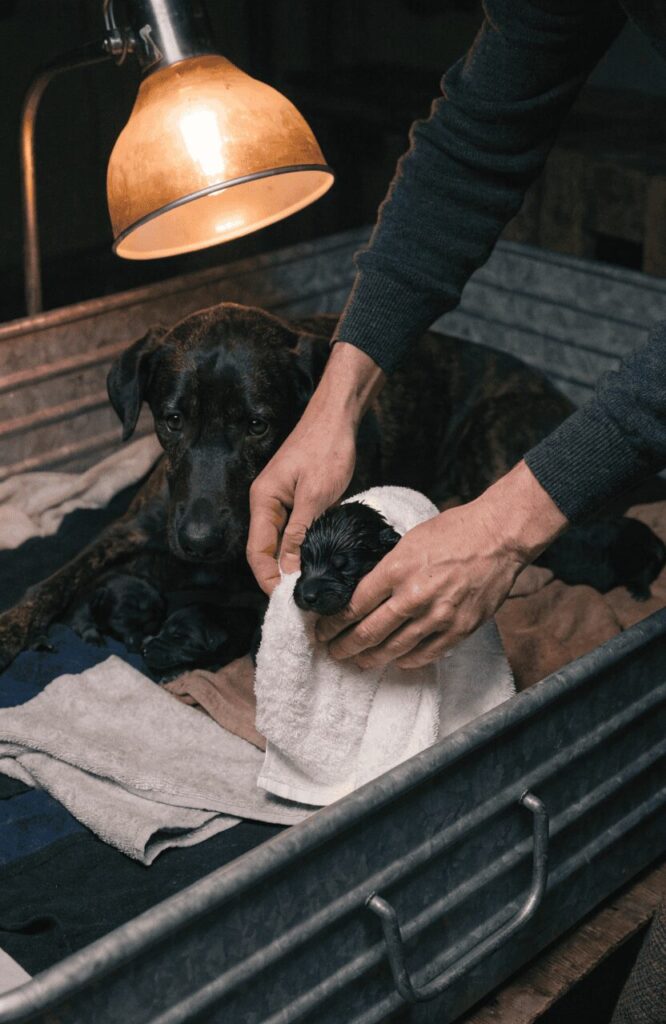
Whelping is the process of giving birth. Most dogs manage well on their own, but you need to be present and alert.
Signs that labour is starting:
- Restlessness and nesting behaviour
- Panting and shivering
- Refusing food
- A drop in rectal temperature below 37.8°C (99°F) — usually 12–24 hours before labour
During delivery: Puppies can be born head-first or tail-first (breech). Both are normal. Each puppy arrives in a sac with a placenta. The mother will usually break the sac and clean the puppy herself. If she does not do this within 60 seconds, you must step in — gently break the sac, clear the nose and mouth, and rub the puppy to stimulate breathing.
Count the placentas. You should have one per puppy. A retained placenta can cause serious infection.
Call your vet immediately if:
- More than 2 hours pass between puppies and she is actively straining
- A puppy is stuck halfway and not progressing
- There is fresh red blood for more than 10 minutes
- The mother suddenly becomes very weak or unresponsive
- Green discharge appears before any puppy has been born
Brachycephalic and small breeds — Bulldogs, French Bulldogs, Boston Terriers, and Chihuahuas are at much higher risk of needing a C-section. Speak to your vet in advance and have a plan ready.
8. Caring for Newborn Puppies Week by Week
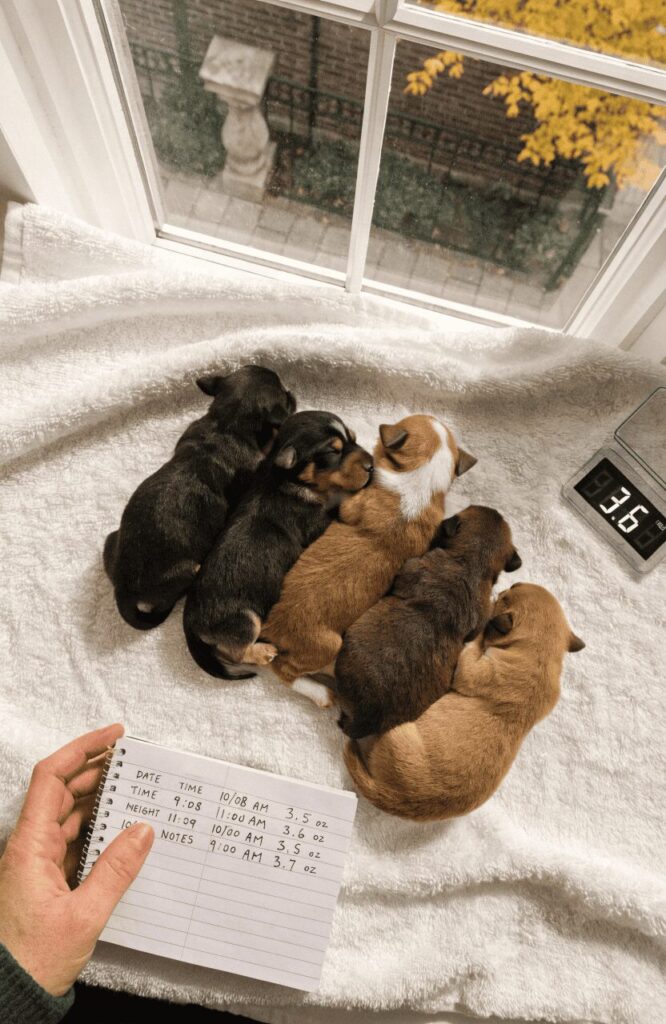
The first 8 weeks are where a breeder’s work really begins. Newborns are totally helpless.
8.1 The First 2 Weeks
Newborn puppies are blind and deaf. They can only smell and feel warmth. During this phase:
- Check on them every few hours, including overnight
- Make sure every puppy is feeding from the mother
- Noisy, crying puppies are usually cold or hungry — help them latch on
- Puppies should gain weight every single day — weigh them daily
- Eyes typically open between days 7 and 14
Keep the whelping area at around 29–32°C (85–90°F) for the first week, then gradually reduce it.
8.2 Weeks 3–4: Eyes Open, Movement Begins
By week 3, puppies will try to stand. By week 4, they are walking, playing, and climbing out of the box. Start introducing solid food at around 3.5 to 4 weeks — a soft, wet puppy food works best. This is called weaning.
Watch for milk fever in the mother during this period (usually weeks 3–5). Signs include muscle spasms, stiff walking, heavy panting, and seizures. This is caused by low calcium levels during heavy milk production. It is a medical emergency — call your vet immediately.
8.3 Weeks 5–8: Socialization Window and Weaning Completion
This window is one of the most important in a puppy’s life. What happens here shapes their personality for the rest of their life. More on this in the next section.
By week 7–8, puppies should be fully weaned and eating solid food independently.
9. Early Socialization — The Step Most Breeders Skip
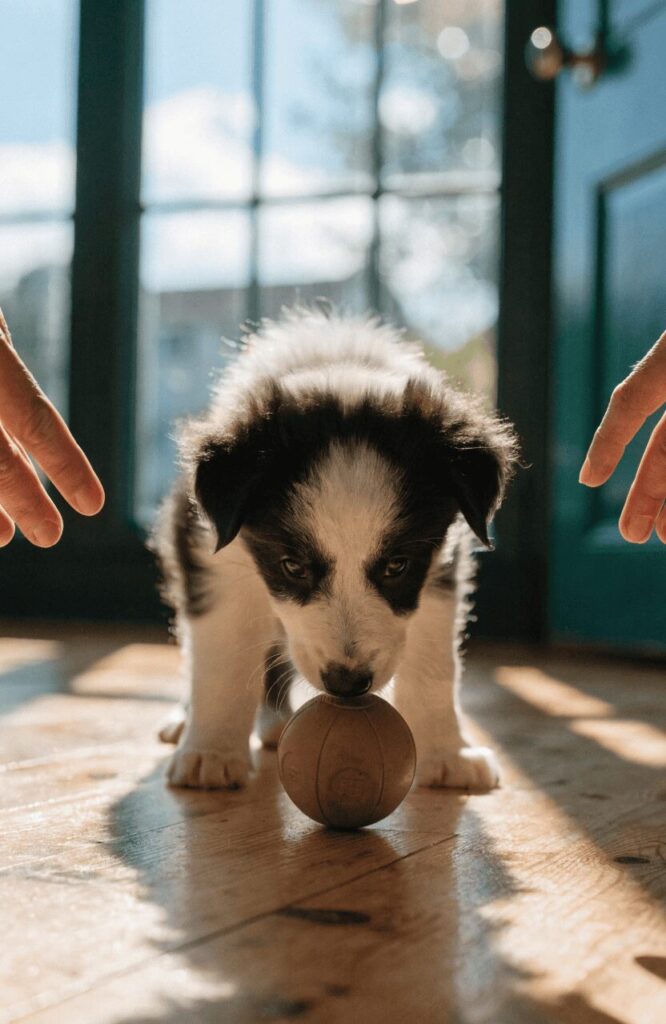
Here is the truth: most basic dog breeding tips online ignore this completely. It is one of the biggest differentiators between average breeders and great ones.
The socialization window runs from roughly 3 to 12 weeks. During this time, the puppy’s brain is wired to accept new experiences. What they encounter now becomes “normal” to them forever.
As a breeder, you are responsible for the first 8 weeks of that window.
Early Neurological Stimulation (ENS) From days 3 to 16, you can perform simple handling exercises that have been shown to improve stress tolerance, cardiovascular performance, and overall resilience. These take less than a minute per puppy per day.
Expose puppies to:
- Different surfaces (carpet, grass, tile, gravel)
- Everyday sounds (TV, vacuum cleaner, children playing)
- Gentle handling by different people
- New objects and mild challenges
Puppies raised in this way are calmer, more confident, and easier for their new owners to train. Check out these essential puppy training tips that new owners can start using from day one.
10. Finding Good Homes for Your Puppies
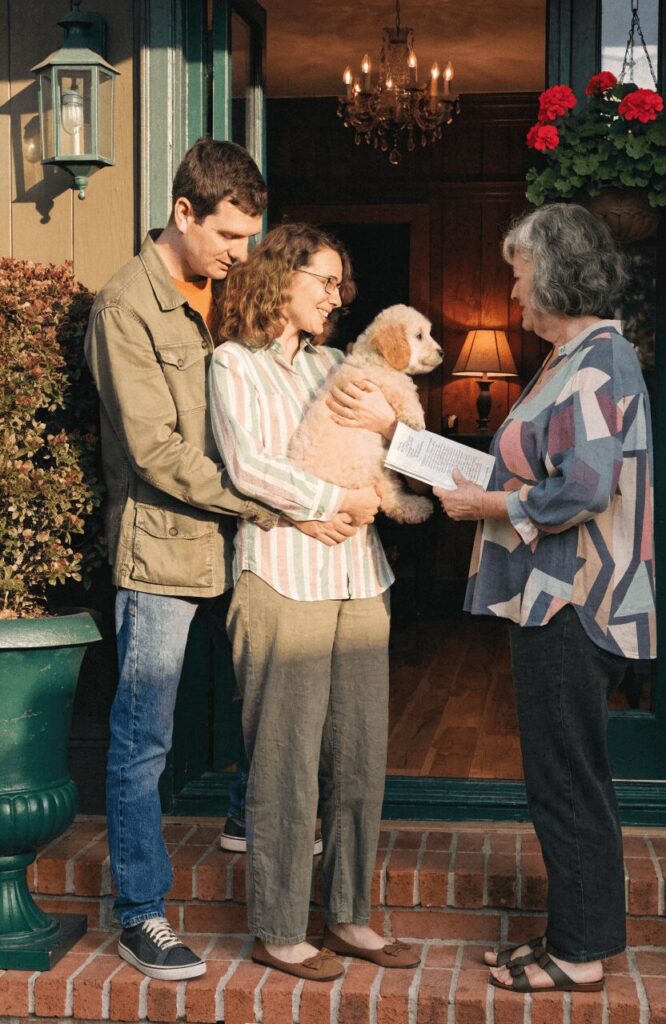
Bringing puppies into the world means being responsible for where they end up. A good breeder screens buyers — not the other way around.
Questions to ask potential buyers:
- Have you owned a dog before?
- Do you have a yard? Is it fenced?
- How many hours is the dog alone each day?
- Do you have young children or other pets?
- What will happen to the dog if your situation changes?
You are not being difficult by asking these questions. You are being responsible.
Puppy contracts Always use a written contract. It should cover health guarantee, return policy (if the buyer can no longer keep the dog), and any breeding restrictions you want to place on the puppy.
Puppy packs Send each puppy home with a pack that includes: feeding schedule, food sample, vaccination records, deworming history, microchip details, and care instructions. This gives new owners a strong start and reflects well on you as a breeder.
If you want ideas on matching the right breed to the right family, take a look at our guide to most loyal dog breeds — it can help you advise buyers on what to expect.
11. Common Dog Breeding Mistakes to Avoid

Even well-meaning breeders make these errors. Knowing them in advance saves a lot of heartache.
Mistake 1: Missing the fertility window Timing mating by calendar alone without progesterone testing often results in failed pregnancies. Use the test — it is worth every penny.
Mistake 2: Skipping health tests Breeding untested dogs is how genetic diseases spread through breeds. Always test both parents, no matter how healthy they look.
Mistake 3: Choosing a stud based on convenience The closest or cheapest stud is rarely the best match. Take your time. The stud dog is responsible for 50% of your puppies’ genetics.
Mistake 4: An unprepared whelping area Setting up the whelping box the night before is too late. Have it ready and introduce your dog to it two weeks early.
Mistake 5: Not watching for emergencies Whelping complications happen fast. Know the warning signs, have your vet’s emergency number saved, and do not leave your dog unattended during labour.
Mistake 6: Rehoming puppies too early Puppies should stay with their mother and littermates until at least 8 weeks old. Leaving earlier disrupts critical social development and can cause behavioural problems.
Mistake 7: Not screening buyers Giving a puppy to the first person who messages you is a mistake. Take time to speak with buyers, ask questions, and trust your instincts.
Conclusion
Learning how to breed a dog properly takes time, research, and real commitment. It is not something to rush into lightly — but when done right, it is incredibly fulfilling.
To recap the key steps in your dog breeding planning guide:
- Decide honestly if breeding is right for you and your dog
- Complete all relevant health tests before mating
- Choose a stud dog carefully based on health, temperament, and genetics
- Identify the exact fertile window using progesterone testing
- Prepare thoroughly for whelping and know the emergency signs
- Care for puppies week by week and prioritise socialisation
- Screen buyers and send puppies to homes you trust
If you are getting a puppy yourself rather than breeding, this guide on how to enjoy life with a new puppy is a great next read.
Good breeding is not about producing as many puppies as possible. It is about producing healthy, well-socialised dogs that improve the breed and bring joy to the families they go to. Start slowly, ask for help from experienced breeders and your vet, and enjoy every step of the journey.
Izzy is an experienced ranch worker who has a passion for exploring nature and getting up close to wildlife. With her connections to various animal organizations, Izzy is well-versed in animal care and rehabilitation.